












Binary Multiplication Examples
Binary multiplication is a basic arithmetic operation in the binary number system. It follows simple multiplication rules using only two digits, 0 and 1. Binary multiplication works similarly to decimal multiplication, but it uses base 2 instead of base 10.
In this article, we will explain binary multiplication examples, including multiplication of 1-bit, 2-bit, 3-bit, and larger binary numbers with step-by-step solutions and decimal verification.
Binary Multiplication Examples
Binary multiplication uses the following four basic rules
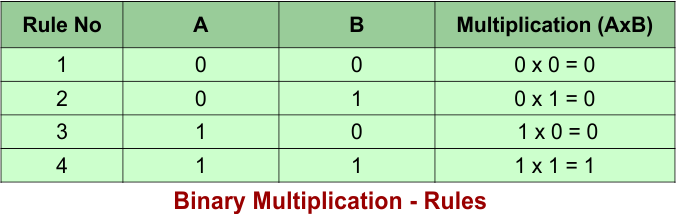
Let’s understand binary multiplication examples from very basic to advanced
Binary Multiplication Example 1
The following example shows the multiplication of 10 × 10
The above diagram shows that
- Binary Value: 10 × 10 = 100
- Decimal Value: 2 × 2 = 4
Both results are equal, so the answer is correct.
Binary Multiplication Example 2
The following example shows the multiplication of 101 × 10.
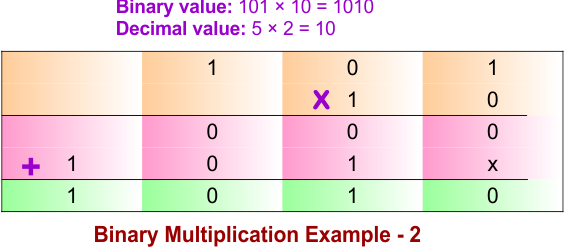
- Binary value: 101 × 10 = 1010
- Decimal value: 5 × 2 = 10
Both results are equal, so the answer is correct.
Binary Multiplication Example 3
The following example shows the multiplication of 110 × 110.
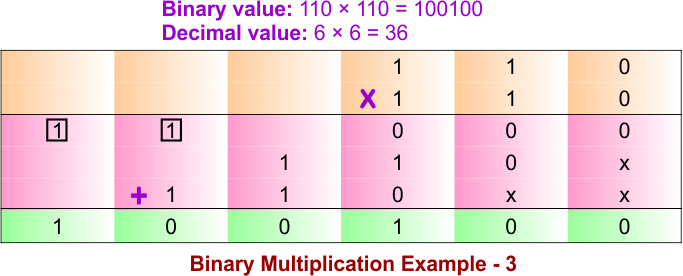
Binary Multiplication Example 4
The following example shows the multiplication of 101101 × 1111.
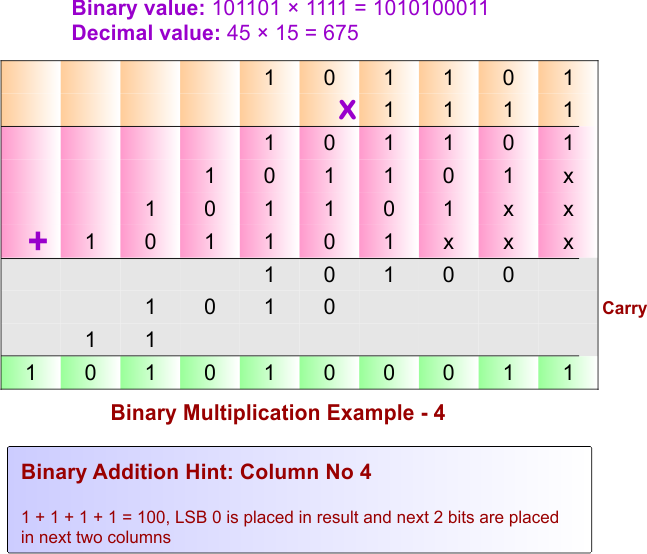
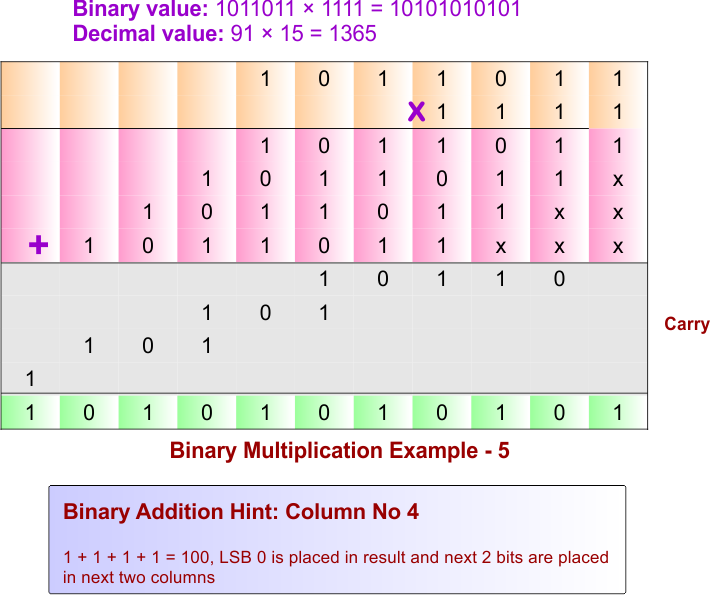
Binary Multiplication Example 5
The following example shows the multiplication of 1011011× 1111
Conclusion
Binary multiplication uses simple rules based on 0 and 1. It follows the same general process as decimal multiplication, but partial products are shifted according to powers of 2. Practicing different binary multiplication examples helps students understand the process and solve larger binary numbers easily.