












Binary Multiplication
Binary multiplication is a mathematical operation used to multiply two binary numbers. It uses only two digits, 0 and 1, and follows simple multiplication rules. Binary multiplication works like decimal multiplication, but it uses the base-2 number system.
The main parts of the binary multiplication process are:
- Multiplicand: The binary number being multiplied.
- Multiplier: The binary number used to multiply the multiplicand.
- Partial Products: The intermediate results obtained by multiplying the multiplicand by each bit of the multiplier.
- Product: The final result obtained by adding all the partial products.
Binary Multiplication Rules
Binary multiplication follows four basic rules:
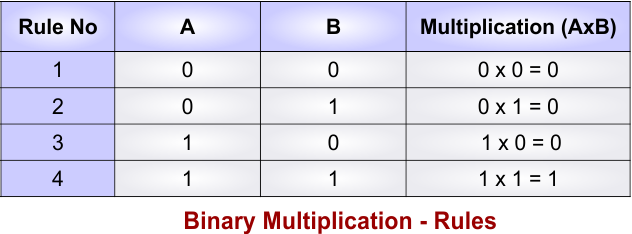
In the above diagram
- 0 × 0 = 0: Multiplying 0 by 0 gives 0.
- 0 × 1 = 0: Multiplying 0 by 1 gives 0.
- 1 × 0 = 0: Multiplying 1 by 0 gives 0.
- 1 × 1 = 1: Multiplying 1 by 1 gives 1.
Binary Multiplication Examples
Binary multiplication examples help explain how to multiply binary numbers using the basic rules.
Binary Multiplication Example – 1
The following diagram shows the multiplication of binary numbers (10 × 11)
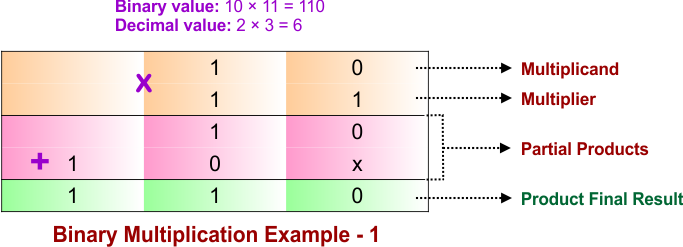
The above diagram shows the results of binary numbers (10 × 11) in both binary and decimal for verification
- Binary value: 10 × 11 = 0110
- Decimal value: 2 × 3 = 6
Binary Multiplication Example – 2
The following diagram shows the multiplication of binary numbers (101 × 11).
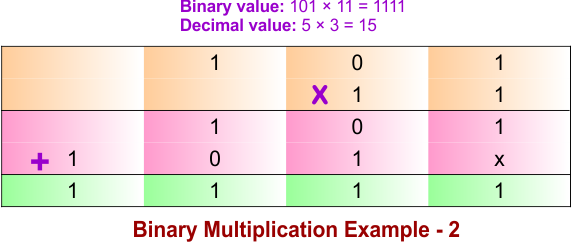
The above diagram shows the result of multiplying binary numbers (101 × 11) in both binary and decimal for verification.
- Binary value: 101 × 11 = 1111
- Decimal value: 5 × 3 = 15
Binary Multiplication Example – 3
The following diagram shows the multiplication of binary numbers (110 × 101).
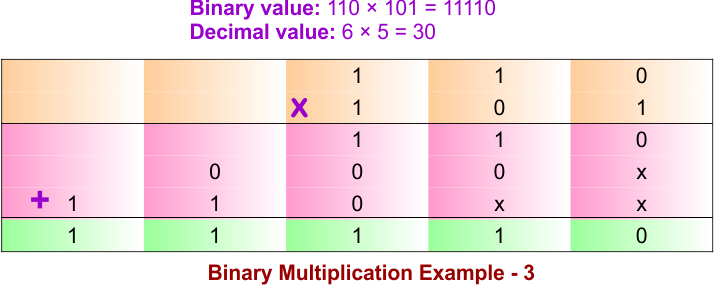
The above diagram shows the result of multiplying binary numbers (110 × 101) in both binary and decimal for verification.
- Binary value: 110 × 101 = 11110
- Decimal value: 6 × 5 = 30
Binary Multiplication Example – 4
The following diagram shows the multiplication of binary numbers (1011 × 110).
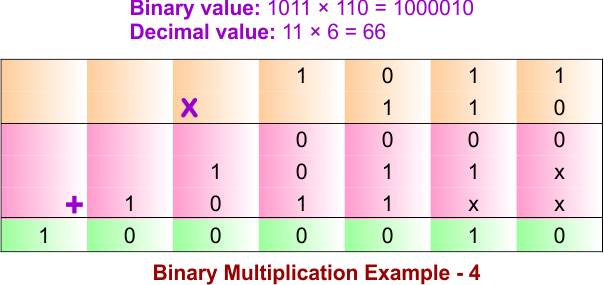
The above diagram shows the result of multiplying binary numbers (1011 × 110) in both binary and decimal for verification.
-
Binary value: 1011 × 110 = 1000010
-
Decimal value: 11 × 6 = 66
Binary Multiplication Example – 5
The following diagram shows the multiplication of binary numbers (11001 × 1011).
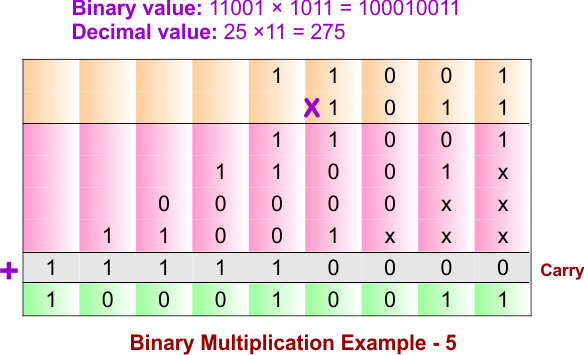
The above diagram shows the result of multiplying binary numbers (11001 × 1011) in both binary and decimal for verification.
- Binary value: 11001 × 1011 = 100010011
- Decimal value: 25 × 11 = 275
Binary Multiplication Example – 6
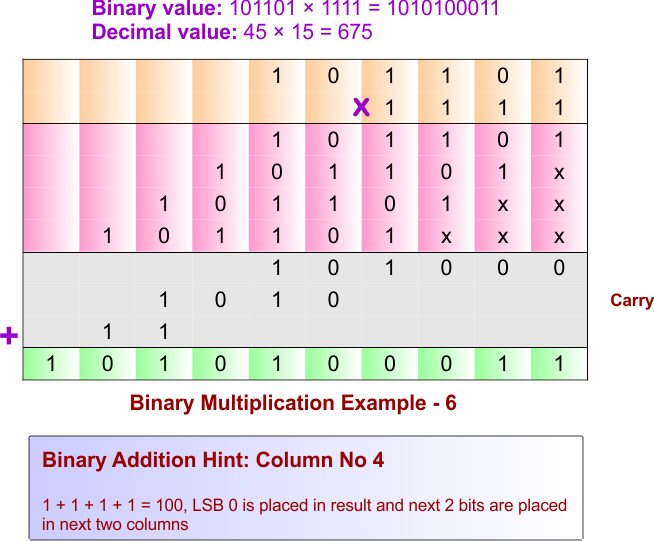
The following diagram shows the multiplication of binary numbers (101101 × 1111).
| Important: If you don’t understand how binary addition works, then go to the binary addition page to learn it first |
The above diagram shows the result of multiplying binary numbers (101101 × 1111) in both binary and decimal for verification.
-
Binary value: 101101 × 1111 = 1010100011
-
Decimal value: 45 × 15 = 675
Binary Multiplication Example – 7
The following diagram shows the multiplication of binary numbers (1011011 × 1111).
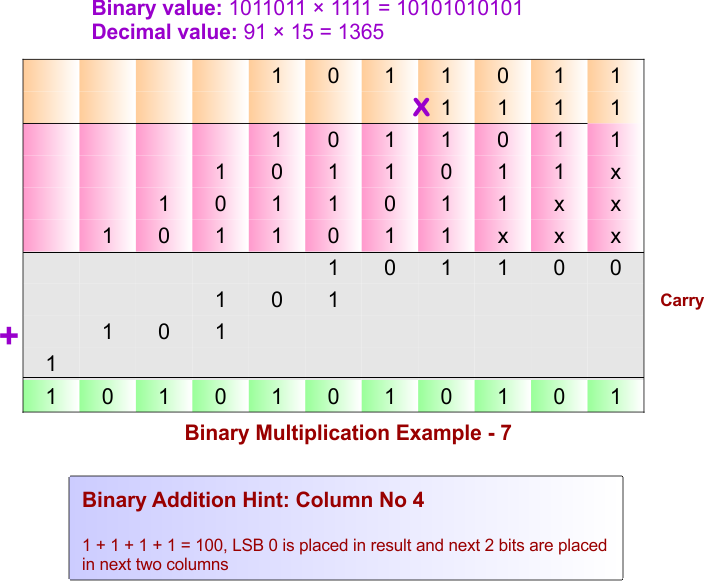
The above diagram shows the result of multiplying binary numbers (1011011 × 1111) in both binary and decimal for verification.
- Binary value: 1011011 × 1111 = 010101010101
- Decimal value: 91 × 15 = 1365
Binary Multiplication Example – 8
The following diagram shows the multiplication of binary numbers (11010101 × 1011).
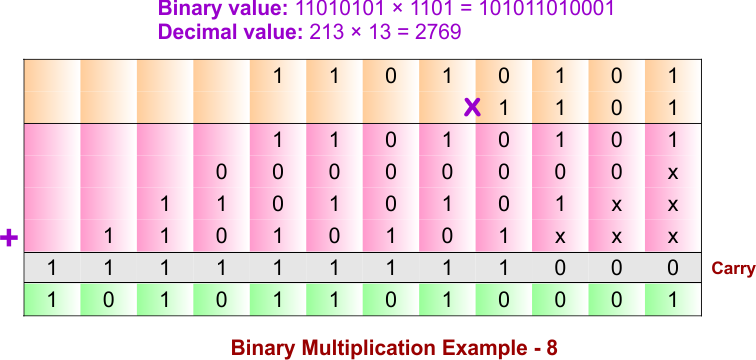
The above diagram shows the result of multiplying binary numbers (11010101 × 1011) in both binary and decimal for verification.
- Binary value: 11010101 × 1101 = 101011010001
- Decimal value: 213 × 13 = 2769
Binary Multiplication Example – 9
The following diagram shows the multiplication of binary numbers (101101101 × 1111).
The above diagram shows the result of multiplying binary numbers (101101101 × 1111) in both binary and decimal for verification.
-
Binary value: 101101101 × 1111 = 01010101100011
-
Decimal value: 365 × 15 = 5475
Binary Multiplication Example – 10
The following diagram shows the multiplication of binary numbers (1101011011 × 10111).
The above diagram shows the result of multiplying binary numbers (1101011011 × 10111) in both binary and decimal for verification.
-
Binary value: 1101011011 × 10111 = 0100110100101101
-
Decimal value: 859 × 23 = 19757
Binary Multiplication Example – 11
The following diagram shows the multiplication of binary numbers (10110101101 × 11111).
The above diagram shows the result of multiplying binary numbers (10110101101 × 11111) in both binary and decimal for verification.
-
Binary value:
10110101101 × 11111
= 01010111111110011Decimal value:
1453 × 31
= 45043
Binary Multiplication Example – 12
The following diagram shows the multiplication of binary numbers (110101101011 × 111111).
The above diagram shows the result of multiplying binary numbers (110101101011 × 111111) in both binary and decimal for verification.
-
Binary value: 110101101011 × 111111 = 0110100110101010101
-
Decimal value: 3435 × 63 = 216405
Steps for Binary Multiplication
Follow these steps to multiply binary numbers:
- Write the binary numbers vertically, placing the multiplier below the multiplicand.
- Start multiplying from the rightmost bit of the multiplier.
- Multiply each bit using the binary multiplication rules.
- Shift each partial product one position to the left when moving to the next bit.
- Add the partial products using binary addition rules.
Binary Multiplication vs. Decimal Multiplication
Binary multiplication uses base 2 and only the digits 0 and 1, while decimal multiplication uses base 10 and the digits 0 through 9. Both methods use partial products and addition to calculate the final result.
Conclusion
Binary multiplication is an important operation in the binary number system and digital logic design. By learning the basic binary multiplication rules and practicing examples, you can multiply binary numbers accurately and efficiently.