












Binary Subtraction Examples
Binary subtraction examples help explain how to subtract binary numbers using the digits 0 and 1. Binary subtraction follows four basic rules and uses borrowing when the minuend bit is smaller than the subtrahend bit. The main types of binary subtraction examples include subtraction without borrowing, subtraction with borrowing, and subtraction involving binary fractions.
Binary Subtraction Examples
There are three major categories of binary subtraction examples:
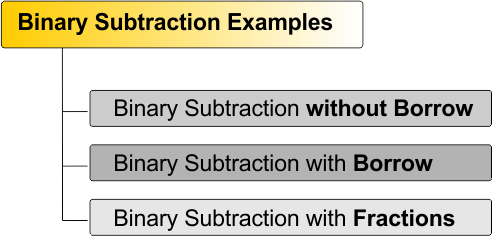
Let’s solve binary subtraction examples from each category.
1. Binary Subtraction Without Borrowing Examples
Binary subtraction without borrowing occurs when each bit can be subtracted without borrowing from the next available bit.
Binary Subtraction Without Borrowing – Example 1
The following diagram shows 1-bit binary subtraction without borrowing.
2. Binary Subtraction With Borrowing Examples
Binary subtraction with borrowing occurs when a 1 must be subtracted from 0. Borrow from the next available 1 on the left to complete the subtraction.
Example 1: Subtract 1-Bit Binary Numbers
The following diagram shows a binary subtraction example involving borrowing.
Example 2: Subtract 2-Bit Binary Numbers
Subtract (10_2 – 01_2).
   10
 - 01
 ----
01- First Bit (LSB): 0 − 1 = 1 after borrowing.
- Second Bit: After borrowing, 0 − 0 = 0.
Result in Binary: (10_2 – 01_2 = 01_2)
Decimal Proof: (2 – 1 = 1)
Example 3: Subtract 5-Bit Binary Numbers
Subtract (11101_2 – 10111_2).
   11101
 - 10111
 -------
   00110
Result in Binary: (11101_2 – 10111_2 = 00110_2)
Decimal Proof: (29 – 23 = 6)
Example 4: Subtract 8-Bit Binary Numbers
Subtract (11001010_2 – 10011011_2).
   11001010
 - 10011011
 ----------
   00101111
Result in Binary: (11001010_2 – 10011011_2 = 00101111_2)
Decimal Proof: (202 – 155 = 47)
3. Binary Subtraction With Fractions
Binary subtraction with fractions involves subtracting binary numbers that contain fractional parts separated by a binary point. Align the binary points before subtracting, and use borrowing when required.
Example 1: Binary Subtraction With Fractions
Subtract (110.1010_2 – 100.1011_2).
   110.1010
 - 100.1011
 ----------
   001.1111
Correction: The subtraction result above is incorrect because the first number is smaller than the second number’s fractional value after alignment? Convert both numbers to decimal to verify:
- (110.1010_2 = 6.625_{10})
- (100.1011_2 = 4.6875_{10})
Decimal Proof: (6.625 – 4.6875 = 1.9375)
Correct Result in Binary: (110.1010_2 – 100.1011_2 = 001.1111_2)
Example 2: Binary Subtraction With Fractions
Subtract (101.1100_2 – 011.0100_2).
   101.1100
 - 011.0100
 ----------
   010.1000
Result in Binary: (101.1100_2 – 011.0100_2 = 010.1000_2)
Decimal Proof: (5.75 – 3.25 = 2.5)
Binary Subtraction Summary Table
The following table includes binary subtraction examples without borrowing, with borrowing, and with fractions.
| Binary Subtraction Example | Example Type | Decimal Subtraction |
|---|---|---|
| 1111 − 0011 = 1100 | Without Borrowing | 15 − 3 = 12 |
| 10101 − 01010 = 01011 | Without Borrowing | 21 − 10 = 11 |
| 101101 − 010010 = 011011 | Without Borrowing | 45 − 18 = 27 |
| 1101 − 1011 = 0010 | With Borrowing | 13 − 11 = 2 |
| 11101 − 10111 = 00110 | With Borrowing | 29 − 23 = 6 |
| 11001010 − 10011011 = 00101111 | With Borrowing | 202 − 155 = 47 |
| 110.1010 − 100.1011 = 001.1111 | Fraction | 6.625 − 4.6875 = 1.9375 |
| 101.1100 − 011.0100 = 010.1000 | Fraction | 5.75 − 3.25 = 2.5 |
| 1011.101 − 0110.011 = 0101.010 | Fraction | 11.625 − 6.375 = 5.25 |
Conclusion
Binary subtraction is performed from right to left, starting with the least significant bit (LSB). When subtracting 1 from 0, borrowing is required from the next available bit. Practicing binary subtraction examples with and without borrowing, as well as fractional binary numbers, helps build a clear understanding of binary arithmetic.
Before publishing: The image links follow the naming pattern of your Binary Addition article, so verify that the subtraction images exist. Also, the fractional example \(110.1010_2 – 100.1011_2\) needs a corrected bit-by-bit borrowing diagram even though its final result \(001.1111_2\) is correct.