












Challenges in Hybrid Cloud Deployment
Hybrid cloud deployment combines public and private cloud environments to deliver flexibility and scalability. However, managing multiple environments together introduces several challenges. Understanding these challenges helps organizations plan and implement hybrid cloud effectively.
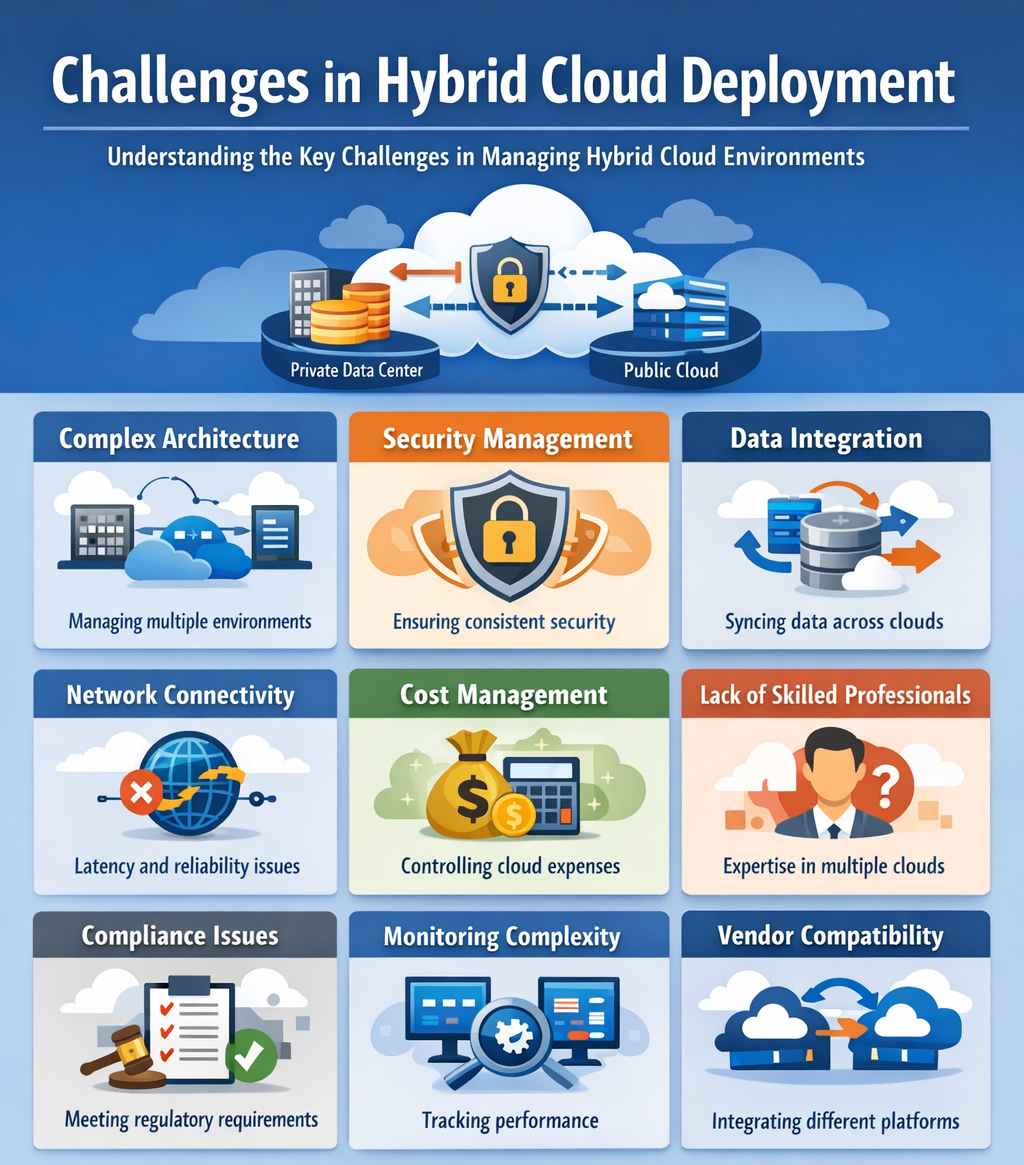
Let us explain the key challenges in hybrid cloud deployment in detail.
1. Complex Architecture
Hybrid cloud involves integrating multiple environments (public and private clouds), which increases overall system complexity.
Challenges
These challenges arise due to managing different cloud environments together.
- Multiple Environments: Managing both public and private cloud systems can be complicated.
- Integration Issues: Connecting different platforms requires careful planning and compatibility checks.
- Design Complexity: Requires well-structured architecture for smooth and efficient operation.
Example
A company struggles to integrate its private data center with a public cloud platform, causing operational inefficiencies.
2. Security Management
Maintaining consistent security across hybrid environments is challenging due to different systems and policies.
Challenges
These challenges highlight security risks in hybrid cloud setups.
- Multiple Security Layers: Different environments may have different security mechanisms.
- Data Transfer Risks: Data moving between clouds can be vulnerable if not properly secured.
- Policy Management: Maintaining consistent security policies across platforms is difficult.
Example
Sensitive data may be exposed if secure connections between clouds are not properly configured.
3. Data Integration and Management
Managing data across multiple environments requires proper synchronization and control mechanisms.
Challenges
These challenges affect data consistency and performance.
- Data Consistency: Keeping data updated across different platforms is difficult.
- Data Transfer Delays: Moving large datasets between clouds can take time.
- Storage Management: Handling data across multiple storage systems adds complexity.
Example
A business experiences delays while syncing customer data between private and public cloud systems.
4. Network Connectivity Issues
Hybrid cloud depends heavily on reliable and high-speed network connectivity.
Challenges
These challenges impact system performance and communication.
- Latency Issues: Slow connections can reduce application performance.
- Network Reliability: Downtime can disrupt communication between environments.
- Bandwidth Limitations: Large data transfers require high bandwidth.
Example
An application slows down due to poor connectivity between private and public cloud environments.
5. Cost Management
Managing costs in hybrid cloud environments can be complex and unpredictable.
Challenges
These challenges affect budgeting and resource optimization.
- Hidden Costs: Data transfer and additional usage can increase expenses.
- Complex Billing: Managing costs across multiple platforms is difficult.
- Resource Wastage: Poor planning may lead to unused or over-provisioned resources.
Example
A company overspends due to unexpected charges from public cloud usage.
6. Lack of Skilled Professionals
Hybrid cloud requires expertise in multiple cloud environments.
Challenges
- Skill gap: Requires knowledge of both public and private cloud systems.
- Training needs: Employees may need additional training.
- Management complexity: Skilled staff are required to manage operations.
Example
An organization struggles to manage hybrid cloud due to lack of trained professionals.
7. Compliance and Regulatory Issues
Meeting compliance requirements across multiple environments is challenging.
Challenges
- Data location concerns: Data may be stored in different regions.
- Regulatory differences: Different clouds may follow different rules.
- Audit complexity: Monitoring compliance becomes difficult.
Example
A company must ensure its data meets legal requirements across regions.
8. Monitoring and Management Complexity
Managing and monitoring hybrid cloud systems can be difficult.
Challenges
- Multiple dashboards: Different tools for different environments.
- Performance tracking: Difficult to monitor all systems together.
- Centralized control issues: Lack of unified management tools.
Example
IT teams struggle to monitor performance across both cloud environments.
9. Vendor Compatibility Issues
Using multiple cloud providers can create compatibility problems.
Challenges
- Different platforms: Providers use different technologies and standards.
- Integration difficulties: Connecting services from different vendors is complex.
- Migration challenges: Moving workloads between providers can be difficult.
Example
An application may not work properly when moved from one cloud provider to another.
10. Data Security During Migration
Moving data between clouds introduces security risks.
Challenges
- Data exposure risk: Data can be vulnerable during transfer.
- Encryption requirements: Secure transfer requires proper encryption.
- Migration complexity: Requires careful planning and execution.
Example
Sensitive data may be at risk if not encrypted during migration.
Top 5 FAQs (Interview & Exam Focused)
1. What is the main challenge of hybrid cloud?
The main challenge is managing the complexity of multiple cloud environments. Integration, security, and monitoring make it more difficult than single-cloud systems.
2. Why is hybrid cloud difficult to manage?
Because it involves managing both public and private cloud systems together. Each environment has different tools, policies, and configurations.
3. How does hybrid cloud affect security?
Security becomes complex due to multiple environments and data transfers. Proper policies and secure connections are required to protect data.
4. What are cost challenges in hybrid cloud?
Costs can increase due to data transfer, scaling, and multiple services. Managing and optimizing expenses across platforms is difficult.
5. Why are skills important in hybrid cloud?
Hybrid cloud requires expertise in multiple technologies and environments. Skilled professionals are needed to manage and maintain the system effectively.
Conclusion
Hybrid cloud deployment provides a flexible and powerful solution by combining public and private cloud environments. However, it also introduces challenges such as complex architecture, security management, and cost control. Organizations must carefully plan integration, enforce consistent security policies, and monitor usage to avoid unnecessary expenses. By understanding and addressing these challenges, businesses can effectively leverage hybrid cloud to achieve a balanced approach between scalability, security, and performance.