











Resource Pooling in Cloud Computing Explained
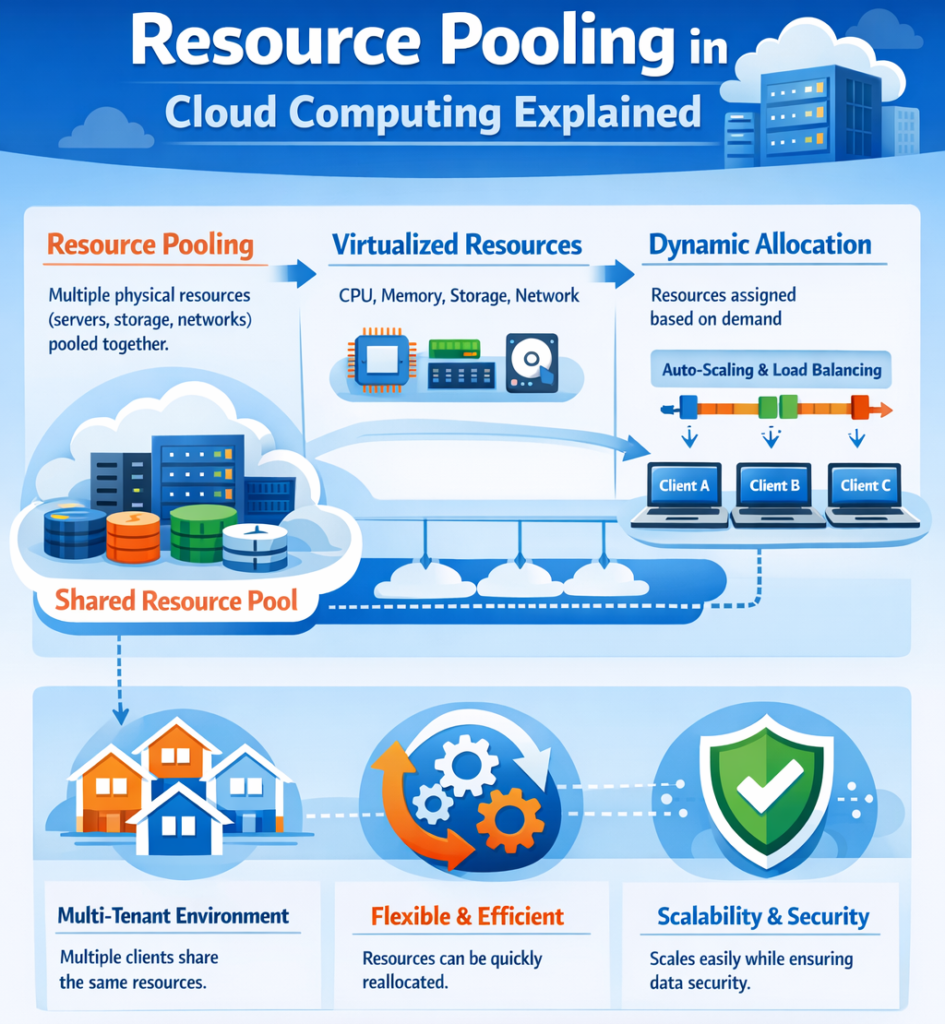
Resource pooling is a core concept in cloud computing where multiple users share a common pool of computing resources such as servers, storage, and networking. These resources are dynamically allocated based on demand.
In simple terms, cloud providers combine all available resources into a shared system and distribute them to users whenever needed. This approach ensures efficient usage, reduces costs, and improves performance.
What is Resource Pooling?
Resource pooling means combining physical and virtual resources into a shared pool that can serve multiple users efficiently. Cloud providers manage these resources centrally and distribute them based on demand.
Key Points of Resource Pooling
- Shared Resources: Multiple users use the same infrastructure
- Dynamic Allocation: Resources are assigned based on user needs
- Efficient Usage: Maximizes utilization of hardware and reduces waste
- Multi-Tenant Model: Many users share one system while remaining isolated
- Location Independence: Users do not know the exact location of resources
- Scalability Support: Resources can be increased or decreased easily
- Cost Efficiency: Sharing reduces overall infrastructure cost
- Automatic Management: The system manages allocation without manual effort
- Optimized Performance: Resources are balanced to maintain efficiency
How Resource Pooling Works
Resource pooling works by combining cloud resources such as servers, storage, and networks into a shared pool. Cloud providers dynamically allocate these resources to multiple users based on demand, ensuring efficient usage and cost optimization. Let exmplain Step-by-Step Process
1. Resource Pool Creation
Cloud providers group physical and virtual resources like servers, storage, and networking into a centralized pool. These resources are managed using virtualization technologies.
2. Multi-User Requests
Multiple users (tenants) request cloud services at the same time. Each user may need different types and amounts of resources.
3. Dynamic Resource Allocation
The system automatically assigns resources from the pool based on user demand. Allocation happens in real time without manual intervention.
4. Isolation Between Users
Even though resources are shared, each user operates in a separate environment. Security and isolation ensure that users cannot access each other’s data.
5. Load Balancing and Optimization
Workloads are distributed across multiple resources to maintain performance. This prevents overloading and ensures efficient utilization.
6. Resource Monitoring
Cloud systems continuously monitor usage and performance. This helps in optimizing resource allocation and avoiding wastage.
7. Resource Release and Reuse
When users no longer need resources, they are released back into the pool. These resources are then reassigned to other users as needed.
Simple Flow (Quick View)
Resource Pool → User Request → Dynamic Allocation → Usage → Release → Reuse
Key Features of Resource Pooling
The following features make resource pooling an essential part of cloud computing by improving efficiency, flexibility, and cost optimization.
- Multi-Tenancy: Multiple users share the same resources securely
- Location Independence: Users do not know the exact location of resources
- Scalability: Resources can be increased or decreased easily
- Efficiency: Reduces waste of unused resources
- Dynamic Allocation: Resources are assigned and re-assigned based on demand
- Resource Abstraction: Physical resources are hidden and presented as virtual resources
- Load Balancing: Workloads are distributed to maintain performance
- Cost Optimization: Shared resources reduce infrastructure costs
- Elastic Resource Usage: Resources expand or shrink automatically
- Centralized Management: All resources are controlled from a single system
- High Utilization: Maximizes usage of available hardware
- Automated Provisioning: Resources are allocated without manual intervention
Deep Concepts in Resource Pooling
Understanding these concepts helps clarify how resource pooling works and how cloud systems efficiently manage shared resources.
1. Multi-Tenancy
Multiple users (tenants) share the same infrastructure while maintaining isolation.
Each user’s data and operations remain secure and separate from others.
- Shared Infrastructure: Many users use the same servers and storage
- Data Isolation: Each user’s data is kept secure and separate
- Cost Efficiency: Sharing reduces overall infrastructure cost
- Secure Access: Access controls prevent unauthorized data access
2. Dynamic Resource Allocation
Resources are assigned based on demand and usage patterns.
This ensures efficient utilization and optimal performance.
- On-Demand Allocation: Resources are provided when needed
- Auto Scaling: Resources increase or decrease automatically
- Efficient Utilization: Prevents overuse and underuse of resources
- Real-Time Adjustment: System adapts instantly to workload changes
3. Resource Abstraction
Physical hardware is hidden from users and presented as virtual resources.
Users interact with simple interfaces instead of complex infrastructure.
- Virtual Resources: Users work with virtual machines and storage
- Simplified Access: No need to manage physical hardware
- Flexibility: Resources can be configured easily
- Hardware Independence: Users are not tied to specific devices
4. Load Distribution
Workloads are distributed across multiple resources to maintain performance.
This prevents system overload and ensures smooth operation.
- Balanced Workload: Tasks are evenly distributed across servers
- Improved Performance: Reduces delays and response time
- High Availability: Prevents system failure due to overload
- Efficient Resource Use: Ensures all resources are utilized properly
Benefits of Resource Pooling
Resource pooling provides several advantages by efficiently sharing and managing cloud resources among multiple users.
Key Benefits of Resource Pooling
- Cost Efficiency: Reduces the need for dedicated hardware
- Better Utilization: Maximizes the use of available resources
- Scalability: Easily handles increasing demand
- Flexibility: Allocates resources based on user needs
- Reduced Infrastructure Cost: Sharing lowers overall setup and maintenance expenses
- On-Demand Availability: Resources are available whenever required
- Efficient Resource Distribution: Ensures balanced usage across systems
- Improved Performance: Optimized allocation enhances system speed
- Energy Efficiency: Reduces power consumption by avoiding idle resources
- Simplified Management: Centralized control makes management easier
- Faster Deployment: Resources can be assigned quickly without delay
- Support for Multiple Users: Enables many users to use the system simultaneously
Challenges of Resource Pooling
Some challenges need to be managed properly when using resource pooling in cloud computing.
Key Challenges
- Security Risks: Shared environments may increase risk
- Performance Issues: High demand can affect system performance
- Resource Contention: Multiple users compete for the same resources
- Data Isolation Concerns: Improper isolation can expose user data
- Unpredictable Workloads: Sudden spikes can impact resource availability
- Limited Control: Users have less control over underlying infrastructure
- Network Dependency: Performance depends on network stability
- Latency Issues: Shared resources may increase response time
- Over-Provisioning Risks: Excess allocation can lead to wasted resources
- Under-Provisioning: Insufficient resources can degrade performance
- Complex Management: Managing shared resources requires advanced systems
- Compliance Challenges: Meeting regulatory requirements can be difficult
Resource Pooling vs Traditional Systems
Understanding this difference helps in better clarity of how cloud computing improves efficiency and cost.
| Feature | Traditional Systems | Cloud Resource Pooling |
|---|---|---|
| Resource Usage | Dedicated resources for each user | Shared resources among multiple users |
| Utilization | Often underutilized | Efficiently utilized based on demand |
| Cost | High upfront investment | Cost-effective (pay-as-you-go) |
| Scalability | Limited and slow | Easily scalable and flexible |
| Management | Manual management required | Automated management |
| Capacity | Fixed capacity | Dynamic allocation of resources |
| Deployment | Slow setup and provisioning | Instant resource provisioning |
| Maintenance | High maintenance effort | Managed by cloud provider |
| Flexibility | Less flexible | Highly flexible |
| Performance | Can be inefficient | Optimized performance through sharing |
Conclusion
Resource pooling is a fundamental concept in cloud computing that enables efficient sharing and dynamic management of resources among multiple users. It allows cloud providers to deliver scalable, flexible, and cost-effective services by using a shared infrastructure.
By combining physical and virtual resources into a centralized pool, cloud systems ensure optimal utilization, reduced waste, and improved performance. Features like multi-tenancy, dynamic allocation, and load balancing make resource pooling highly efficient and reliable.
Key Highlights
- Efficient Resource Usage: Maximizes utilization of servers, storage, and networks
- Cost Optimization: Reduces infrastructure and operational costs through sharing
- Scalability: Easily adjusts resources based on demand
- Flexibility: Supports dynamic allocation and real-time changes
- Improved Performance: Load distribution ensures smooth operation
- Supports Multi-Tenancy: Multiple users share resources securely
Overall, resource pooling is a core pillar of cloud computing that makes modern cloud systems scalable, efficient, and economical for individuals, businesses, and large-scale applications.