












How Cloud Deployment Models Work in Real World
Cloud deployment models are not just theoretical concepts, they are widely used in real-world industries to manage data, applications, and services efficiently. Understanding how cloud deployment models work in real life helps students and professionals connect concepts with practical usage.
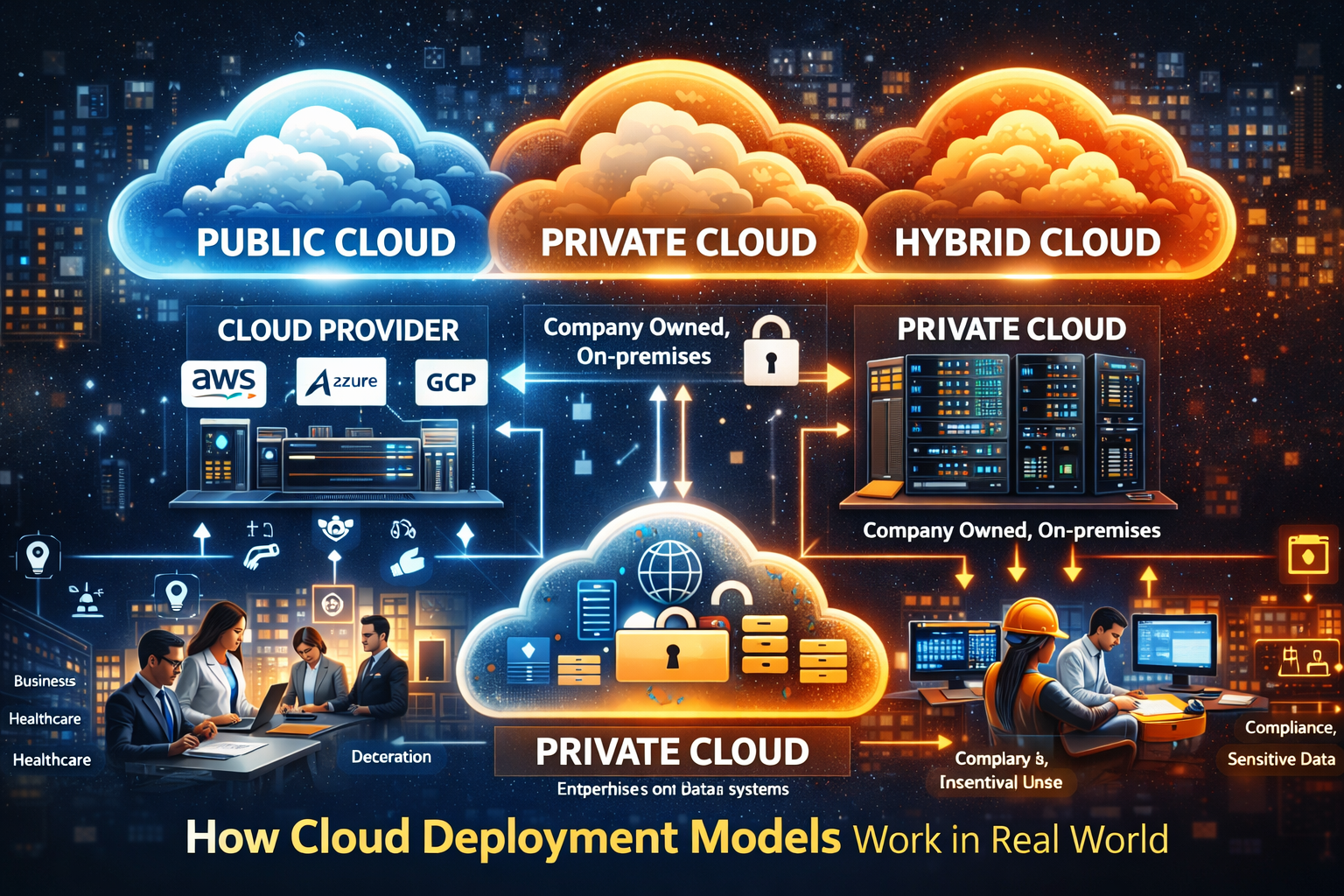
Let us explore how cloud deployment models work in real-world scenarios.
How Cloud Deployment Models Work in Practice
Cloud deployment models define how cloud resources are organized and delivered based on access level, security requirements, and usage needs. They ensure that users can access applications and data efficiently while maintaining control and flexibility.
Basic Working of Cloud Deployment Models
- Users Access Applications via the Internet: Applications are hosted on cloud servers and can be accessed remotely from any device using an internet connection.
- Data is stored in Cloud Environments: Information is stored in different deployment models such as public, private, or hybrid cloud, depending on business needs.
- Resources are Allocated Dynamically: Cloud providers automatically allocate and adjust computing resources based on demand, ensuring efficient performance and scalability.
Cloud Deployment Models in Real World
Cloud deployment models are applied in real-world scenarios based on factors such as security, cost, scalability, and control requirements. Each model serves different business needs and helps organizations choose the most suitable cloud strategy for their operations.
1. Public Cloud in Real World
Public cloud is widely used for applications that require high scalability, flexibility, and cost efficiency. It is ideal for businesses that want to avoid infrastructure costs and focus on growth. Here are some key points of public cloud in real world.
- Shared Infrastructure: Multiple users share the same cloud servers and resources, reducing cost and improving efficiency.
- On-Demand Services: Resources are instantly available whenever required without waiting for setup.
- Pay-as-You-Go Model: Users pay only for what they use, making it budget-friendly for startups and small businesses.
- High Scalability: Systems can easily scale up or down based on traffic and demand.
- Minimal Maintenance: Cloud provider handles updates, security, and infrastructure management.
Real-Life Example
- Startup Website Hosting: Uses public cloud to host websites without investing in hardware.
- Automatic Scaling: Handles sudden traffic increases during promotions or viral growth.
- Cost Reduction: Eliminates the need for expensive servers and maintenance.
2. Private Cloud in Real World
Private cloud is used when security, privacy, and full control are the top priorities. It is best for organizations dealing with sensitive and confidential data. Here are some key points of private cloud in real world.
- Dedicated Infrastructure: Resources are used by a single organization, ensuring complete isolation.
- Controlled Access: Only authorized users can access systems, improving security.
- Custom Configuration: Infrastructure is tailored according to business and application needs.
- High Compliance Support: Meets strict regulatory requirements in industries like banking and healthcare.
- Enhanced Data Protection: Provides strong security measures for sensitive information.
Real-Life Example
- Banking System: Stores and processes sensitive financial data securely.
- Strict Security Policies: Implements encryption, access control, and monitoring systems.
- Regulatory Compliance: Ensures adherence to financial and legal standards.
3. Hybrid Cloud in Real World
Hybrid cloud combines both public and private cloud environments to achieve a balance between flexibility, scalability, and security. It is widely used by organizations that need both control and cost efficiency. Here are some key points of hybrid cloud in real world.
- Data Separation: Sensitive data is stored in private cloud, while non-critical data is handled by public cloud.
- Workload Distribution: Tasks are divided between environments to optimize performance and cost.
- Scalable Expansion: Public cloud is used to handle extra demand during peak times.
- Improved Flexibility: Organizations can switch workloads between clouds as needed.
- Cost Optimization: Reduces cost by using public cloud for less sensitive operations.
Real-Life Example
- E-Commerce Platform: Uses private cloud for payment systems and user data.
- Public Cloud Usage: Hosts website and manages customer traffic.
- Peak-Time Scaling: Automatically scales during sales events or high traffic periods.
4. Community Cloud in Real World
Community cloud is used by organizations that share common goals, security requirements, or compliance standards. It allows collaboration while maintaining controlled access. Here are some key points of community cloud in real world.
- Shared Infrastructure: Multiple organizations use the same cloud environment for collaboration.
- Common Policies: Security, compliance, and operational standards are shared among all users.
- Cost Sharing: Infrastructure and operational costs are distributed across organizations.
- Collaborative Environment: Enables data sharing and joint operations between organizations.
- Specialized Use Cases: Suitable for sectors like education, research, and government.
Real-Life Example
- Government Departments: Use a shared cloud platform to collaborate and exchange data.
- Secure Data Sharing: Maintain confidentiality while allowing controlled access.
- Standard Compliance: Follow unified security and regulatory policies.
Real-World Combined Scenario
In real-world environments, organizations often use a combination of cloud deployment models to balance security, scalability, cost, and flexibility. This approach allows them to take advantage of each model’s strengths while meeting different operational needs efficiently.
Example: University System
A university can use multiple cloud models together to manage academic, administrative, and research activities effectively. Here are some key points of this combined approach.
- Public Cloud Usage: Used to host university websites, learning management systems (LMS), and online classes that require high availability and scalability.
- Private Cloud Usage: Stores sensitive data such as student records, exam results, and administrative information with strict security and controlled access.
- Hybrid Cloud Integration: Combines public and private cloud environments to enable secure data handling while supporting scalable applications.
- Community Cloud Collaboration: Shared among multiple universities for research projects, academic data sharing, and collaborative innovation.
Why This Approach is Used
Organizations prefer a combined cloud approach because it provides balanced benefits across different requirements. Here are some key reasons.
- Better Security: Sensitive and confidential data is stored in private cloud environments for maximum protection.
- High Scalability: Public cloud handles large numbers of users, especially during peak usage such as admissions or exams.
- Cost Efficiency: Resources are used based on demand, reducing unnecessary infrastructure costs.
- Flexibility: Organizations can choose where to run specific workloads depending on their needs.
- Improved Performance: Workloads are distributed efficiently across different cloud environments.
- Collaboration: Community cloud enables multiple organizations to share knowledge, research, and resources securely.
Conclusion
Cloud deployment models work in real life by providing different levels of access, security, and scalability based on user needs.
-
Used across industries like banking, education, and e-commerce
-
Help organizations manage resources efficiently
-
Enable flexible and secure cloud solutions
Understanding how these models work in real-world scenarios prepares students and professionals for practical cloud computing applications.