












Absorption Law in Boolean Algebra
According to the Absorption Law in Boolean Algebra, a Boolean variable can absorb another Boolean expression without changing the result. The Absorption Law is used to simplify Boolean expressions by removing unnecessary terms.
The Absorption Law applies to both AND and OR operations.
- In the OR operation, a variable absorbs an AND expression containing the same variable.
- In the AND operation, a variable absorbs an OR expression containing the same variable.
Absorption laws are fundamental laws used to simplify Boolean expressions and reduce unnecessary logic gates in digital circuits.
Types of Absorption Laws
There are two types of Absorption Laws in Boolean algebra:
1. OR Absorption Law
The Absorption Law for the OR operation states that a variable absorbs an AND expression containing the same variable. It can be expressed as:
A + (A · B) = A
The following diagram of the OR Absorption Law explains it.
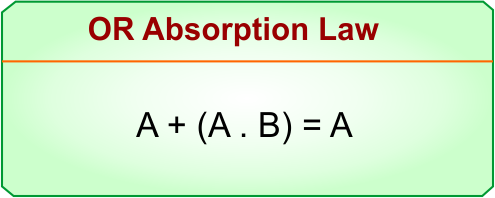
Let’s explain the diagram.
A + (A · B) = A. It means that when A is ORed with an AND expression containing A, the result is always A.
- If A = 0 and B = 0, then 0 + (0 · 0) = 0.
- If A = 0 and B = 1, then 0 + (0 · 1) = 0.
- If A = 1 and B = 0, then 1 + (1 · 0) = 1.
- If A = 1 and B = 1, then 1 + (1 · 1) = 1.
Therefore, A + (A · B) = A because the output is always equal to A. It is called the OR Absorption Law.
2. AND Absorption Law
The Absorption Law for the AND operation states that a variable absorbs an OR expression containing the same variable. It can be expressed as:
A · (A + B) = A
The following diagram of the AND Absorption Law explains it.
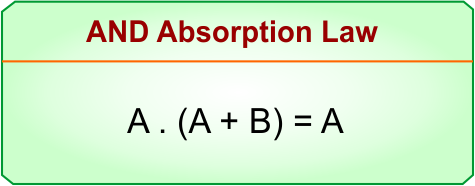
Let’s explain the diagram.
A · (A + B) = A. It means that when A is ANDed with an OR expression containing A, the result is always A.
- If A = 0 and B = 0, then 0 · (0 + 0) = 0.
- If A = 0 and B = 1, then 0 · (0 + 1) = 0.
- If A = 1 and B = 0, then 1 · (1 + 0) = 1.
- If A = 1 and B = 1, then 1 · (1 + 1) = 1.
Therefore, A · (A + B) = A because the output is always equal to A. It is called the AND Absorption Law.
Absorption Law Truth Table
Let’s explain the truth table of AND and OR Absorption Laws in Boolean algebra.
OR Absorption Law Truth Table
In the OR Absorption Law, the expression A + (A · B) always produces the same output as A. The following diagram shows the truth table of the OR Absorption Law.
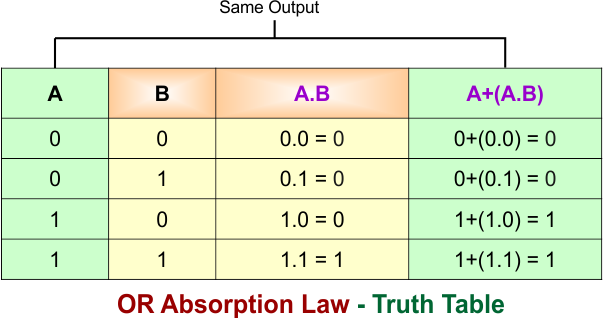
So, A + (A · B) = A because both expressions produce the same output for every combination of A and B.
AND Absorption Law Truth Table
In the AND Absorption Law, the expression A · (A + B) always produces the same output as A. The following diagram shows the truth table of the AND Absorption Law.
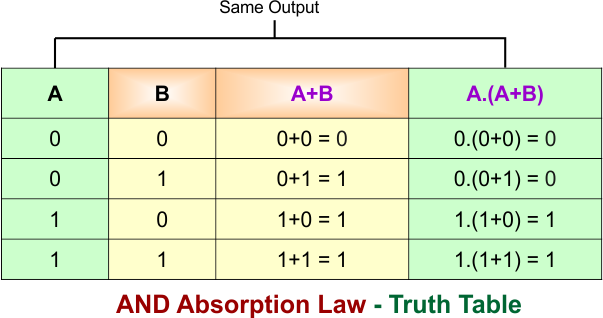
So, A · (A + B) = A because both expressions produce the same output for every combination of A and B.
Absorption Law Logic Gates
Let’s explain the logic gates of the Absorption Law in Boolean algebra.
OR Absorption Law – Logic Gate
In the OR Absorption Law, A is ORed with the AND operation of A and B. The following diagram shows the OR Absorption Law using logic gates.
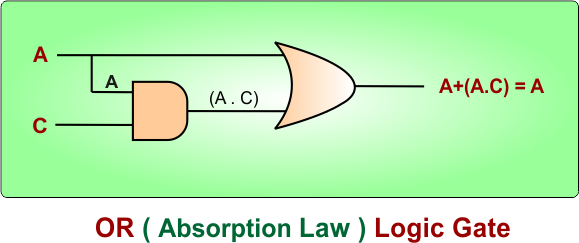
The first circuit represents A + (A · B), while the simplified circuit represents A. Both circuits produce the same output.
AND Absorption Law – Logic Gate
In the AND Absorption Law, A is ANDed with the OR operation of A and B. The following diagram shows the AND Absorption Law using logic gates.
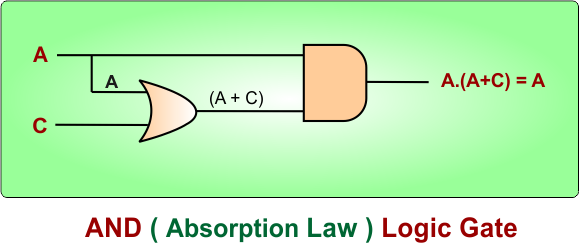
The first circuit represents A · (A + B), while the simplified circuit represents A. Both circuits produce the same output.
Absorption Law – Circuit Switches
Let’s explain the Absorption Law using circuit switches. The Absorption Law can be represented using circuit switches to show that the additional branch or path does not change the final output.
OR Absorption Law – Circuit Switches
In a parallel circuit, the expression A + (A · B) represents A in parallel with a series combination of A and B. Since the second path also contains A, it cannot produce an output of 1 when A is 0. The following diagram explains the process
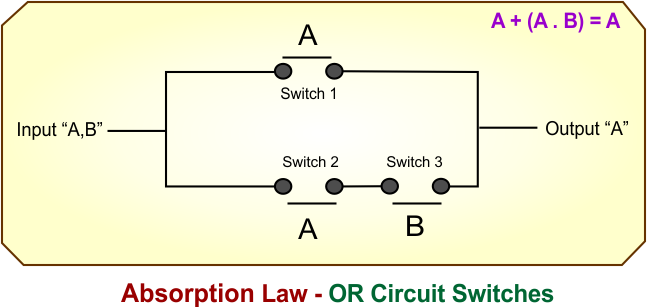
In the first circuit, A is connected in parallel with the series combination of A and B. In the simplified circuit, only A is required. Both circuits produce the same output.
- Case 01: When A = 0 and B = 0, the output is 0.
- Case 02: When A = 0 and B = 1, the output is 0.
- Case 03: When A = 1 and B = 0, the output is 1.
- Case 04: When A = 1 and B = 1, the output is 1.
Therefore, the additional branch containing A and B does not change the output.
AND Absorption Law – Circuit Switches
In a series circuit, the expression A · (A + B) represents A in series with a parallel combination of A and B. Since A is already required for the circuit to produce an output of 1, the additional B branch does not change the result. The following diagram explains the process
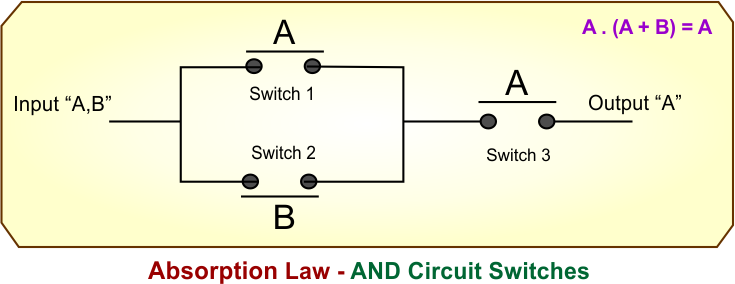
In the first circuit, A is connected in series with the parallel combination of A and B. In the simplified circuit, only A is required. Both circuits produce the same output.
- Case 01: When A = 0 and B = 0, the output is 0.
- Case 02: When A = 0 and B = 1, the output is 0.
- Case 03: When A = 1 and B = 0, the output is 1.
- Case 04: When A = 1 and B = 1, the output is 1.
Therefore, the additional branch containing B does not change the output.
Absorption Law in Boolean Simplification
The Absorption Law is commonly used to remove unnecessary terms from Boolean expressions without changing their value. Let’s explain some examples.
Absorption Law Example 1: A + AB
The OR Absorption Law states that A absorbs AB because AB already contains A. Therefore, the term AB can be removed without changing the result.
- A + AB = A
Absorption Law Example 2: A(A + B)
The AND Absorption Law states that A absorbs (A + B) because A is already present inside the OR expression. Therefore, the expression simplifies to A.
- A(A + B) = A
Absorption Law Example 3: A + ABC
The term ABC contains A, so when A is ORed with ABC, the term ABC is absorbed by A. Therefore, ABC can be removed.
- A + ABC = A
Absorption Law Example 4: A(A + B + C)
The variable A is already present inside the OR expression. Since A is also outside the parentheses and connected by AND, the complete expression is absorbed by A.
- A(A + B + C) = A
Absorption Law Example 5: AB + ABC
The term ABC contains the common term AB. Therefore, AB absorbs ABC, and the additional term ABC can be removed.
- AB + ABC = AB
Absorption Law Example 6: AB(AB + C)
The common term AB is already present inside the OR expression. Therefore, AB absorbs the expression (AB + C), leaving only AB.
- AB(AB + C) = AB
Absorption Law Example 7: A + A(B + C)
The expression A(B + C) contains A, which is already present as a separate term. Therefore, A absorbs the complete expression A(B + C).
- A + A(B + C) = A
Absorption Law Example 8: A(A + B + C + D)
The variable A is present both outside and inside the parentheses. Therefore, A absorbs the complete OR expression, and the remaining variables can be removed.
- A(A + B + C + D) = A
This gives each example a little more explanation without making the section unnecessarily long.