












Involution Law in Boolean Algebra
The Involution Law is also called the Double Complement Law or Double Negation Law. According to the Involution Law in Boolean Algebra, applying the NOT operation twice returns the original Boolean value. In simple terms, taking a variable’s complement twice returns the original variable.
The following diagram represents the involution law:
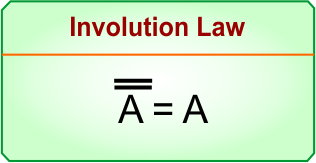
Let’s explain the expression
- If
A = 0, thenA' = 1and(A')' = 0 - If
A = 1, thenA' = 0and(A')' = 1
Therefore, (A')' = A because the final value is always the same as the original value of A. It is called the Involution Law.
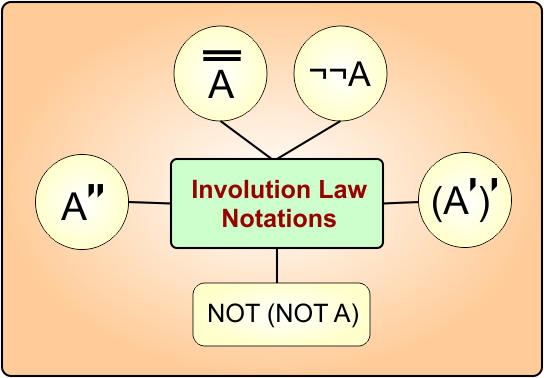
Involution Law Notations
There are various notations of the Involution Law. The following diagram shows the notations of the Involution Law
Step-by-Step Proof of the Involution Law
Let’s prove the involution law step by step.
Step 1: Define the Boolean Variable
Let A be a Boolean variable that can take only two values:
- A = 0 (False)
- A = 1 (True)
Step 2: Apply the NOT Operation
Apply the NOT operation to A.
- If A = 0, then A’ = 1
- If A = 1, then A’ = 0
The NOT operation changes 0 to 1 and 1 to 0.
Step 3: Apply the NOT Operation Again
Now apply the NOT operation to A'.
- If
A' = 1, then(A')' = 0 - If
A' = 0, then(A')' = 1
Therefore, the second NOT operation changes the value back to its original value.
(A')' = A
Thus, the Involution Law is proven.
Involution Law Truth Table
When a Boolean variable is complemented twice, the final output is always equal to the original input. The following diagram shows the truth table of the involution law.
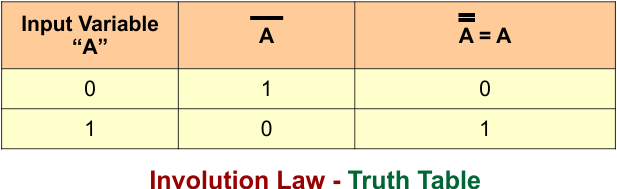
So, (A')' = A because the double complement returns the original value of A.
Involution Law Logic Gates
The Involution Law can be implemented using two NOT gates connected in sequence. The first NOT gate produces the complement of A, and the second NOT gate complements it again
- The first NOT gate produces: A’
- The second NOT gate produces: (A’)’ = A
The following diagram explains the process
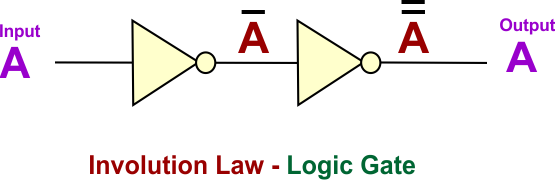
Therefore, two NOT gates connected in sequence return the original input.
Involution Law in Boolean Simplification
The Involution Law is commonly used to simplify Boolean expressions by removing double complements. Whenever a variable or expression has two complements, they can be removed.
Involution Law Example 1: (A’)’
The Involution Law removes the two complements from A.
(A')' = A
Involution Law Example 2: (AB)”
The expression AB has two complements, so they can be removed using the Involution Law.
(AB)'' = AB
Involution Law Example 3: (A + B)” + C
Apply the Involution Law to (A + B)''.
(A + B)'' + C = A + B + C
Involution Law Example 4: ABC” + D
Apply the Involution Law to C''.
ABC'' + D = ABC + D
Involution Law Example 5: (A + BC)” + D
Apply the Involution Law to (A + BC)''.
(A + BC)'' + D = A + BC + D