












Complement Law in Boolean Algebra
According to the Complement Law in Boolean Algebra, combining a Boolean variable with its complement produces a fixed result. The result is different for AND and OR operations.
- The result of the AND operation with its complement is 0
- The result of the OR operation with its complement is 1
Complement laws are fundamental laws used to simplify Boolean expressions and digital logic circuits.
Types of Complement Laws
There are two types of complement laws in Boolean algebra
1. AND Complement Law
The result of the AND operation between a variable and its complement is 0. When any variable is ANDed with its complement, then the result is always 0. The following diagram of the AND complement law explains it.
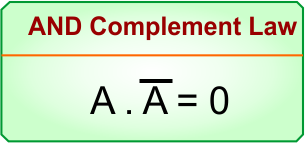
Let’s explain the diagram
A · A’ = 0. It means that a variable and its complement cannot both have a value of 1 at the same time.
- If A = 0 then 0 · 1 = 0
- If A = 1 then 1 · 0 = 0
Therefore, A · A’ = 0 because the result is always 0 whether A is 0 or 1. It is called AND complement Law
2. OR Complement Law
The result of the OR operation between a variable and its complement is 1. When any variable is ORed with its complement, then the result is always 1. The following diagram of the OR complement law explains it.
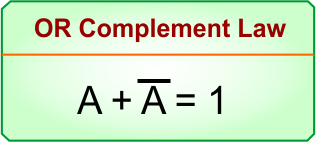
Let’s explain the diagram
A + A’ = 1. It means that a variable and its complement will always include one value of 1.
- If A = 0 then 0 + 1 = 1
- If A = 1 then 1 + 0 = 1
Therefore, A + A’ = 1 because the result is always 1 whether A is 0 or 1. It is called OR complement Law
Complement Law Truth Table
Let’s explain the truth table of AND and OR operations in Boolean algebra
AND Complement Law Truth Table
In an AND operation, a variable and its complement always produce 0. When A is ANDed with A’, the result is always 0. The following diagram shows the truth table of AND complement law
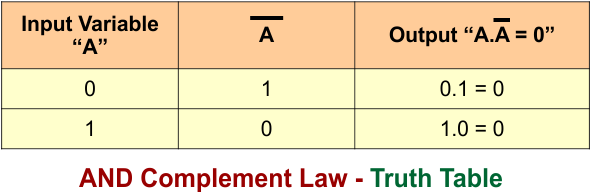
So, A · A’ = 0 because A and A’ cannot both be 1 at the same time.
OR Complement Law Truth Table
In an OR operation, a variable and its complement always produce 1. When A is ORed with A’, the result is always 1. The following diagram shows the truth table of OR complement law
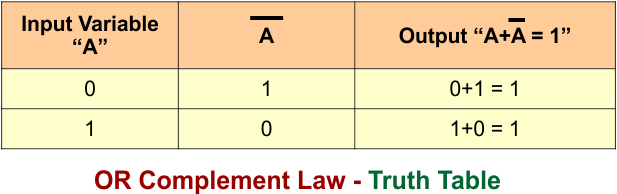
So, A + A’ = 1 because either A or A’ will always be 1.
Complement Law Logic Gates
Let’s explain the logic gates of the complement law in Boolean algebra
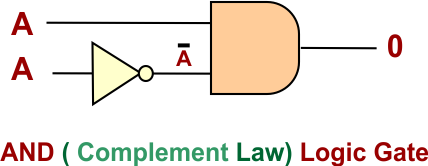
AND Complement law – Logic Gate
The following diagram shows how the AND complement law is implemented using logic gates
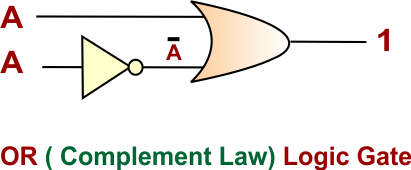
OR Complement law – Logic Gate
The following diagram shows how the OR complement law is implemented using logic gates
Complement Law – Circuit switches
Let’s explain the logic gates of the circuit switches in Boolean algebra. The Complement Law can be represented using circuit switches to show how a variable and its complement always produce a fixed output.
AND Complement law – Circuit switches
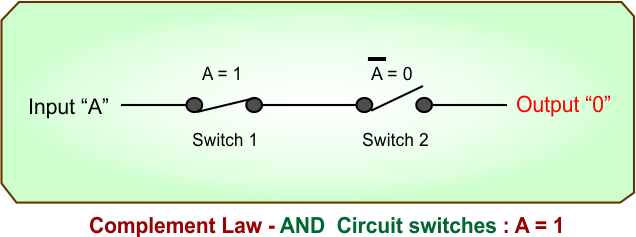
Switch 1 represents A and Switch 2 represents A'. When A is 0, A’ is 1, and when A is 1, A’ is 0. Therefore, both switches can never be closed at the same time, giving A · A' = 0.
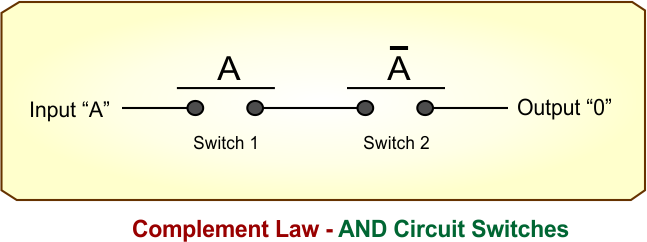
Case 01: When A = 0, the output becomes 0
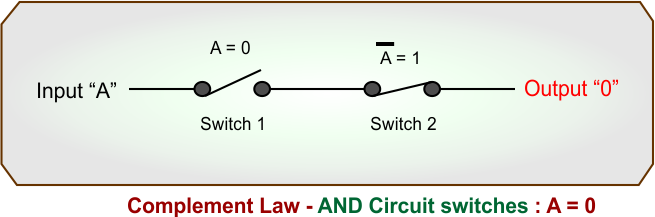
Case 02: When A = 1, the output becomes 0
OR Complement law – Circuit switches
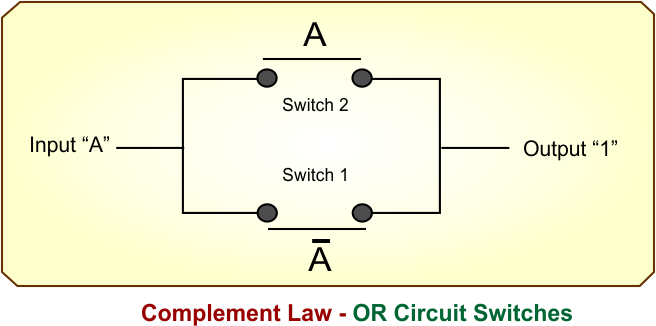
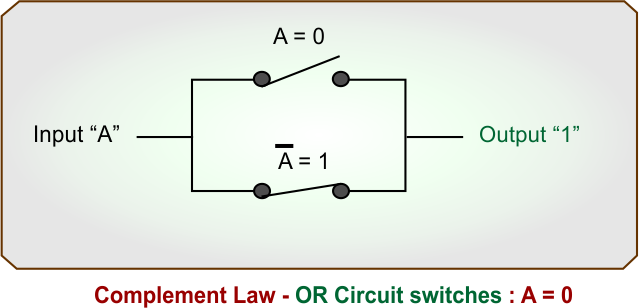
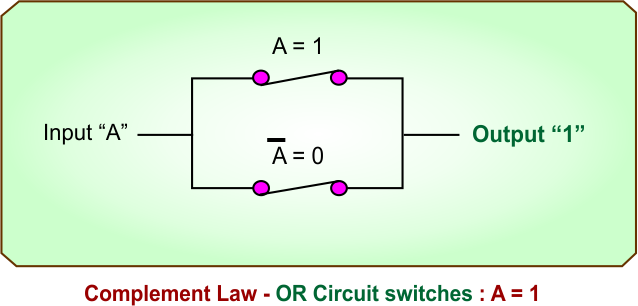
Switch 1 represents A and Switch 2 represents A'. When A is 0, A’ is 1, and when A is 1, A’ is 0. Therefore, at least one switch is always closed, giving A + A' = 1.
Case 01: When A = 0, the output becomes 1
Case 02: When A = 1, the output becomes 1
Complement Law in Boolean Simplification
The Complement Law is commonly used to simplify Boolean expressions by combining a variable with its complement. Let’s explain some examples
Complement Law Example 1: A · A’ + B
The Complement Law X · X’ = 0 changes A · A’ into 0.
- A · A’ + B = 0 + B = B
Complement Law Example 2: A + A’ + B
The Complement Law X + X’ = 1 changes A + A’ into 1.
- A + A’ + B = 1 + B = 1
Complement Law Example 3: AB · (AB)’ + C
Using X · X’ = 0, the complement terms produce 0.
- AB · (AB)’ + C = 0 + C = C
Complement Law Example 4: A + A’ + BC
Apply the Complement Law to A + A’.
- A + A’ + BC = 1 + BC = 1
Complement Law Example 5: ABC · (ABC)’ + D
Apply X · X’ = 0 to ABC · (ABC)’.
- ABC · (ABC)’ + D = 0 + D = D