












Identity Law in Boolean Algebra
According to the Identity Law in Boolean Algebra, combining a Boolean variable with its identity value does not change the variable’s value. The identity value is different in AND and OR operations.
- The identity value for the AND operation is 1
- The identity value for the OR operation is 0
Identity laws are fundamental laws used to simplify Boolean expressions and digital logic circuits.
Types of Identity Laws
There are two types of identity laws in Boolean algebra
1. AND Identity Law
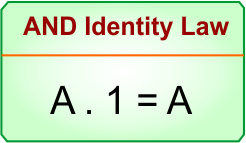
The identity value for the AND operation is 1. When any variable is ANDed with “1”, then the result remains the same variable. The following diagram of the AND identity law explains it.
Let’s explain the diagram
A · 1 = A. It means that1 does not change the value of A.
- If A = 0 then 0 · 1 = 0
- If A = 1 then1 · 1 = 1
Therefore, A · 1 = A because the value of A remains the same whether A is 0 or 1. It is called AND identity Law
2. OR Identity Law
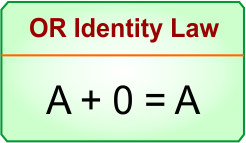
The identity value for the OR operation is 0. When any variable is OR with “0”, then the result remains the same variable. The following diagram of the OR identity law explains it.
Let’s explain the diagram
A + 0 = A. It means that0 does not change the value of A.
- If A = 0 then 0 + 0 = 0
- If A = 1 then1 + 0 = 1
Therefore, A + 0 = A because the value of A remains the same whether A is 0 or 1. It is called OR identity Law
Identity Law Truth Table
Let’s explain the truth table of AND and OR operations in Boolean algebra
AND Identity Law Truth Table
In an AND operation, 1 acts as the identity value. When A is ANDed with 1, the result is always the same as A. The following diagram shows the truth table of AND identity law
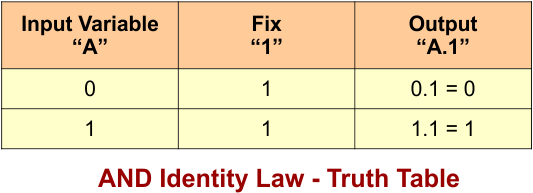
So, A · 1 = A because 1 does not change A’s value.
OR Identity Law Truth Table
In an OR operation, 0 acts as the identity value. When A is ORed with 0, the result is always the same as A. The following diagram shows the truth table of OR identity law
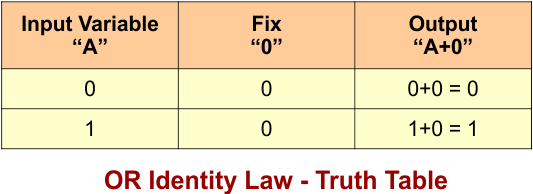
So, A + 0 = A because 0 does not change the value of A.
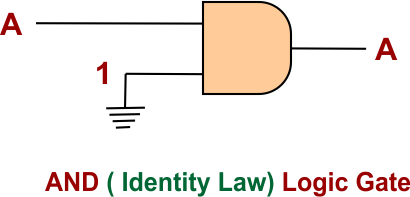
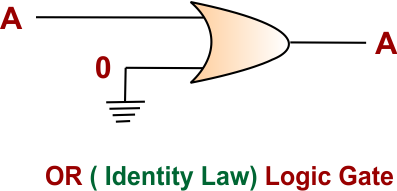
Identity Law Logic Gates
Let’s explain the logic gates of the identity law in Boolean algebra
AND Identity law – Logic Gate
OR Identity law – Logic Gate
Identity Law – Circuit switches
Let’s explain the logic gates of the circuit switches in Boolean algebra
AND Identity law – Circuit switches
OR Identity law – Circuit switches
Why Is It Called the Identity Law?
It is called the Identity Law because 1 acts as the identity element for AND, while 0 acts as the identity element for OR.
- AND identity →
1 - OR identity →
0
The identity element leaves the original value unchanged.
Identity Law in Boolean Simplification
The Identity Law is commonly used to remove unnecessary constants from Boolean expressions.
Example 1:
Y = A · 1
Using the AND Identity Law:
Y = A
Example 2:
Y = A + 0
Using the OR Identity Law:
Y = A
Example 3:
Y = AB + 0
Using the OR Identity Law:
Y = AB
Identity Law and Logic Gates
The Identity Law also has a practical application in digital circuits.
For AND:
A · 1 = A
Connecting an input to an AND gate with a constant HIGH (1) produces the original input.
For OR:
A + 0 = A
Connecting an input to an OR gate with a constant LOW (0) also produces the original input.
Thus, the Identity Law helps identify and eliminate unnecessary logic operations and gates during circuit simplification.
Identity Law vs Null/Domination Law
These two laws are sometimes confused:
| Law | Expression | Result |
|---|---|---|
| AND Identity | A · 1 = A |
Variable remains unchanged |
| OR Identity | A + 0 = A |
Variable remains unchanged |
| AND Null | A · 0 = 0 |
0 dominates |
| OR Null | A + 1 = 1 |
1 dominates |
In short: The Identity Law says 1 does not change an AND operation, and 0 does not change an OR operation.