











IoT System Design Architecture Overview
The IoT system design architecture overview explains how smart devices, networks, and software systems work together to build connected and intelligent solutions. It is essential for students and developers to understand this structure for designing scalable and efficient IoT systems.
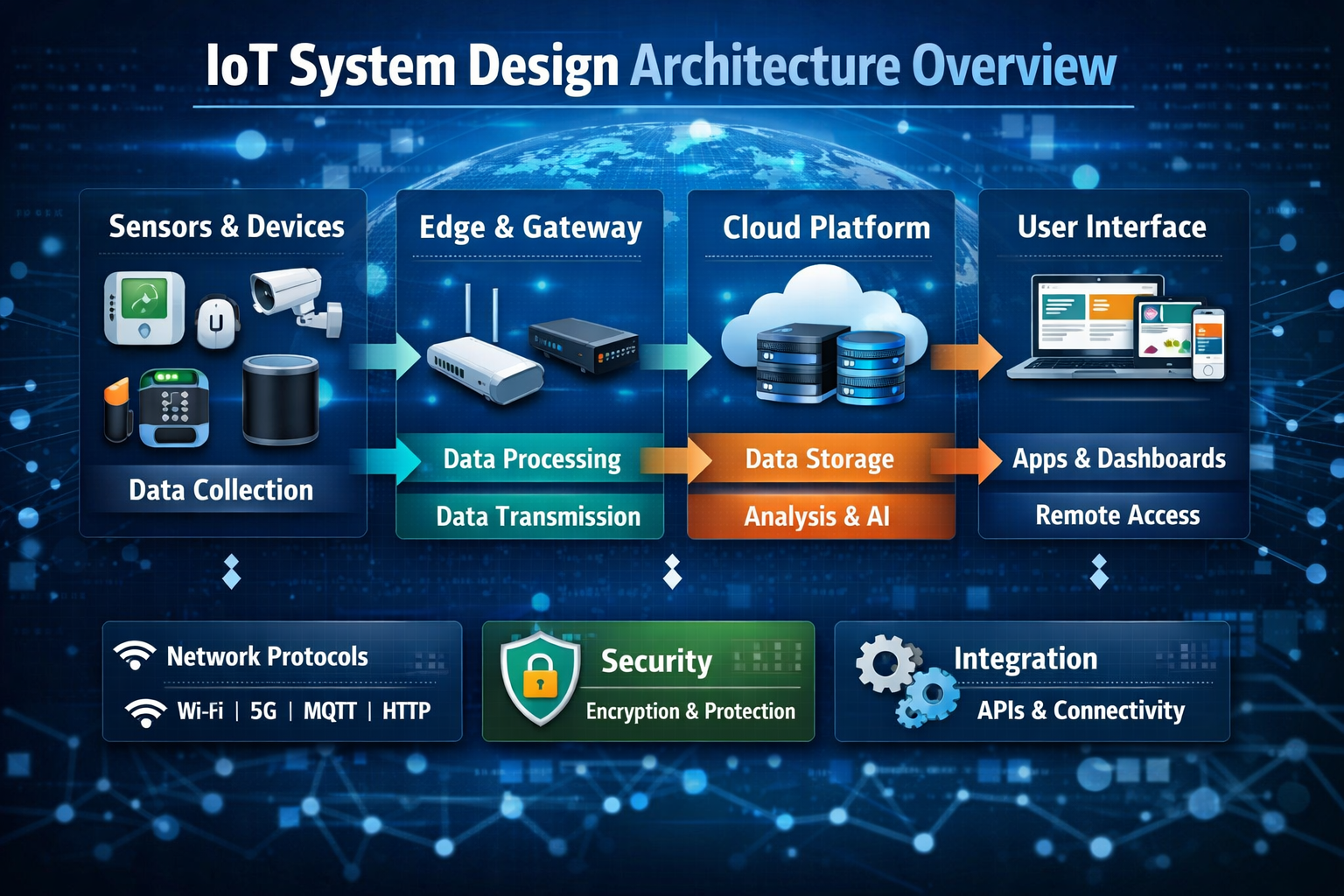
This section introduces the foundation of IoT system architecture, and the list of key concepts given below.
Introduction to IoT System Design Architecture
IoT system design architecture defines how sensors, devices, networks, and processing systems interact to create a connected ecosystem for data exchange and decision-making. It ensures smooth communication and structured data flow across all components.
Below is the list of key components and layers involved in IoT system design architecture given below.
- System Interaction: Defines how devices, networks, and applications communicate to form a unified IoT ecosystem.
- Data Flow Structure: Ensures efficient movement of data from sensors to processing units without delay or loss.
- Integration Framework: Combines hardware and software components for seamless IoT operations.
- Communication Pathways: Establishes reliable channels for transmitting data across IoT layers.
Definition of IoT Architecture
IoT architecture is a structured framework that organizes devices, software systems, and communication technologies to enable smart and automated interactions.
Below is the list of key characteristics of IoT architecture given below.
- Layered Structure: Organizes IoT systems into multiple layers for simplified management and scalability.
- Device Connectivity: Connects sensors and actuators to enable real-world data exchange.
- System Coordination: Ensures smooth coordination between hardware and software components.
- Smart Interaction: Enables automated decision-making between connected devices.
Importance of IoT Architecture
IoT architecture plays a crucial role in building efficient, scalable, and secure IoT systems for real-world applications.
Below is the list of importance factors of IoT architecture given below.
- Scalability Support: Allows systems to expand easily with increasing devices and data load.
- Security Enhancement: Provides secure communication channels and data protection mechanisms.
- Efficient Management: Simplifies monitoring and maintenance of complex IoT systems.
- Performance Optimization: Improves overall system speed and reliability.
Key Objectives of IoT Architecture
The main objectives of IoT architecture focus on ensuring reliable communication, data processing, and system efficiency.
Below is the list of key objectives of IoT architecture given below.
- Reliable Communication: Ensures stable and uninterrupted data transfer between devices.
- Real-Time Processing: Supports instant analysis and decision-making from incoming data.
- Interoperability: Enables different devices and platforms to work together seamlessly.
- Resource Optimization: Improves efficient use of computing and network resources.
Core Components of IoT System Design
IoT system design consists of multiple components that work together to collect, transmit, and process data for intelligent decision-making.
Below is the list of core components used in IoT system design given below.
- Sensors and Actuators: Collect environmental data and perform actions based on processed instructions.
- Connectivity Modules: Enable communication between devices using wireless or wired technologies.
- Data Processing Systems: Analyze raw data using edge or cloud computing techniques.
- User Interfaces: Provide dashboards and applications for user interaction and control.
Layers of IoT System Architecture
IoT system architecture is divided into layers to simplify design, development, and management of connected systems.
Below is the list of IoT architecture layers given below.
- Perception Layer: Collects real-world data using sensors and physical devices.
- Network Layer: Transfers data from devices to processing systems using communication protocols.
- Processing Layer: Analyzes, stores, and processes data using cloud or edge computing.
- Application Layer: Provides end-user services such as smart home and healthcare applications.
Three-Layer vs Five-Layer IoT Architecture
Different IoT architectures are used based on system complexity and application requirements.
Below is the list of differences between three-layer and five-layer IoT architecture given below.
Comparison Table
| Feature | Three-Layer Architecture | Five-Layer Architecture |
|---|---|---|
| Complexity | Low | High |
| Number of Layers | 3 | 5 |
| Data Processing | Limited | Advanced |
| Scalability | Moderate | High |
| Use Cases | Basic IoT Systems | Enterprise IoT Systems |
- Three-Layer Model: Simplified structure with perception, network, and application layers for basic IoT systems.
- Five-Layer Model: Advanced structure including processing and business layers for complex IoT solutions.
IoT Communication Models
IoT communication models define how devices and systems interact and exchange data efficiently.
Below is the list of major IoT communication models given below.
- Device-to-Device (D2D): Enables direct communication between devices without cloud dependency.
- Device-to-Cloud (D2C): Sends data directly from devices to cloud platforms for processing.
- Device-to-Gateway (D2G): Uses a gateway to filter and forward data securely to the cloud.
- Back-End Data Sharing: Allows data sharing between multiple applications for advanced analytics.
IoT Design Considerations
Designing IoT systems requires careful planning to ensure performance, security, and reliability.
Below is the list of important IoT design considerations given below.
- Scalability: Ensures system can handle growing devices and data without performance issues.
- Security: Protects data using encryption, authentication, and secure protocols.
- Interoperability: Allows devices from different manufacturers to work together efficiently.
- Power Management: Optimizes energy usage for battery-operated IoT devices.
- Data Management: Ensures proper storage, processing, and analysis of collected data.
IoT System Design Workflow
The IoT system design workflow follows a structured process to develop and deploy efficient IoT solutions.
Below is the list of IoT system design steps given below.
- Requirement Analysis: Identifies system goals, user needs, and environmental conditions.
- System Design: Defines architecture, hardware selection, and communication protocols.
- Development and Integration: Builds software and integrates devices into a working system.
- Testing and Deployment: Ensures system reliability before deploying in real-world environments.
Applications of IoT System Design Architecture
IoT system architecture is widely used across industries to improve automation, efficiency, and decision-making.
Below is the list of major applications of IoT system design given below.
- Smart Homes: Automates lighting, security, and appliances for better convenience.
- Healthcare Systems: Enables remote patient monitoring and real-time health tracking.
- Industrial Automation: Improves manufacturing efficiency through predictive maintenance.
- Smart Cities: Enhances traffic control, waste management, and energy optimization.
Challenges in IoT System Design
Despite its advantages, IoT system design faces several technical and operational challenges.
Below is the list of common IoT challenges given below.
- Data Privacy Issues: Protecting sensitive data from unauthorized access remains a major concern.
- Network Reliability: Requires stable connectivity for uninterrupted IoT communication.
- System Complexity: Managing large-scale IoT systems increases design and maintenance difficulty.
- Standardization Issues: Lack of universal standards affects interoperability across devices.
Conclusion
IoT system design architecture is the foundation of modern connected systems that enable smart automation and real-time decision-making. Understanding its components, layers, communication models, and challenges helps students and professionals build efficient and scalable IoT solutions for real-world applications.