










Key Components of IoT System Architecture
The key components of IoT system architecture form a complete ecosystem that enables devices, networks, and applications to work together efficiently for data collection, processing, and decision-making. These components are essential for building scalable, secure, and intelligent IoT solutions used in smart homes, industries, healthcare, and cities.
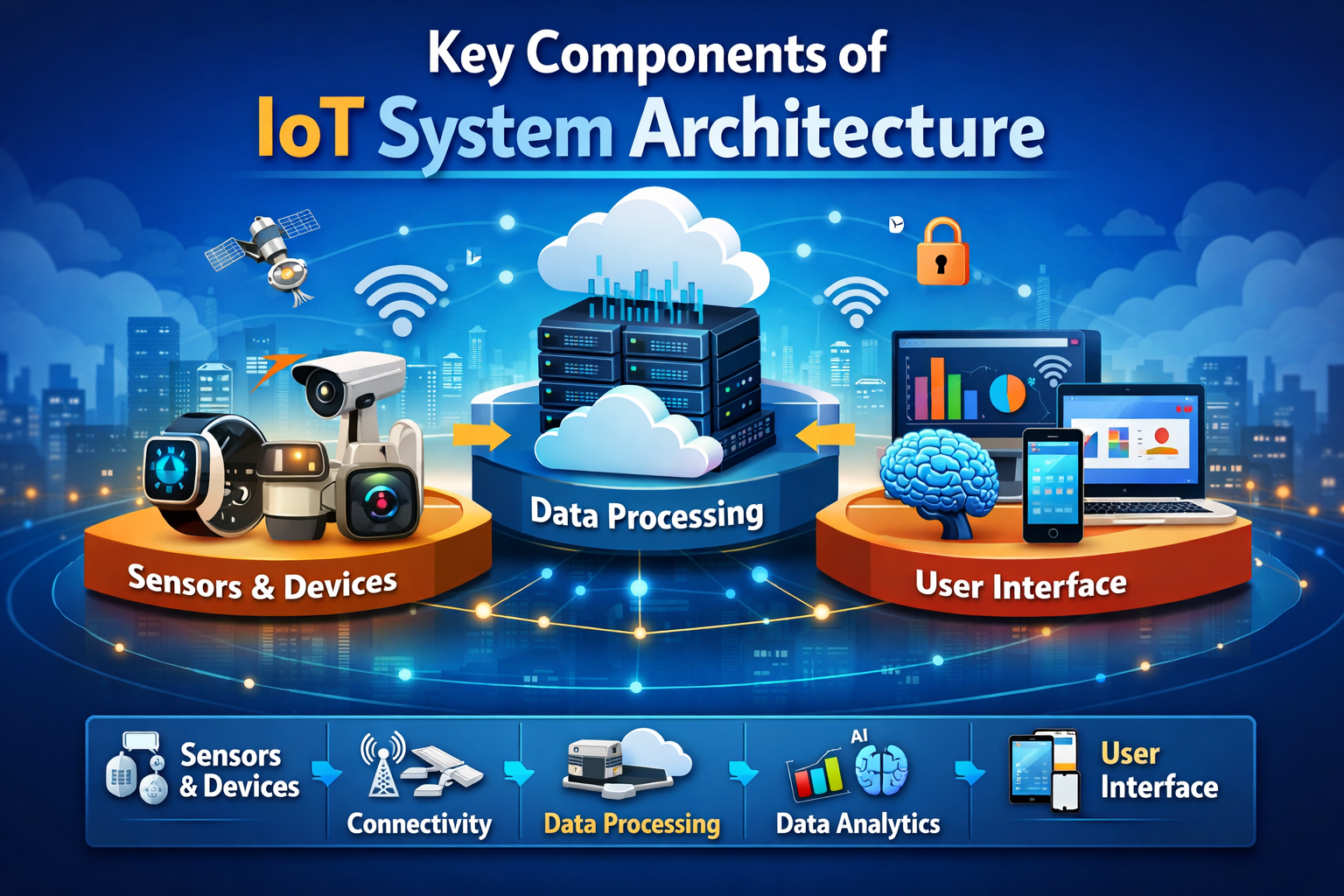
List of key components of IoT system architecture given below:
1. Devices (Sensors and Actuators)
Devices are the foundation of IoT system architecture, responsible for interacting with the physical world by collecting data and performing actions based on processed instructions.
List of functions and types of IoT devices given below:
1.1 Sensors in IoT
Sensors are essential input devices in IoT systems that capture environmental data and convert it into digital signals for processing.
- Real-time data collection in IoT sensors: Captures temperature, humidity, motion, and light data from the environment.
- Signal conversion in sensors: Converts physical parameters into digital signals for system processing.
- Accurate monitoring in IoT systems: Ensures precise environmental tracking for smart applications.
1.2 Actuators in IoT
Actuators are output devices that perform physical actions based on commands received from IoT systems.
- Physical action execution in actuators: Converts digital instructions into mechanical movements.
- Automation control in IoT systems: Operates motors, valves, and switches for automated processes.
- Smart response systems using actuators: Enables intelligent control in smart homes and industries.
2. Connectivity (Network Layer)
Connectivity is a crucial layer in IoT architecture that enables communication between devices, gateways, and cloud systems, ensuring smooth and reliable data transmission.
List of IoT networking technologies given below:
2.1 Wired Communication
Wired communication provides stable and secure data transfer channels in IoT environments.
- High reliability in wired IoT networks: Ensures consistent and uninterrupted data flow.
- Low latency communication in IoT systems: Reduces delay in data transmission for critical applications.
- Industrial-grade connectivity solutions: Uses Ethernet and fiber optics for secure environments.
2.2 Wireless Communication
Wireless communication enables flexible and scalable IoT deployments without physical cabling.
- Flexible connectivity in IoT devices: Supports Wi-Fi, Bluetooth, Zigbee, and LoRaWAN technologies.
- Remote access in wireless IoT systems: Enables monitoring and control from distant locations.
- Easy deployment in IoT networks: Reduces installation cost and complexity.
2.3 IoT Protocols
IoT protocols define communication rules that ensure efficient and standardized data exchange between devices.
- Efficient messaging in IoT protocols: MQTT, HTTP, and CoAP enable lightweight communication.
- Device interoperability in IoT systems: Ensures different devices can communicate effectively.
- Standardized communication in IoT networks: Maintains consistency across platforms.
3. Data Processing (Edge and Cloud Computing)
Data processing in IoT architecture transforms raw data into useful insights using edge and cloud computing techniques for better decision-making and performance.
List of data processing approaches in IoT given below:
3.1 Edge Computing
Edge computing processes data closer to the source, reducing latency and improving real-time performance.
- Real-time processing in edge computing: Enables instant decision-making in IoT systems.
- Reduced cloud dependency in IoT: Minimizes bandwidth usage and server load.
- Faster response systems using edge technology: Ideal for time-sensitive applications.
3.2 Cloud Computing
Cloud computing provides centralized processing power and storage for large-scale IoT applications.
- Scalable IoT data processing in cloud systems: Handles massive datasets efficiently.
- Remote access in cloud-based IoT: Enables data access from anywhere.
- AI integration in IoT cloud platforms: Supports machine learning and advanced analytics.
Edge vs Cloud Computing in IoT
| Feature | Edge Computing | Cloud Computing |
|---|---|---|
| Processing Location | Near data source | Centralized servers |
| Speed | High (low latency) | Moderate |
| Storage | Limited | High scalability |
| Use Case | Real-time systems | Big data analytics |
4. Data Storage
Data storage is a key component in IoT architecture that ensures safe, scalable, and reliable storage of large volumes of sensor-generated data.
List of data storage methods in IoT given below:
4.1 Local Storage
Local storage keeps data closer to devices for quick access and temporary usage.
- Fast data access in local IoT storage: Reduces retrieval time for immediate processing.
- Limited capacity in local storage systems: Suitable for short-term data handling.
- Edge-level storage efficiency in IoT: Supports temporary buffering of data.
4.2 Cloud Storage
Cloud storage provides centralized data management for large-scale IoT systems.
- Scalable storage in IoT cloud systems: Handles massive datasets efficiently.
- Remote data access in cloud storage: Enables access from any location.
- Reliable backup systems in IoT: Ensures data recovery and protection.
5. Application Layer
The application layer in IoT architecture delivers user-facing services that convert processed data into meaningful actions and insights for real-world use.
List of IoT applications and functionalities given below:
5.1 Smart Applications
Smart applications use IoT data to automate processes across various industries and environments.
- Smart home automation in IoT systems: Controls lighting, security, and appliances.
- Smart healthcare monitoring solutions: Tracks patient health in real time.
- Smart agriculture systems in IoT: Improves crop monitoring and irrigation.
5.2 Data Visualization
Data visualization helps users understand complex IoT data through graphical representations.
- Interactive dashboards in IoT systems: Displays real-time analytics.
- Graph-based monitoring in IoT applications: Improves decision-making.
- User-friendly data insights in IoT: Enhances system understanding.
6. Security Mechanisms
Security mechanisms are essential in IoT architecture to protect devices, networks, and data from cyber threats and unauthorized access.
List of IoT security measures given below:
6.1 Data Encryption
Data encryption ensures secure transmission and storage of IoT data.
- Secure data transmission in IoT systems: Protects information during transfer.
- SSL/TLS encryption in IoT networks: Prevents unauthorized access.
- Data confidentiality in IoT architecture: Keeps sensitive information safe.
6.2 Authentication and Authorization
These mechanisms ensure that only authorized users and devices can access IoT systems.
- User verification in IoT systems: Confirms identity before access.
- Secure access control in IoT networks: Restricts unauthorized entry.
- Multi-factor authentication in IoT security: Enhances system protection.
6.3 Network Security
Network security protects communication channels and prevents cyber attacks in IoT systems.
- Firewall protection in IoT networks: Blocks unauthorized traffic.
- Intrusion detection in IoT systems: Identifies potential threats.
- Secure communication in IoT architecture: Maintains system integrity.
7. User Interface (UI)
The user interface in IoT architecture allows users to interact with devices and systems easily through web and mobile platforms for monitoring and control.
List of IoT user interface features given below:
7.1 Web Interfaces
Web interfaces provide browser-based access to IoT systems for monitoring and control.
- Remote access via web dashboards in IoT: Enables system control from anywhere.
- Real-time monitoring in IoT web systems: Displays live data updates.
- Centralized control panels in IoT applications: Improves usability.
7.2 Mobile Applications
Mobile applications provide portable and convenient access to IoT systems.
- On-the-go IoT control via mobile apps: Enables remote device management.
- Instant notifications in IoT systems: Sends alerts for real-time events.
- Smart home integration using mobile apps: Enhances user convenience.
Conclusion
The key components of IoT system architecture work together to form a complete and intelligent ecosystem that supports data collection, communication, processing, storage, security, and user interaction. Understanding these components helps students and professionals design efficient, scalable, and secure IoT solutions for real-world applications such as smart cities, healthcare systems, and industrial automation.