










Current Trends in IoT Technology
The Internet of Things (IoT) is rapidly evolving with new technologies that are transforming industries, smart environments, and everyday life. Understanding current IoT trends helps students and professionals stay updated with real-world innovations and future opportunities.
Introduction to Current IoT Trends
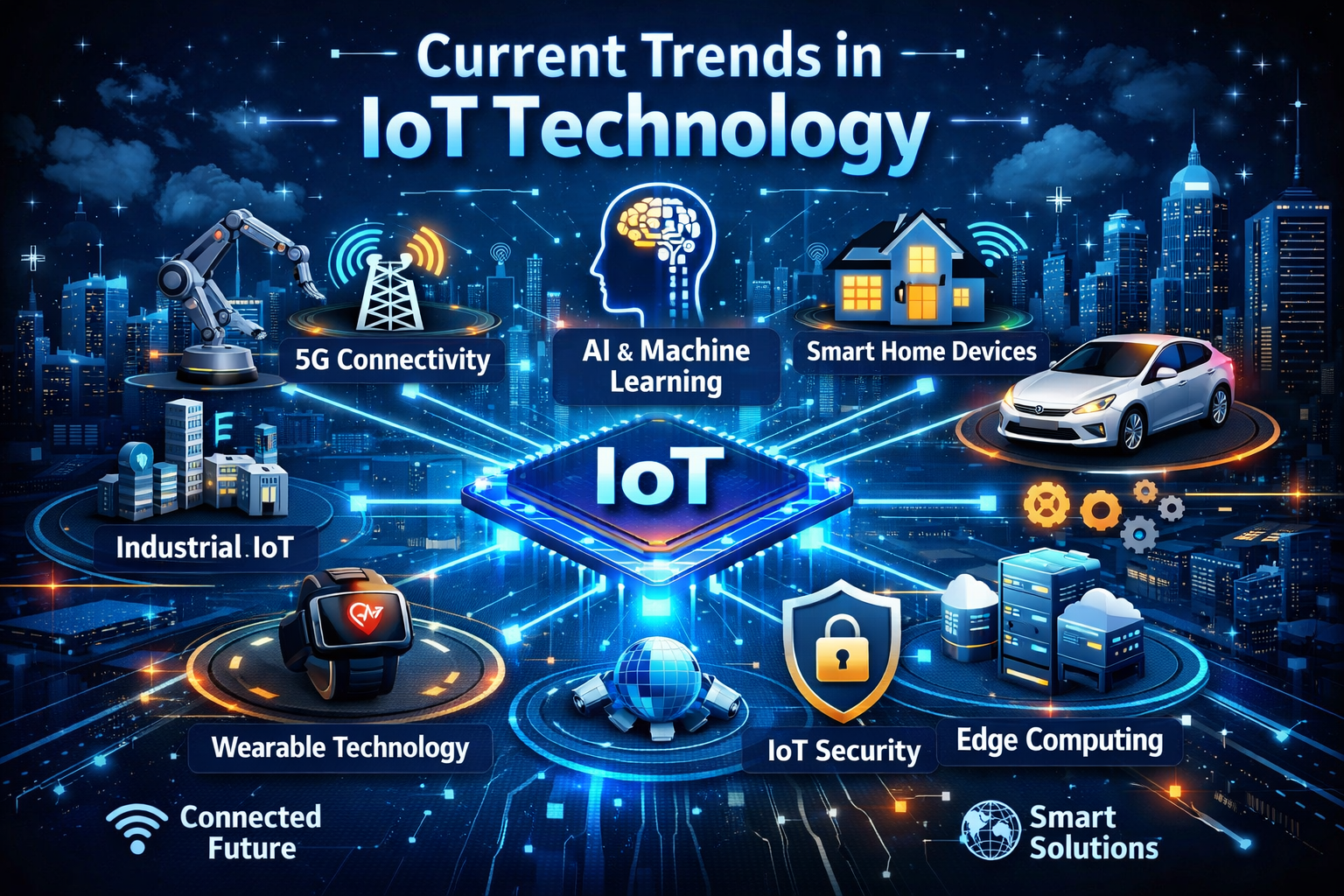
IoT trends represent the latest technological advancements that improve connectivity, automation, and intelligent decision-making. These trends show how IoT is becoming smarter, faster, and more efficient in modern digital ecosystems.
The list of key current trends in IoT technology is given below:
1. Edge Computing in IoT
Edge computing is transforming IoT by processing data closer to devices instead of relying only on centralized cloud systems.
- Reduced Latency: Data is processed near the source, enabling faster response times
- Improved Performance: Real-time analytics enhance system efficiency
- Lower Bandwidth Usage: Reduces data transfer to cloud servers
- Enhanced Security: Sensitive data stays closer to the device
2. AI and Machine Learning Integration
Artificial Intelligence (AI) and Machine Learning (ML) are making IoT systems more intelligent and predictive.
- Smart Decision Making: Devices can analyze data and take actions automatically
- Predictive Maintenance: Detects failures before they occur
- Pattern Recognition: Identifies trends from large datasets
- Automation: Reduces human intervention in complex processes
3. 5G Connectivity for IoT
The adoption of 5G networks is enabling faster and more reliable IoT communication.
- High Speed: Supports real-time data transmission
- Low Latency: Critical for applications like autonomous vehicles
- Massive Device Connectivity: Connects billions of IoT devices
- Improved Reliability: Ensures stable connections
4. IoT Security Enhancements
As IoT grows, security becomes a major concern, leading to new security solutions and practices.
- End-to-End Encryption: Protects data during transmission
- Device Authentication: Ensures only authorized devices connect
- Blockchain Integration: Enhances trust and data integrity
- Threat Detection Systems: Identifies cyber-attacks in real time
5. Digital Twins Technology
Digital twins are virtual replicas of physical objects or systems used for monitoring and simulation.
- Real-Time Monitoring: Tracks performance of physical assets
- Simulation: Tests scenarios without affecting real systems
- Improved Maintenance: Helps in predictive maintenance
- Cost Efficiency: Reduces operational risks and costs
Emerging IoT Technologies and Innovations
New innovations are shaping the future of IoT by improving scalability, intelligence, and integration. These technologies are pushing IoT beyond basic connectivity into advanced automation systems.
The list of emerging IoT technologies is given below:
1. IoT with Cloud and Edge Hybrid Models
Combining cloud and edge computing provides a balanced architecture for IoT systems.
- Flexible Processing: Data processed both locally and in cloud
- Scalability: Easily handle growing data loads
- Cost Optimization: Reduces unnecessary cloud usage
- Better Performance: Ensures faster and efficient operations
2. TinyML (Machine Learning on Small Devices)
TinyML allows machine learning models to run directly on low-power IoT devices.
- Low Power Consumption: Ideal for battery-operated devices
- Real-Time Processing: No need to send data to cloud
- Compact Models: Efficient for embedded systems
- Faster Decision Making: Immediate insights from data
3. Smart Sensors and Advanced Devices
Modern IoT sensors are becoming more powerful, accurate, and energy-efficient.
- Multi-Functional Sensors: Measure multiple parameters
- Energy Efficiency: Longer device lifespan
- High Accuracy: Improved data quality
- Self-Calibrating Systems: Reduce maintenance needs
4. IoT and Blockchain Integration
Blockchain technology is enhancing IoT systems with decentralized and secure data management.
- Data Integrity: Prevents unauthorized data changes
- Decentralization: Eliminates single points of failure
- Secure Transactions: Enables trusted device communication
- Transparency: Improves system reliability
Industry-Specific IoT Trends
IoT is being widely adopted across various industries, each with unique applications and benefits. These trends show how IoT is transforming real-world sectors.
The list of industry-specific IoT trends is given below:
1. Smart Cities Development
IoT is enabling the development of smart cities with improved infrastructure and services.
- Smart Traffic Management: Reduces congestion
- Energy Optimization: Efficient power usage
- Waste Management Systems: Automated waste collection
- Public Safety: Real-time monitoring systems
2. Industrial IoT (IIoT)
Industrial IoT is revolutionizing manufacturing and industrial operations.
- Automation: Reduces manual labor
- Predictive Maintenance: Minimizes downtime
- Supply Chain Optimization: Improves logistics
- Real-Time Monitoring: Enhances production efficiency
3. IoT in Healthcare
Healthcare systems are becoming smarter with IoT-based monitoring and diagnostics.
- Remote Patient Monitoring: Track health in real time
- Wearable Devices: Monitor vital signs
- Smart Medical Equipment: Improves accuracy
- Telemedicine: Enables remote consultations
4. IoT in Agriculture
IoT is improving agricultural productivity and resource management.
- Smart Irrigation Systems: Optimize water usage
- Soil Monitoring: Provides real-time soil data
- Crop Health Analysis: Detects diseases early
- Automated Farming: Reduces labor costs
Benefits of Current IoT Trends
Current IoT trends provide significant advantages for businesses, industries, and individuals. These benefits highlight the importance of adopting modern IoT technologies.
The key benefits of current IoT trends are given below:
1. Improved Efficiency
Modern IoT systems optimize processes and reduce resource wastage.
- Automation: Streamlines operations
- Real-Time Data: Enables quick decision-making
- Reduced Errors: Minimizes human mistakes
2. Cost Savings
IoT reduces operational costs through automation and predictive systems.
- Lower Maintenance Costs: Early issue detection
- Energy Efficiency: Reduces power consumption
- Optimized Resources: Better utilization
3. Enhanced User Experience
IoT improves user interaction with devices and services.
- Personalization: Customized user experiences
- Convenience: Easy access and control
- Smart Automation: Seamless operations
Challenges in Current IoT Trends
Despite its growth, IoT still faces several challenges that must be addressed for wider adoption. These challenges highlight areas needing improvement.
The key challenges in current IoT trends are given below:
1. Security Risks
IoT devices are vulnerable to cyber-attacks due to weak security systems.
- Data Breaches: Sensitive data exposure
- Unauthorized Access: Device hacking risks
- Network Vulnerabilities: Weak communication channels
2. Data Management Issues
Handling large volumes of IoT data is complex and challenging.
- Big Data Processing: Requires advanced systems
- Storage Limitations: High storage requirements
- Data Analysis Complexity: Difficult to extract insights
3. Interoperability Problems
Different IoT devices and platforms often lack compatibility.
- Lack of Standards: Different communication protocols
- Integration Issues: Difficulty connecting devices
- Vendor Lock-in: Dependency on specific providers
Comparison of Traditional vs Modern IoT Trends
| Feature | Traditional IoT | Modern IoT Trends |
|---|---|---|
| Data Processing | Cloud-based only | Edge + Cloud Hybrid |
| Intelligence | Limited automation | AI-powered systems |
| Connectivity | 3G/4G | 5G and beyond |
| Security | Basic protection | Advanced encryption & blockchain |
| Scalability | Limited | Highly scalable |
| Decision Making | Manual | Automated & predictive |
Future Direction of IoT Trends
IoT is continuously evolving with new technologies shaping its future landscape. Understanding future directions helps in preparing for upcoming innovations.
Key Future Directions
- Integration with AI and Robotics: Fully automated systems
- Expansion of 5G and 6G: Faster connectivity
- Growth of Smart Environments: Smart homes and cities
- Sustainable IoT Solutions: Energy-efficient devices
- Increased Use of Digital Twins: Advanced simulations
Conclusion
Current trends in IoT technology are transforming the way devices interact, communicate, and make decisions. With advancements like AI integration, edge computing, and 5G connectivity, IoT is becoming more powerful and intelligent. Understanding these trends is essential for students and professionals to stay competitive in the evolving digital world.