










IoT Adoption Across Different Industries
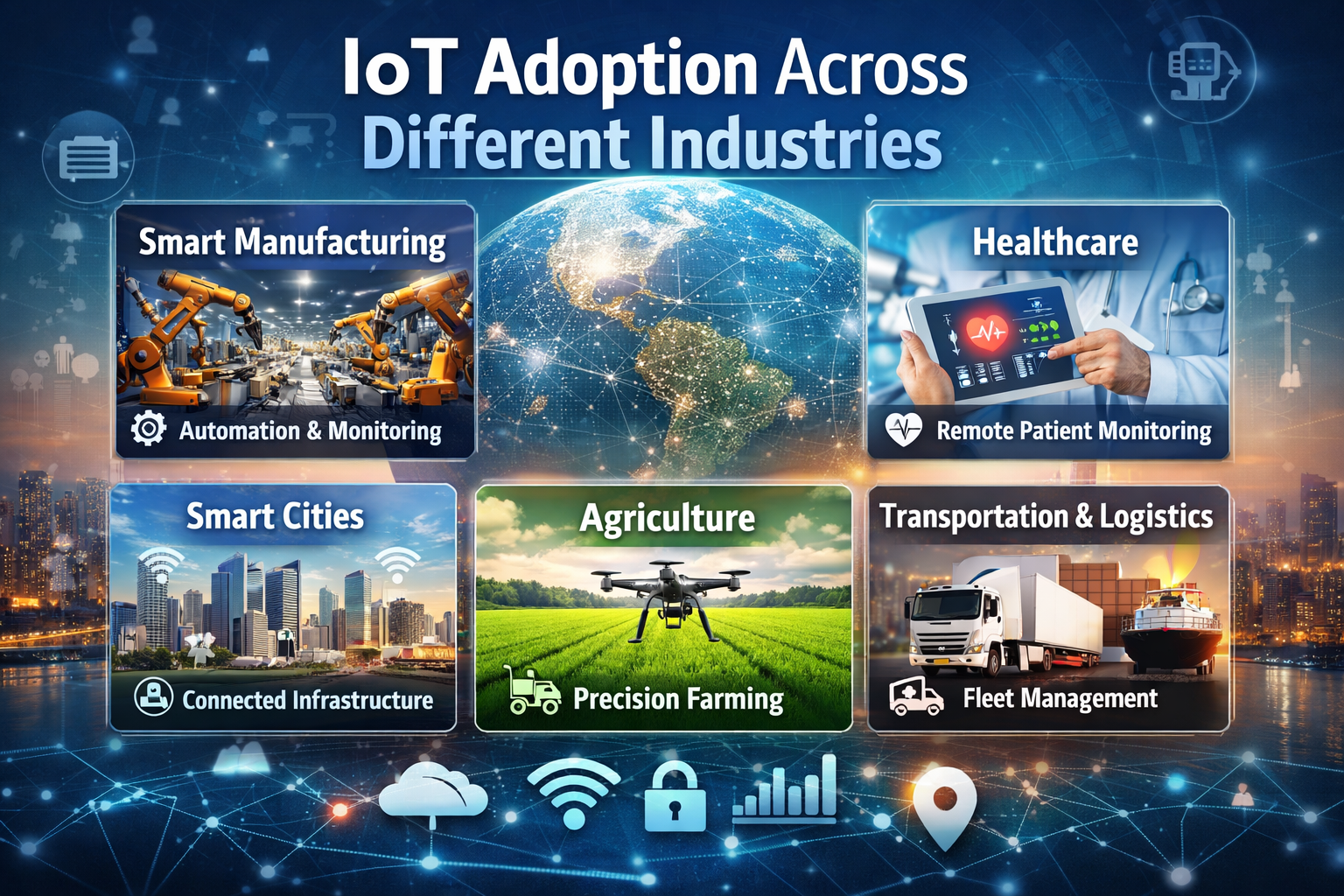
The adoption of Internet of Things (IoT) across industries is transforming how businesses operate, make decisions, and deliver value. IoT connects devices, collects real-time data, and enables automation, improving efficiency and innovation in every sector.
Introduction to IoT Adoption in Industries
IoT adoption in industries refers to the integration of smart devices, sensors, and connected systems to enhance operations and decision-making. It enables industries to shift from traditional processes to intelligent, data-driven systems.
The list of key industries adopting IoT technologies is given below.
1. Manufacturing Industry (Industrial IoT – IIoT)
IoT is revolutionizing manufacturing by enabling smart factories and automated production systems. It helps improve productivity, reduce downtime, and enhance product quality.
- Predictive Maintenance: Machines are monitored using sensors to detect faults before failure
- Smart Production Lines: Automated systems optimize manufacturing processes
- Quality Control: Real-time monitoring ensures product consistency
- Energy Management: Efficient use of energy reduces operational costs
2. Healthcare Industry
IoT is improving patient care and healthcare management through connected medical devices. It enables remote monitoring and faster diagnosis.
- Remote Patient Monitoring: Wearable devices track patient health in real time
- Smart Medical Devices: Devices like heart monitors and insulin pumps are connected
- Hospital Management: IoT helps manage equipment and patient flow
- Emergency Response: Real-time alerts improve patient safety
3. Agriculture Industry (Smart Farming)
IoT helps farmers make better decisions by providing data about soil, weather, and crops. It increases productivity and reduces resource waste.
- Soil Monitoring: Sensors measure moisture and nutrients
- Smart Irrigation: Automated watering systems save water
- Livestock Tracking: Animals are monitored for health and location
- Weather Forecast Integration: Farmers plan activities based on real-time data
4. Transportation and Logistics
IoT enhances the efficiency of transportation systems and supply chains. It provides real-time tracking and improves delivery processes.
- Fleet Management: Vehicles are tracked using GPS systems
- Route Optimization: IoT suggests the best routes to save time and fuel
- Cargo Monitoring: Sensors track temperature and conditions of goods
- Traffic Management: Smart systems reduce congestion
5. Retail Industry
IoT is transforming retail by improving customer experience and inventory management. It enables smart stores and personalized services.
- Smart Shelves: Automatically track product availability
- Customer Behavior Analysis: Data helps understand shopping patterns
- Inventory Management: Real-time stock monitoring reduces shortages
- Automated Checkout: Faster and contactless payment systems
6. Smart Cities and Infrastructure
IoT is playing a major role in building smart cities by improving urban services and infrastructure. It enhances quality of life and resource management.
- Smart Traffic Systems: Reduce congestion and improve flow
- Waste Management: Smart bins optimize garbage collection
- Energy Management: Smart grids improve electricity usage
- Public Safety: Surveillance systems enhance security
7. Energy and Utilities
IoT helps energy companies manage resources efficiently and improve service reliability. It enables smart grids and better energy distribution.
- Smart Meters: Track energy consumption in real time
- Grid Monitoring: Detect faults and outages quickly
- Renewable Energy Integration: Manage solar and wind energy systems
- Demand Response Systems: Balance supply and demand
8. Automotive Industry
IoT enables connected vehicles and smart transportation systems. It improves safety, navigation, and driving experience.
- Connected Cars: Vehicles communicate with each other and infrastructure
- Real-Time Diagnostics: Detect issues before breakdown
- Autonomous Driving: IoT supports self-driving technologies
- Navigation Systems: Provide real-time traffic updates
9. Education Sector
IoT is enhancing learning environments by enabling smart classrooms and digital education systems. It improves engagement and accessibility.
- Smart Classrooms: Interactive boards and connected devices
- Student Monitoring: Track attendance and performance
- Remote Learning: IoT supports online education platforms
- Resource Management: Efficient use of school facilities
10. Banking and Financial Services
IoT is improving security and customer experience in financial institutions. It enables smarter and safer transactions.
- Smart ATMs: Provide enhanced services and security
- Fraud Detection: Real-time monitoring prevents fraud
- Customer Insights: Data helps personalize services
- Asset Tracking: Monitor physical assets in banks
Key Benefits of IoT Adoption Across Industries
IoT adoption provides multiple advantages that help industries grow and innovate. These benefits are applicable across different sectors.
The list of major benefits of IoT adoption is given below.
1. Improved Efficiency
IoT automates processes and reduces manual work, increasing operational efficiency.
- Automation: Reduces human effort
- Real-Time Monitoring: Improves performance tracking
- Process Optimization: Enhances productivity
2. Cost Reduction
IoT helps industries save money by optimizing resources and reducing waste.
- Energy Savings: Efficient energy usage lowers costs
- Maintenance Reduction: Predictive maintenance avoids expensive repairs
- Resource Optimization: Better use of materials
3. Data-Driven Decision Making
IoT provides valuable data that helps businesses make informed decisions.
- Real-Time Insights: Immediate access to data
- Analytics Integration: Supports better planning
- Improved Accuracy: Reduces errors
4. Enhanced Customer Experience
IoT enables personalized services and faster responses to customer needs.
- Personalization: Tailored services based on user behavior
- Faster Service: Quick response times
- Improved Satisfaction: Better user experience
5. Increased Safety and Security
IoT improves safety by monitoring systems and detecting risks early.
- Real-Time Alerts: Immediate notifications of issues
- Surveillance Systems: Enhanced monitoring
- Risk Reduction: Prevent accidents
Challenges in IoT Adoption Across Industries
Despite its benefits, IoT adoption also comes with challenges that industries must address.
The list of major challenges in IoT adoption is given below.
1. Security and Privacy Issues
IoT devices are vulnerable to cyberattacks, making security a major concern.
- Data Breaches: Sensitive data can be exposed
- Unauthorized Access: Hackers can control devices
- Privacy Concerns: User data may be misused
2. High Implementation Cost
Setting up IoT infrastructure requires significant investment.
- Device Cost: Sensors and hardware are expensive
- Maintenance Cost: Ongoing system management
- Integration Cost: Connecting with existing systems
3. Data Management Complexity
IoT generates large amounts of data that must be managed efficiently.
- Big Data Handling: Requires advanced tools
- Storage Issues: Large storage capacity needed
- Data Processing: Complex analytics required
4. Lack of Standardization
Different IoT devices and platforms may not work together smoothly.
- Compatibility Issues: Devices from different vendors may not integrate
- Interoperability Challenges: Communication problems between systems
- Standard Protocols: Lack of universal standards
5. Connectivity Issues
Reliable internet connectivity is essential for IoT systems to function properly.
- Network Dependence: IoT relies on stable networks
- Latency Issues: Delays in data transmission
- Coverage Limitations: Poor connectivity in remote areas
IoT Adoption Across Industries – Comparison Table
| Industry | Main Use Case | Key Benefit | Example Application |
|---|---|---|---|
| Manufacturing | Smart factories | Increased productivity | Predictive maintenance |
| Healthcare | Patient monitoring | Better healthcare | Wearable devices |
| Agriculture | Smart farming | Higher crop yield | Smart irrigation |
| Transportation | Fleet tracking | Efficient logistics | GPS tracking |
| Retail | Smart stores | Improved customer experience | Automated checkout |
| Smart Cities | Urban management | Better infrastructure | Smart traffic systems |
| Energy | Smart grids | Efficient energy use | Smart meters |
| Automotive | Connected vehicles | Improved safety | Real-time diagnostics |
| Education | Smart classrooms | Better learning | Digital learning tools |
| Banking | Smart services | Enhanced security | Fraud detection |
Future of IoT Adoption Across Industries
The future of IoT adoption is very promising as industries continue to innovate and expand digital transformation. Emerging technologies like AI, 5G, and edge computing will further enhance IoT capabilities.
The list of future trends in IoT adoption is given below.
1. Integration with Artificial Intelligence
AI will enhance IoT systems by enabling smarter decision-making and automation.
- Predictive Analytics: Advanced forecasting
- Automation: Intelligent systems
- Self-Learning Systems: Continuous improvement
2. Growth of 5G Technology
5G will improve IoT performance by providing faster and more reliable connectivity.
- High Speed: Faster data transfer
- Low Latency: Real-time communication
- Mass Connectivity: Support for more devices
3. Expansion of Edge Computing
Edge computing will process data closer to devices, reducing latency and improving efficiency.
- Faster Processing: Reduced delay
- Reduced Bandwidth Usage: Efficient data transfer
- Improved Performance: Better system response
4. Increased Adoption in Developing Countries
IoT adoption will grow in developing regions, improving industries and economies.
- Smart Infrastructure: Improved urban development
- Agricultural Growth: Better farming practices
- Economic Development: Increased productivity
Conclusion
IoT adoption across different industries is transforming the modern world by enabling smarter, faster, and more efficient systems. While challenges exist, the benefits of IoT far outweigh the limitations, making it a key driver of future technological innovation.