












Challenges Faced During IoT Evolution
The evolution of the Internet of Things (IoT) has transformed modern technology by connecting billions of devices worldwide. However, this rapid growth has also introduced multiple challenges that impact performance, security, scalability, and user trust.
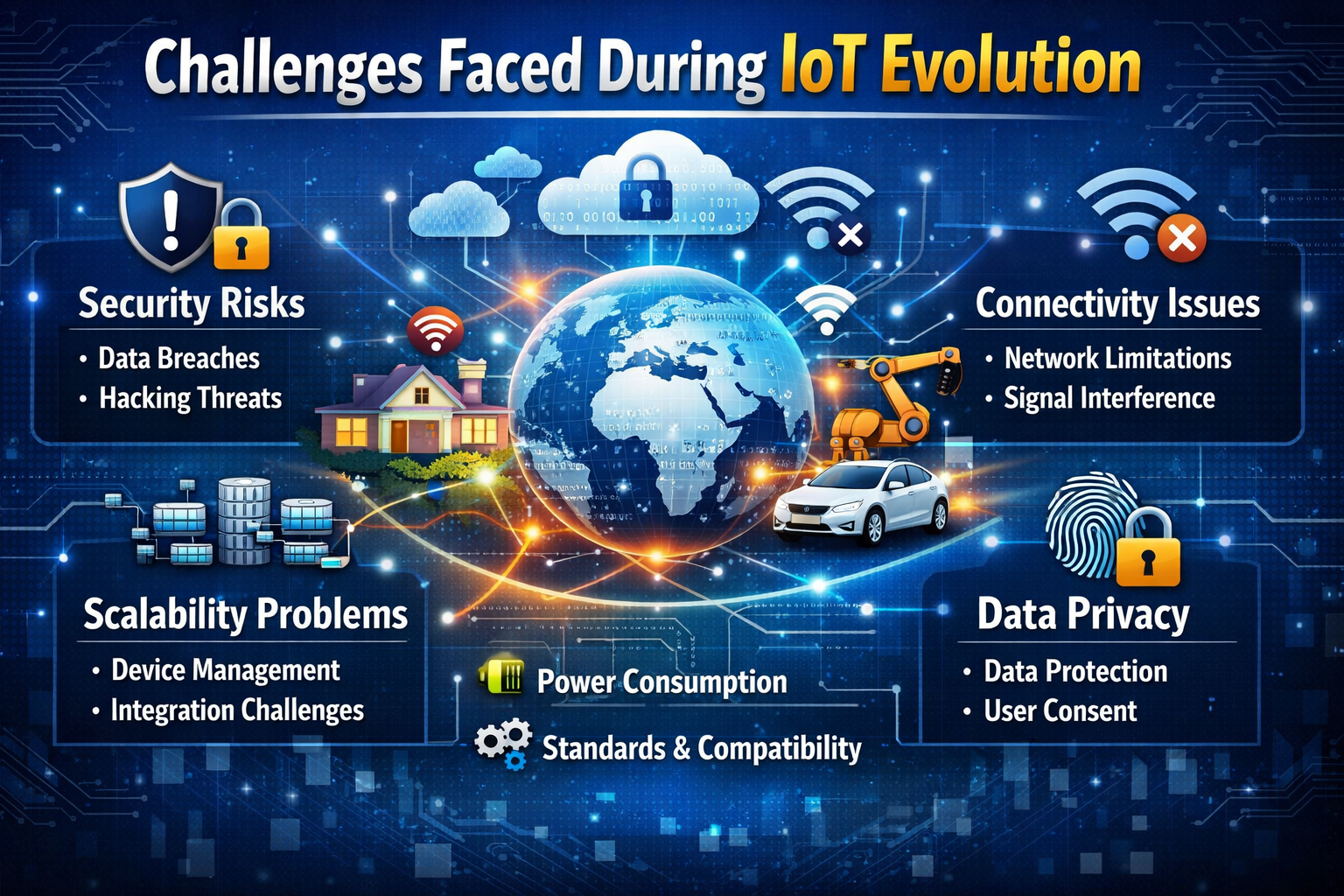
Security and Privacy Challenges in IoT
IoT security and privacy challenges are among the biggest concerns as connected devices continuously collect and transmit sensitive data. Below is the list of major security and privacy issues faced during IoT evolution:
1. Data Security Risks
IoT devices handle large volumes of sensitive data, making them attractive targets for cyberattacks. Weak encryption and poor security practices can lead to data breaches.
- Unauthorized Access: Hackers can access personal or business data
- Data Leakage: Sensitive information may be exposed during transmission
- Weak Encryption: Many IoT devices lack strong security protocols
2. Privacy Concerns
IoT devices continuously monitor user behavior, raising serious privacy concerns. Improper data handling can violate user trust.
- Continuous Monitoring: Devices track user activities and habits
- Lack of Consent: Users may not fully understand data usage
- Data Misuse: Personal information can be sold or misused
3. Device Vulnerabilities
Many IoT devices are designed with limited security features, making them easy targets.
- Default Passwords: Devices often use weak or unchanged credentials
- Unpatched Software: Lack of updates leads to vulnerabilities
- Limited Processing Power: Difficult to implement strong security
Connectivity and Network Challenges
IoT systems rely heavily on stable and high-speed connectivity, which can be difficult to maintain. Below is the list of connectivity-related challenges:
1. Network Reliability Issues
Reliable communication is essential for IoT devices to function effectively. Network failures can disrupt operations.
- Signal Loss: Devices may disconnect due to weak signals
- Latency Problems: Delays in data transmission affect real-time systems
- Downtime: Network outages can stop entire IoT operations
2. Bandwidth Limitations
With billions of connected devices, managing network bandwidth becomes a major challenge.
- High Data Traffic: Large volumes of data overload networks
- Congestion: Too many devices connected at once
- Performance Degradation: Slower communication speeds
3. Interoperability Issues
Different devices and platforms often fail to communicate properly due to lack of standards.
- Multiple Protocols: Devices use different communication standards
- Compatibility Problems: Difficulty in integrating devices
- Vendor Lock-In: Limited flexibility across platforms
Scalability and Performance Challenges
As IoT networks grow, maintaining performance and scalability becomes complex. Below is the list of scalability and performance challenges:
1. Handling Large-Scale Data
IoT generates massive amounts of data that must be processed efficiently.
- Big Data Management: Storing and analyzing large datasets
- Real-Time Processing: Need for immediate data analysis
- Storage Issues: Limited storage capacity
2. System Scalability
IoT systems must support increasing numbers of devices without affecting performance.
- Dynamic Growth: Rapid addition of devices
- Infrastructure Limitations: Difficulty in expanding systems
- Load Management: Handling increased workloads
3. Performance Optimization
Ensuring consistent performance across all devices is a key challenge.
- Processing Delays: Slow response times
- Resource Allocation: Efficient use of computing resources
- Energy Efficiency: Balancing performance with power consumption
Hardware and Device Challenges
IoT devices are often constrained by hardware limitations that affect their functionality. Below is the list of hardware-related challenges:
1. Limited Power Supply
Many IoT devices operate on batteries, limiting their lifespan and functionality.
- Battery Drain: Frequent charging or replacement needed
- Energy Constraints: Limited processing capabilities
- Power Optimization Needs: Efficient energy usage required
2. Device Durability
IoT devices are often deployed in harsh environments, affecting their reliability.
- Environmental Conditions: Heat, dust, and moisture damage devices
- Wear and Tear: Continuous operation reduces lifespan
- Maintenance Challenges: Difficult to repair or replace devices
3. Cost of Devices
The cost of developing and deploying IoT devices can be high.
- Initial Investment: Expensive hardware setup
- Maintenance Costs: Ongoing operational expenses
- Upgradation Costs: Regular updates required
Data Management and Analytics Challenges
Effective data management is crucial for extracting value from IoT systems. Below is the list of data-related challenges:
1. Data Storage Complexity
Managing and storing large volumes of IoT data is a major issue.
- Distributed Storage: Data stored across multiple locations
- Scalability Issues: Growing storage demands
- Data Redundancy: Duplicate data increases complexity
2. Data Processing and Analysis
Extracting meaningful insights from raw data requires advanced analytics.
- Complex Algorithms: Need for advanced data processing techniques
- Real-Time Analytics: Immediate decision-making requirements
- Data Quality Issues: Inaccurate or incomplete data
3. Data Integration Challenges
Combining data from multiple sources is difficult due to format differences.
- Heterogeneous Data: Different data formats and structures
- Integration Complexity: Difficulty in merging datasets
- Standardization Issues: Lack of uniform data formats
Regulatory and Standardization Challenges
The absence of global standards and regulations affects IoT development. Below is the list of regulatory challenges:
1. Lack of Standard Protocols
No universal standards exist for IoT communication and security.
- Fragmentation: Different standards across industries
- Compatibility Issues: Devices cannot easily interact
- Development Complexity: Increased design challenges
2. Legal and Compliance Issues
IoT systems must comply with various regional laws and regulations.
- Data Protection Laws: Compliance with privacy regulations
- Cross-Border Data Transfer: Legal restrictions on data movement
- Liability Issues: Responsibility for failures or breaches
3. Ethical Concerns
IoT raises ethical questions regarding data usage and automation.
- User Consent: Transparency in data collection
- Surveillance Risks: Continuous monitoring concerns
- Decision Accountability: Automated systems making decisions
Comparison Table of Major IoT Challenges
| Challenge Category | Key Issues | Impact on IoT |
|---|---|---|
| Security & Privacy | Data breaches, unauthorized access | Loss of trust and data leaks |
| Connectivity | Network failures, latency | Poor system performance |
| Scalability | Data overload, system expansion | Reduced efficiency |
| Hardware | Power and durability issues | Limited device lifespan |
| Data Management | Storage and analytics problems | Poor decision-making |
| Regulations | Lack of standards and laws | Slow adoption |
Future Directions to Overcome IoT Challenges
Overcoming IoT challenges is essential for sustainable growth and innovation. Below is the list of possible solutions and future directions:
1. Enhanced Security Mechanisms
Advanced security techniques can reduce risks in IoT systems.
- End-to-End Encryption: Secure data transmission
- Authentication Mechanisms: Strong user verification
- Regular Updates: Fix vulnerabilities
2. Improved Connectivity Technologies
New technologies can enhance network performance and reliability.
- 5G Networks: Faster and more reliable connections
- Edge Computing: Reduced latency and faster processing
- Optimized Protocols: Efficient communication
3. Standardization and Regulations
Developing global standards can improve compatibility and trust.
- Unified Protocols: Better device interoperability
- Clear Regulations: Improved compliance
- Industry Collaboration: Shared frameworks
4. Advanced Data Analytics
Better analytics tools can help extract meaningful insights.
- AI Integration: Smarter data processing
- Real-Time Analytics: Faster decision-making
- Data Optimization: Efficient storage and usage
Conclusion
The evolution of IoT has brought significant advancements but also introduced complex challenges in security, connectivity, scalability, hardware, data management, and regulation. Addressing these challenges through innovation, standardization, and advanced technologies will ensure the successful growth and future of IoT systems.