












Key Milestones in IoT Technology Development
The Internet of Things (IoT) has evolved through several important milestones that transformed simple machine communication into today’s smart, connected world. Understanding these key milestones helps students grasp how IoT became a powerful technology driving modern innovation.
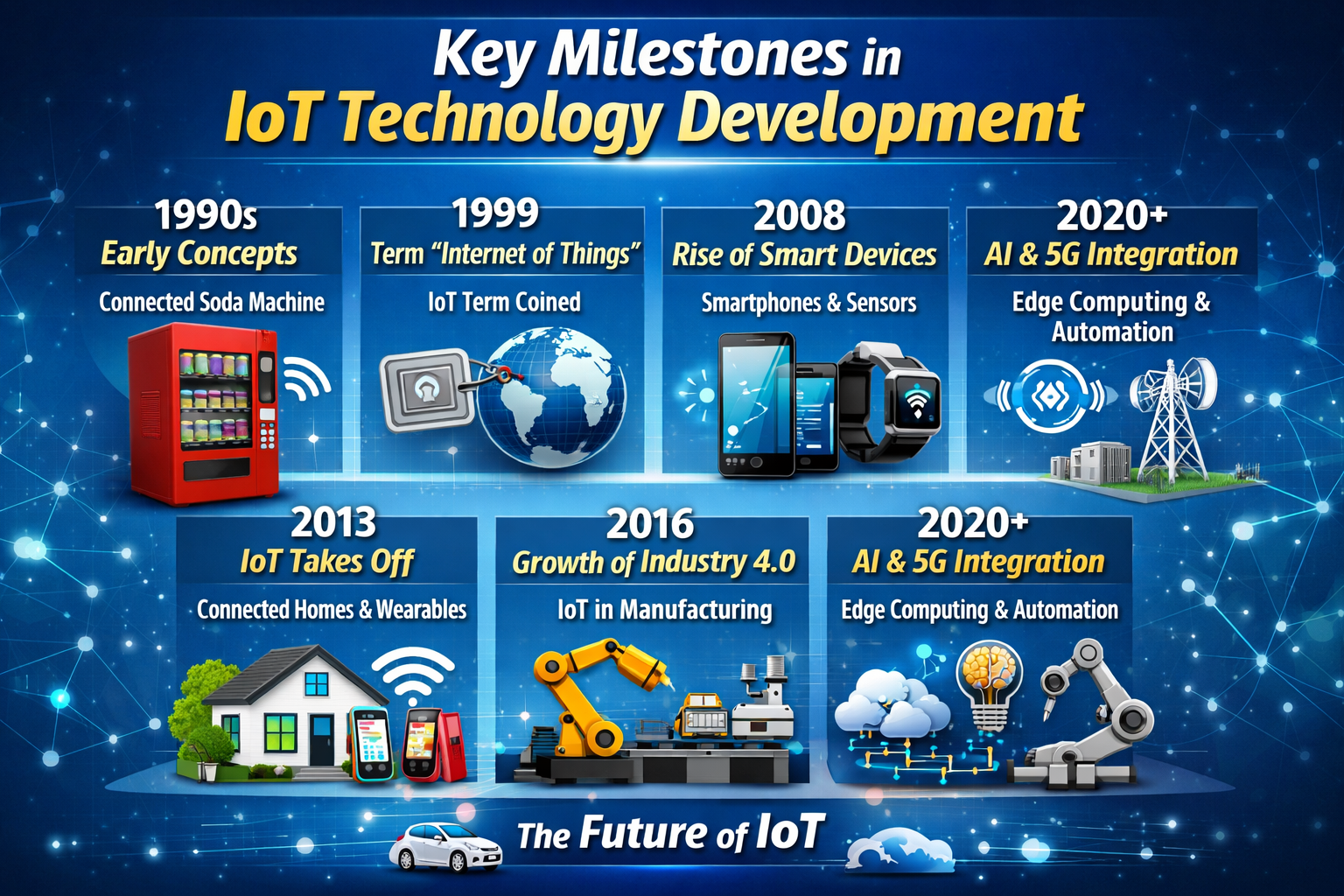
Introduction to IoT Evolution Milestones
IoT development is the result of decades of technological advancements in computing, networking, and embedded systems. These milestones show how innovation gradually connected devices, data, and people in real time. The list of key milestones in IoT technology development is given below.
1. Early Machine-to-Machine (M2M) Communication
This milestone marks the beginning of device-to-device communication without human intervention, forming the base of IoT systems.
- Basic Connectivity: Machines started sharing data using wired networks like telephone lines
- Industrial Use: Used in manufacturing and telemetry systems
- Limited Intelligence: Systems were simple and lacked automation or analytics
2. Development of Embedded Systems
Embedded systems introduced intelligence into devices, enabling them to perform specific tasks efficiently.
- Microcontrollers: Small processors allowed devices to process data locally
- Smart Devices: Appliances became capable of performing automated functions
- Real-Time Operations: Devices could respond instantly to inputs
3. Introduction of the Internet Protocol (IP)
The adoption of IP technology allowed devices to communicate over the internet, a major step toward IoT.
- Global Connectivity: Devices could connect from anywhere in the world
- Standard Communication: IP provided a common language for devices
- Scalability: Enabled the expansion of connected systems
4. Rise of Wireless Communication Technologies
Wireless technologies removed physical barriers, making IoT more flexible and scalable.
- Wi-Fi and Bluetooth: Enabled short-range communication between devices
- Mobile Networks: 2G, 3G, 4G supported remote connectivity
- Low-Power Networks: Technologies like Zigbee and LoRa improved efficiency
5. Emergence of Cloud Computing
Cloud computing became a backbone for IoT by providing storage and processing capabilities.
- Data Storage: Large volumes of IoT data stored securely in cloud servers
- On-Demand Processing: Real-time data analysis became possible
- Cost Efficiency: Pay-as-you-go model reduced infrastructure costs
6. Growth of Big Data and Analytics
IoT systems generate massive data, and analytics helped convert this data into meaningful insights.
- Data Processing: Advanced tools analyze real-time and historical data
- Decision Making: Businesses use insights for optimization
- Predictive Analysis: Forecasting trends and preventing failures
7. Introduction of IPv6
IPv6 solved the limitation of IP addresses, allowing billions of devices to connect to the internet.
- Unlimited Addressing: Supports a huge number of connected devices
- Efficient Routing: Improves network performance
- Future Scalability: Essential for large-scale IoT ecosystems
8. Development of Smart Sensors and Actuators
Sensors and actuators made IoT systems capable of interacting with the physical environment.
- Data Collection: Sensors capture temperature, motion, humidity, etc.
- Automation: Actuators perform actions based on data
- Accuracy: Improved precision in monitoring systems
9. Integration with Artificial Intelligence (AI)
AI enhanced IoT systems by enabling intelligent decision-making and automation.
- Smart Automation: Devices can learn and adapt to user behavior
- Machine Learning: Improves system performance over time
- Real-Time Insights: Faster and more accurate decisions
10. Edge and Fog Computing Development
Edge computing brought data processing closer to devices, reducing latency and improving performance.
- Low Latency: Faster response times for real-time applications
- Reduced Bandwidth: Less data sent to cloud servers
- Local Processing: Devices handle data independently
Timeline of IoT Technology Milestones
The evolution of IoT can be better understood through a timeline of key developments and innovations.
| Year/Period | Milestone | Description |
|---|---|---|
| 1980s | M2M Communication | Machines connected via telephone lines |
| 1990s | Embedded Systems | Smart devices with processing power |
| Early 2000s | Internet Integration | Devices connected using IP protocols |
| Mid 2000s | Wireless Expansion | Growth of Wi-Fi, Bluetooth, mobile networks |
| 2010s | Cloud Computing | Scalable storage and processing |
| 2010s | Big Data Analytics | Data-driven decision making |
| 2010s | IPv6 Adoption | Expansion of connected devices |
| 2020s | AI Integration | Intelligent IoT systems |
| 2020s | Edge Computing | Real-time processing at device level |
Importance of IoT Milestones in Modern Technology
Understanding these milestones helps in recognizing how IoT evolved into a critical technology in today’s digital world. The list of importance of IoT milestones is given below.
1. Foundation for Smart Systems
These milestones created the base for smart homes, smart cities, and industrial automation.
- Connected Devices: Seamless communication between devices
- Automation: Reduced human effort
- Efficiency: Improved system performance
2. Enabling Real-Time Data Processing
IoT advancements allow systems to process and respond to data instantly.
- Quick Decisions: Immediate responses to changing conditions
- Improved Monitoring: Continuous tracking of systems
- Better Performance: Reduced delays and downtime
3. Driving Innovation in Industries
IoT milestones opened new opportunities across multiple industries.
- Healthcare: Remote monitoring and smart diagnostics
- Agriculture: Smart farming and precision agriculture
- Manufacturing: Industrial automation and predictive maintenance
4. Supporting Scalable and Flexible Systems
IoT systems can grow and adapt according to requirements.
- Scalability: Easy addition of new devices
- Flexibility: Customizable solutions
- Cost Optimization: Efficient resource usage
Challenges Faced During IoT Development Milestones
Despite rapid growth, IoT development faced several challenges that influenced its evolution. The list of challenges is given below.
1. Security and Privacy Issues
Security has always been a major concern in IoT systems.
- Data Breaches: Risk of unauthorized access
- Weak Security: Early devices lacked protection
- Privacy Concerns: Sensitive data exposure
2. Connectivity and Network Limitations
Reliable communication has been a challenge in IoT development.
- Network Reliability: Frequent disconnections
- Bandwidth Issues: Limited data transfer capacity
- Latency Problems: Delay in communication
3. Standardization Issues
Lack of universal standards slowed IoT adoption.
- Compatibility Issues: Devices from different vendors struggle to connect
- Fragmentation: Multiple protocols and platforms
- Integration Complexity: Difficult system design
4. Data Management Challenges
Handling large volumes of data became a major issue.
- Storage Problems: Managing huge datasets
- Processing Complexity: Analyzing real-time data
- Data Quality: Ensuring accurate and reliable data
Future Trends Based on IoT Milestones
The milestones of IoT continue to shape its future direction and innovation. The list of future trends based on IoT development is given below.
1. Expansion of AI-Driven IoT
AI will further enhance automation and intelligence in IoT systems.
- Autonomous Systems: Self-operating devices
- Smart Decision Making: AI-based analytics
- Personalization: User-focused services
2. Growth of 5G and Beyond
Advanced networks will improve IoT connectivity and performance.
- Ultra-Fast Communication: High-speed data transfer
- Low Latency: Real-time responsiveness
- Massive Device Support: Billions of connected devices
3. Increased Use of Edge Computing
Edge computing will become more important for real-time applications.
- Faster Processing: Reduced delay
- Efficient Data Handling: Local analysis
- Improved Reliability: Less dependency on cloud
4. Enhanced Security Mechanisms
Future IoT systems will focus more on security and privacy.
- Advanced Encryption: Strong data protection
- Secure Devices: Built-in security features
- Regulatory Compliance: Better standards and policies
Conclusion
The key milestones in IoT technology development highlight a journey from simple machine communication to intelligent, automated systems. Each milestone contributed to building a connected ecosystem that supports modern applications like smart cities, healthcare, and industrial automation. Understanding these milestones not only helps students learn IoT concepts deeply but also prepares them for future innovations in this rapidly evolving field.