











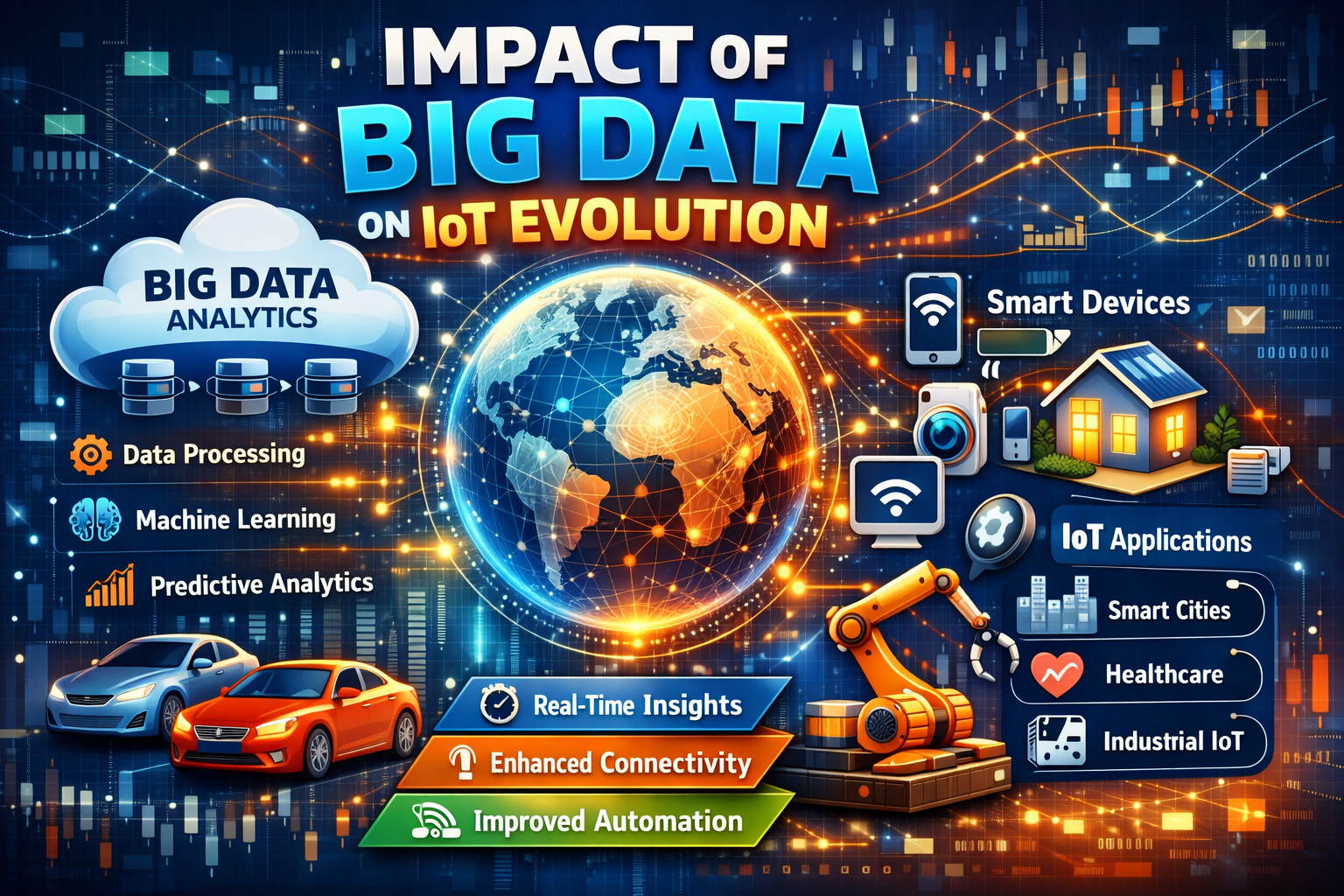
Impact of Big Data on IoT Evolution
Big Data and IoT are transforming modern technology by enabling smart decision-making and automation. This article explains how Big Data drives IoT evolution with deep concepts, real-world insights, and practical understanding.
Introduction to Big Data in IoT
Big Data plays a critical role in IoT by handling massive volumes of data generated by connected devices. It enables intelligent analysis, automation, and predictive capabilities in IoT systems.
Below is the list of key aspects of Big Data in IoT evolution explained through structured headings.
1. What is Big Data in IoT?
Big Data in IoT refers to the large amount of structured and unstructured data generated by IoT devices and sensors in real time.
- Volume: Huge data generated from billions of IoT devices
- Velocity: Continuous data flow in real-time
- Variety: Different types like text, video, sensor data
- Veracity: Data accuracy and reliability
- Value: Extracting useful insights from data
2. Role of Data in IoT Systems
Data is the backbone of IoT systems as it enables devices to communicate, analyze, and respond intelligently.
- Data Collection: Sensors gather environmental data
- Data Transmission: Data sent through networks
- Data Processing: Cloud/edge systems analyze data
- Data Action: Automated decisions are made
How Big Data Drives IoT Evolution
Big Data technologies enhance IoT capabilities by improving efficiency, intelligence, and scalability.
Below is the list of major ways Big Data contributes to IoT evolution.
1. Real-Time Data Processing
Real-time processing allows IoT systems to respond instantly to changing conditions and events.
- Immediate Insights: Detect issues instantly
- Faster Decision-Making: Quick responses improve performance
- Use Case: Smart traffic systems adjust signals dynamically
2. Predictive Analytics in IoT
Predictive analytics uses historical data to forecast future events and behaviors in IoT systems.
- Failure Prediction: Detect device faults before they occur
- Maintenance Planning: Reduce downtime using predictions
- Improved Efficiency: Optimize operations proactively
3. Enhanced Automation
Big Data enables intelligent automation in IoT by analyzing patterns and triggering actions without human intervention.
- Smart Homes: Automatic lighting and temperature control
- Industrial Automation: Machines operate autonomously
- Reduced Human Effort: Improves productivity
4. Data-Driven Decision Making
Organizations use Big Data insights from IoT to make informed and strategic decisions.
- Business Intelligence: Better planning using data insights
- Operational Optimization: Improve resource usage
- Customer Insights: Understand user behavior
Big Data Technologies Supporting IoT
Various Big Data tools and platforms are used to manage and process IoT data efficiently.
Below is the list of key technologies used in Big Data-driven IoT systems.
1. Cloud Computing
Cloud platforms store and process large IoT datasets efficiently with scalable infrastructure.
- Scalable Storage: Handle massive IoT data
- High Processing Power: Analyze data quickly
- Accessibility: Access data from anywhere
2. Edge Computing
Edge computing processes data closer to IoT devices to reduce latency and improve speed.
- Low Latency: Faster response time
- Reduced Bandwidth Usage: Less data sent to cloud
- Real-Time Processing: Ideal for critical applications
3. Data Analytics Platforms
Analytics platforms help extract meaningful insights from IoT data using algorithms and models.
- Machine Learning: Learn patterns from data
- AI Integration: Enable smart decision-making
- Visualization Tools: Easy data interpretation
4. Distributed Databases
Distributed systems store IoT data across multiple locations for better reliability and scalability.
- High Availability: Data always accessible
- Fault Tolerance: Prevent data loss
- Scalability: Handle growing data needs
Benefits of Big Data in IoT Evolution
Big Data significantly improves the performance and capabilities of IoT systems.
Below is the list of major benefits of integrating Big Data with IoT.
1. Improved Efficiency
Big Data optimizes processes by analyzing performance and identifying inefficiencies.
- Resource Optimization: Better utilization of resources
- Process Automation: Faster operations
- Reduced Costs: Minimize waste
2. Better Decision Making
Data insights help organizations make smarter and faster decisions.
- Accurate Predictions: Data-driven strategies
- Risk Reduction: Identify potential issues early
- Improved Planning: Better forecasting
3. Enhanced User Experience
Big Data improves user satisfaction by personalizing services and improving performance.
- Personalization: Customized user experiences
- Real-Time Feedback: Immediate responses
- Smart Services: Improved convenience
4. Scalability and Flexibility
Big Data allows IoT systems to scale easily as the number of devices increases.
- Flexible Infrastructure: Easily expand systems
- Dynamic Scaling: Handle varying workloads
- Future-Ready Systems: Support growth
Challenges of Big Data in IoT
Despite its advantages, integrating Big Data with IoT comes with several challenges.
Below is the list of key challenges faced in Big Data-driven IoT systems.
1. Data Security and Privacy
Large volumes of data increase the risk of cyber threats and privacy issues.
- Data Breaches: Sensitive information exposure
- Unauthorized Access: Security vulnerabilities
- Compliance Issues: Legal challenges
2. Data Management Complexity
Managing massive IoT data requires advanced tools and infrastructure.
- Storage Challenges: Handling large datasets
- Data Integration: Combining multiple data sources
- Processing Overhead: High computational needs
3. High Infrastructure Cost
Implementing Big Data solutions requires significant investment in technology and resources.
- Hardware Costs: Servers and storage systems
- Software Costs: Analytics tools
- Maintenance Costs: Continuous monitoring
4. Data Quality Issues
Poor data quality can lead to incorrect insights and decisions.
- Incomplete Data: Missing information
- Inconsistent Data: Lack of standardization
- Noise in Data: Irrelevant data points
Real-World Applications of Big Data in IoT
Big Data and IoT are widely used across various industries to improve efficiency and innovation.
Below is the list of real-world applications demonstrating Big Data impact on IoT evolution.
1. Smart Cities
Big Data helps manage traffic, energy, and public services in smart cities.
- Traffic Management: Reduce congestion
- Energy Optimization: Smart grid systems
- Public Safety: Surveillance systems
2. Healthcare Systems
IoT devices generate health data that Big Data analyzes for better patient care.
- Remote Monitoring: Track patient health
- Disease Prediction: Early diagnosis
- Personalized Treatment: Data-driven care
3. Industrial IoT (IIoT)
Industries use Big Data with IoT to optimize manufacturing processes.
- Predictive Maintenance: Reduce machine failures
- Production Optimization: Increase efficiency
- Quality Control: Detect defects
4. Agriculture and Smart Farming
Big Data enhances IoT-based farming techniques for better productivity.
- Soil Monitoring: Analyze soil conditions
- Weather Forecasting: Improve crop planning
- Smart Irrigation: Efficient water usage
Comparison: IoT Without Big Data vs IoT With Big Data
Big Data significantly enhances IoT capabilities compared to traditional IoT systems.
| Feature | IoT Without Big Data | IoT With Big Data |
|---|---|---|
| Data Processing | Limited | Advanced and real-time |
| Decision Making | Manual | Automated and intelligent |
| Scalability | Low | High |
| Insights | Basic | Deep and predictive |
| Efficiency | Moderate | High |
Conclusion
Big Data has a transformative impact on IoT evolution by enabling intelligent systems, real-time processing, and predictive analytics. It enhances efficiency, scalability, and decision-making while also introducing challenges like security and data management. As technology advances, the integration of Big Data and IoT will continue to shape smarter and more connected systems in the future.