











History of Internet of Things (IoT) Explained
The history of Internet of Things (IoT) explains how connected devices evolved from simple machine communication to intelligent smart systems. Understanding IoT history helps students learn how modern technology like smart homes, industries, and cities developed over time. 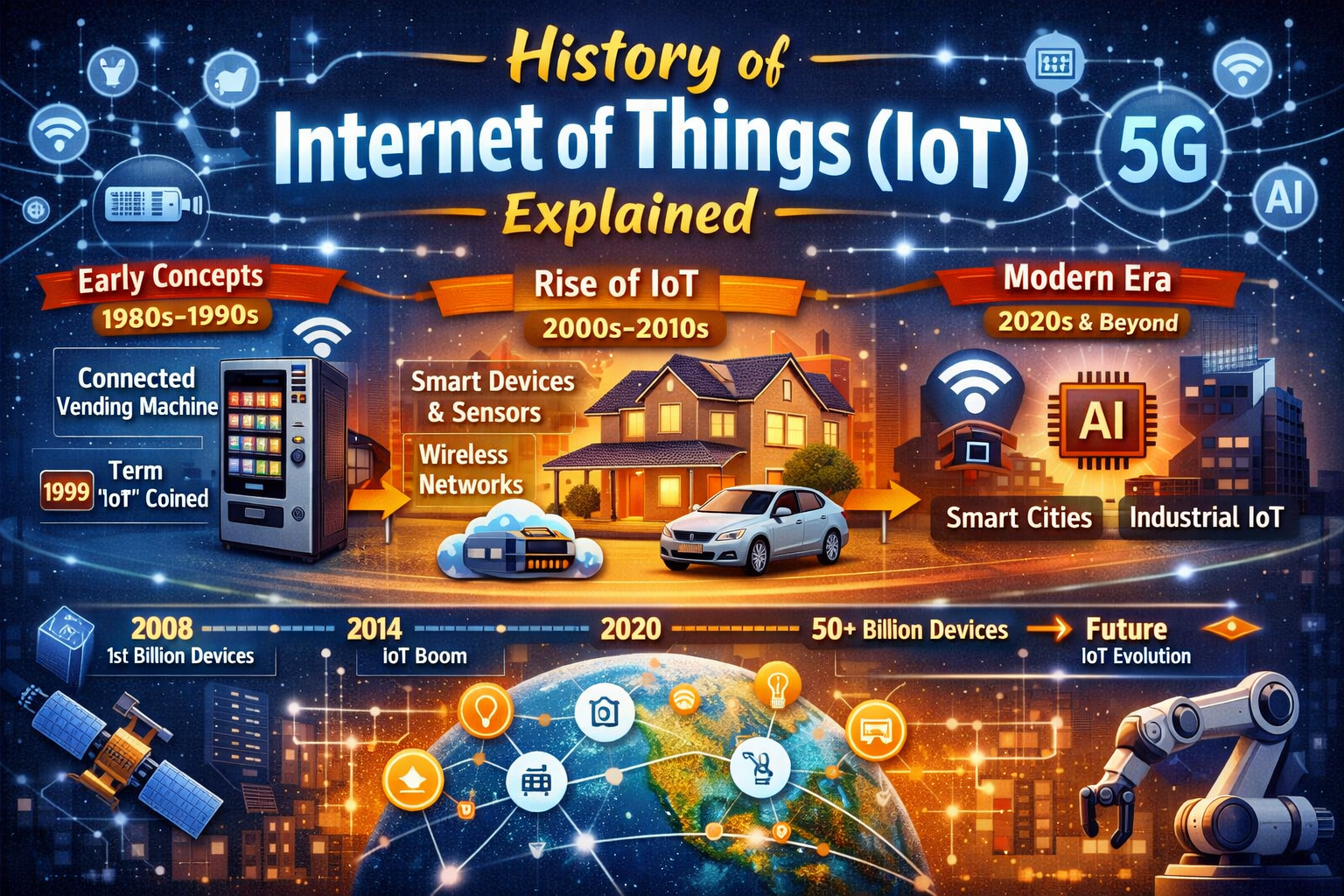
Introduction to IoT History
The evolution of IoT started from basic networking ideas and grew into a powerful technology connecting billions of devices worldwide. The key stages of IoT development, innovations, and milestones are explained in the list of IoT history phases given below.
1. Early Foundations of IoT (Pre-Internet Era)
This phase explains the basic concept of connecting machines before the internet became common, focusing on automation and communication systems.
- Machine-to-Machine Communication (M2M): Early systems allowed machines to communicate without human involvement, mainly in industries
- SCADA Systems: Supervisory Control and Data Acquisition systems were used to monitor industrial processes remotely
- Embedded Systems Development: Small computing devices were built into machines for automation
- Limited Connectivity: Communication was mostly through wired networks with restricted functionality
2. Birth of the Internet (1960s–1980s)
This phase highlights how the invention of the internet created the foundation for IoT by enabling global communication between devices.
- ARPANET Development: The first network that allowed computers to communicate over long distances
- TCP/IP Protocols: Standard communication rules that enabled devices to connect and share data
- Expansion of Networking: More institutions and systems started connecting to networks
- Digital Communication Growth: Enabled faster and more reliable data exchange
3. Emergence of IoT Concept (1990s)
This stage explains how the idea of IoT was introduced and how devices started connecting to the internet.
- First Internet-Connected Device: A Coca-Cola vending machine at Carnegie Mellon University reported inventory and temperature
- Term “Internet of Things”: Coined by Kevin Ashton in 1999 to describe connected objects
- RFID Technology: Used for tracking objects and enabling automatic identification
- Smart Devices Beginning: Early experiments in connecting household devices
4. IoT Development in Early 2000s
This phase shows how IoT started growing with better connectivity, hardware, and software technologies.
- Improved Internet Access: Broadband internet made connections faster and more stable
- Wireless Technologies: Wi-Fi and Bluetooth enabled device connectivity without cables
- Cloud Computing Emergence: Allowed storage and processing of large IoT data
- Mobile Technology Growth: Smartphones helped control IoT devices remotely
5. Rapid Growth of IoT (2010–2020)
This period marks the expansion of IoT into real-world applications with smart devices becoming common.
- Smart Home Devices: Smart thermostats, lights, and security systems became popular
- Wearable Technology: Devices like fitness trackers and smartwatches emerged
- Industrial IoT (IIoT): Automation and monitoring in industries improved efficiency
- Big Data and Analytics: IoT data started being analyzed for better decision-making
6. Modern IoT Era (2020–Present)
This phase explains how IoT has become more intelligent, scalable, and widely used across industries.
- Artificial Intelligence Integration: IoT devices now use AI for smart decision-making
- Edge Computing: Data processing happens closer to devices for faster response
- 5G Technology: Enables faster communication and supports massive device connectivity
- Smart Cities Development: IoT is used in traffic control, energy management, and public services
Key Milestones in IoT History
Important milestones in IoT development show how technology evolved step by step from simple networks to smart ecosystems, with key events listed below.
1. 1982 – First Smart Device
This milestone marks the creation of the first internet-connected vending machine that could report its status remotely.
- Coca-Cola Machine: Located at Carnegie Mellon University
- Real-Time Monitoring: Provided information about drink availability and temperature
- Innovation Start: Considered the first example of IoT
2. 1999 – IoT Term Introduction
This milestone highlights the origin of the term “Internet of Things,” which defined the concept of connected devices.
- Kevin Ashton Contribution: Introduced the term while working on RFID projects
- Concept Definition: Focused on connecting physical objects to the internet
- Industry Awareness: Increased interest in smart technologies
3. 2005 – IoT Recognition by ITU
This milestone shows how IoT gained global recognition as an important technology.
- ITU Report: International Telecommunication Union published a report on IoT
- Global Importance: Recognized IoT as a future technology
- Standardization Efforts: Encouraged development of IoT standards
4. 2010 – IoT Expansion
This milestone explains how IoT started growing rapidly with technological advancements.
- Increase in Connected Devices: More devices connected than humans
- Cloud Platforms: Enabled scalable IoT solutions
- Commercial Applications: Businesses started adopting IoT
5. 2020 and Beyond – Intelligent IoT
This milestone represents the modern phase where IoT integrates advanced technologies.
- AI and Machine Learning: Improve automation and decision-making
- Massive Connectivity: Billions of devices connected globally
- Smart Ecosystems: Integration of IoT in daily life and industries
Evolution of IoT Technologies
The evolution of IoT technologies explains how different innovations contributed to the development of IoT systems, with major technologies listed below.
1. Communication Technologies
This section explains how networking technologies enabled IoT connectivity and data exchange.
- Wi-Fi: Provides wireless internet connectivity
- Bluetooth: Enables short-range communication
- Zigbee and LoRaWAN: Used for low-power IoT devices
- 5G Networks: Support high-speed and large-scale IoT deployment
2. Sensor and Device Technologies
This section explains how sensors and smart devices collect and process data in IoT systems.
- Sensors: Detect temperature, motion, humidity, and other data
- Actuators: Perform actions based on received data
- Microcontrollers: Control device operations
- Smart Devices: Combine hardware and software for automation
3. Cloud and Data Processing
This section explains how cloud computing plays a key role in storing and processing IoT data.
- Cloud Storage: Stores large amounts of IoT data
- Data Analytics: Helps in decision-making
- Scalability: Supports growing number of devices
- Remote Access: Allows users to control devices from anywhere
4. Security Technologies
This section explains how IoT systems are protected from threats and unauthorized access.
- Encryption: Secures data transmission
- Authentication: Ensures authorized access
- Firewalls: Protect networks from attacks
- Monitoring Systems: Detect unusual activities
IoT Timeline Overview
| Year/Period | Development Stage | Key Contribution |
|---|---|---|
| Pre-1960s | Early Automation | Machine communication and control systems |
| 1960s–1980s | Internet Foundation | ARPANET and TCP/IP protocols |
| 1990s | IoT Concept | RFID and connected devices idea |
| 2000s | Growth Phase | Wireless tech and cloud computing |
| 2010–2020 | Expansion | Smart devices and industrial IoT |
| 2020–Present | Modern IoT | AI, 5G, and smart ecosystems |
Importance of Understanding IoT History
Understanding the history of IoT helps students learn how technology evolved and how modern systems are built, with key benefits listed below.
1. Understanding Technology Evolution
This explains how IoT developed step by step from simple systems to advanced smart environments.
- Concept Clarity: Helps understand how IoT works today
- Learning Foundation: Builds strong technical knowledge
- Innovation Awareness: Shows how technologies evolve
2. Identifying Trends and Future Scope
This explains how past developments help predict future IoT trends and innovations.
- Future Predictions: Understand upcoming technologies
- Career Opportunities: Identify skills needed in IoT field
- Technology Growth: Track advancements over time
3. Real-World Application Awareness
This explains how IoT history connects to real-life applications and systems.
- Smart Homes: Automation and remote control systems
- Healthcare: Remote patient monitoring
- Smart Cities: Traffic and energy management
- Industries: Automation and predictive maintenance
Conclusion
The history of Internet of Things (IoT) shows a clear journey from simple machine communication to advanced intelligent systems. By understanding its evolution, students can better grasp how IoT works today and how it will shape the future of technology.