








Future Scope of Internet of Things (IoT)
The future scope of Internet of Things (IoT) is rapidly expanding as connected devices transform industries, businesses, and daily life. IoT is shaping a smarter, automated, and data-driven world with endless growth opportunities.
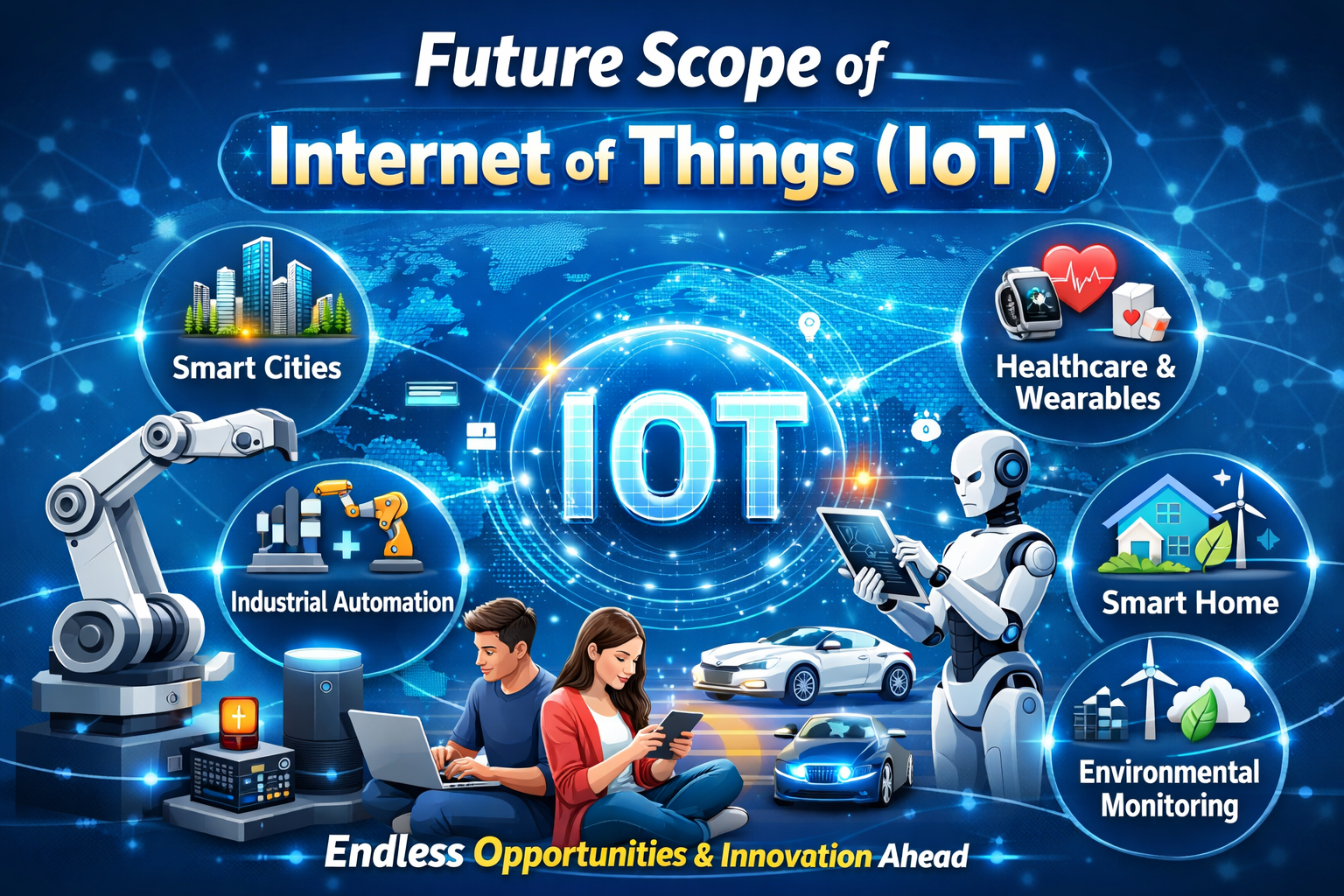
Introduction to Future Scope of IoT
The future scope of IoT focuses on how connected devices, sensors, and intelligent systems will evolve to improve efficiency and decision-making. It highlights upcoming trends, innovations, and real-world impacts across different sectors, list of future possibilities of IoT are given below.
1. Growth of Smart Cities
Smart cities are one of the biggest future applications of IoT, where technology improves urban living through automation and data insights.
- Traffic Management: Smart traffic lights reduce congestion and improve flow
- Smart Lighting: Automated street lights save energy and cost
- Waste Management: IoT-enabled bins optimize garbage collection
- Public Safety: Surveillance systems enhance city security
2. Expansion in Healthcare Sector
IoT will revolutionize healthcare by enabling real-time monitoring and remote treatment solutions.
- Remote Patient Monitoring: Wearable devices track health data continuously
- Smart Medical Devices: Connected equipment improves diagnosis accuracy
- Telemedicine Growth: Patients consult doctors online easily
- Emergency Alerts: Devices notify doctors instantly during critical conditions
3. Industrial Automation and IIoT
Industrial IoT (IIoT) will drive automation and efficiency in manufacturing and production systems.
- Predictive Maintenance: Machines detect faults before failure
- Automation Systems: Reduced human intervention increases productivity
- Supply Chain Optimization: Real-time tracking improves logistics
- Energy Efficiency: Smart systems reduce power consumption
4. Smart Homes and Lifestyle Automation
IoT will continue to transform homes into intelligent living spaces with advanced automation features.
- Smart Appliances: Devices operate automatically based on user behavior
- Home Security Systems: Cameras and sensors enhance protection
- Voice Control: Assistants manage home devices easily
- Energy Management: Smart meters reduce electricity usage
5. Agriculture and Smart Farming
IoT will play a major role in improving agricultural productivity and sustainability.
- Soil Monitoring: Sensors track moisture and nutrient levels
- Automated Irrigation: Water usage is optimized based on data
- Crop Monitoring: Drones and sensors analyze crop health
- Livestock Tracking: Farmers monitor animal health and location
Key Technologies Driving IoT Future
The future of IoT depends on advanced technologies that enhance connectivity, intelligence, and performance. These technologies support faster data processing and smarter decision-making, list of key technologies are given below.
1. Artificial Intelligence (AI) Integration
AI enhances IoT systems by enabling smart data analysis and automation.
- Data Analytics: AI processes large IoT data efficiently
- Automation: Systems make decisions without human input
- Predictive Insights: AI predicts future trends and outcomes
- Improved Accuracy: Reduces errors in decision-making
2. 5G Connectivity
5G technology will boost IoT performance by providing faster and more reliable communication.
- High Speed: Faster data transmission improves real-time applications
- Low Latency: Immediate response in critical systems
- Massive Connectivity: Supports millions of connected devices
- Better Reliability: Stable connections for IoT networks
3. Edge Computing
Edge computing processes data closer to the source, reducing delay and improving efficiency.
- Real-Time Processing: Faster decision-making at device level
- Reduced Bandwidth: Less data sent to cloud servers
- Improved Security: Local processing reduces data exposure
- Better Performance: Minimizes latency issues
4. Cloud Computing Integration
Cloud platforms provide scalable infrastructure for IoT data storage and processing.
- Data Storage: Handles large volumes of IoT data
- Remote Access: Access data from anywhere
- Scalability: Easily increase system capacity
- Cost Efficiency: Pay-as-you-go model reduces costs
Future Career Opportunities in IoT
The future scope of IoT also includes a wide range of career opportunities as demand for skilled professionals increases. These roles focus on designing, developing, and managing IoT systems, list of career options are given below.
1. IoT Developer
IoT developers design and build applications for connected devices.
- Device Programming: Develop software for IoT hardware
- Integration: Connect devices with cloud platforms
- Testing: Ensure system reliability and performance
- Maintenance: Update and improve IoT systems
2. IoT Data Analyst
Data analysts interpret IoT data to generate meaningful insights.
- Data Processing: Analyze sensor-generated data
- Visualization: Present data in understandable formats
- Decision Support: Help organizations make data-driven decisions
- Trend Analysis: Identify patterns and future trends
3. IoT Security Specialist
Security experts protect IoT systems from cyber threats and vulnerabilities.
- Risk Assessment: Identify potential security issues
- Encryption: Secure data transmission
- Monitoring: Detect suspicious activities
- Compliance: Ensure security standards are followed
4. IoT System Architect
Architects design the overall structure of IoT systems and networks.
- System Design: Plan IoT architecture
- Technology Selection: Choose appropriate tools and platforms
- Scalability Planning: Ensure system growth capability
- Performance Optimization: Improve system efficiency
Benefits of IoT in the Future
The future scope of IoT offers numerous benefits that improve efficiency, productivity, and quality of life. These benefits show how IoT will impact various industries, list of advantages are given below.
1. Improved Efficiency
IoT automates processes and reduces manual effort, increasing operational efficiency.
- Automation: Reduces human intervention
- Time Saving: Faster task completion
- Resource Optimization: Efficient use of resources
- Reduced Errors: Minimizes human mistakes
2. Cost Reduction
IoT helps organizations reduce costs through better resource management and automation.
- Energy Savings: Smart systems reduce electricity consumption
- Maintenance Reduction: Predictive maintenance lowers repair costs
- Operational Efficiency: Less waste and better productivity
- Optimized Processes: Streamlined workflows
3. Better Decision Making
IoT provides real-time data that supports smarter and faster decision-making.
- Real-Time Insights: Immediate access to data
- Data-Driven Decisions: Accurate and reliable outcomes
- Forecasting: Predict future trends
- Performance Monitoring: Track system performance
4. Enhanced User Experience
IoT improves user experience by offering convenience and personalized services.
- Personalization: Systems adapt to user preferences
- Convenience: Easy control of devices
- Accessibility: Access services anytime, anywhere
- Improved Comfort: Better living and working environments
Challenges Affecting the Future Scope of IoT
Despite its growth, IoT faces several challenges that must be addressed to ensure successful implementation. Understanding these challenges helps in developing better solutions, list of challenges are given below.
1. Security and Privacy Issues
Security is a major concern due to the large number of connected devices.
- Data Breaches: Risk of unauthorized access
- Weak Authentication: Poor security mechanisms
- Privacy Concerns: Sensitive data exposure
- Cyber Attacks: Increased attack surface
2. Data Management Complexity
Managing large volumes of IoT data is a significant challenge.
- Big Data Handling: Massive data generation
- Storage Issues: Need for scalable storage solutions
- Data Processing: Complex data analysis requirements
- Data Accuracy: Ensuring data reliability
3. Interoperability Problems
Different devices and platforms often lack compatibility.
- Standardization Issues: Lack of common standards
- Device Compatibility: Difficulty in integration
- Vendor Lock-In: Dependence on specific providers
- System Integration: Complex connectivity
4. High Implementation Cost
Initial setup and maintenance of IoT systems can be expensive.
- Infrastructure Cost: High cost of devices and sensors
- Maintenance Expenses: Regular system updates required
- Training Cost: Skilled professionals needed
- Technology Investment: Continuous upgrades required
Future Scope of IoT: Summary Table
The future of IoT can be summarized by its key areas of growth, technologies, and impacts.
| Area | Future Impact | Key Benefits |
|---|---|---|
| Smart Cities | Improved urban management | Efficiency, sustainability |
| Healthcare | Remote monitoring & smart devices | Better patient care |
| Industry (IIoT) | Automation and predictive systems | Higher productivity |
| Agriculture | Smart farming techniques | Increased crop yield |
| Smart Homes | Automated living environments | Comfort and convenience |
| AI & 5G | Faster and smarter systems | Real-time performance |
Conclusion
The future scope of Internet of Things (IoT) is vast and continuously growing, with strong potential across industries like healthcare, agriculture, smart cities, and industrial automation. As technologies like AI, 5G, and cloud computing evolve, IoT will become more intelligent, efficient, and essential in shaping a connected and smarter world.