











Advantages and Disadvantages of IoT
The Internet of Things (IoT) is transforming modern technology by connecting smart devices, enabling automation, and improving decision-making. Understanding the advantages and disadvantages of IoT helps students and professionals evaluate its real-world impact and future potential.
What is IoT and Why It Matters
IoT refers to a network of connected devices that collect, share, and analyze data to automate processes and improve efficiency. It plays a critical role in industries like healthcare, agriculture, smart homes, and industrial automation.
The key aspects of IoT importance are explained in the list of advantages and disadvantages given below.
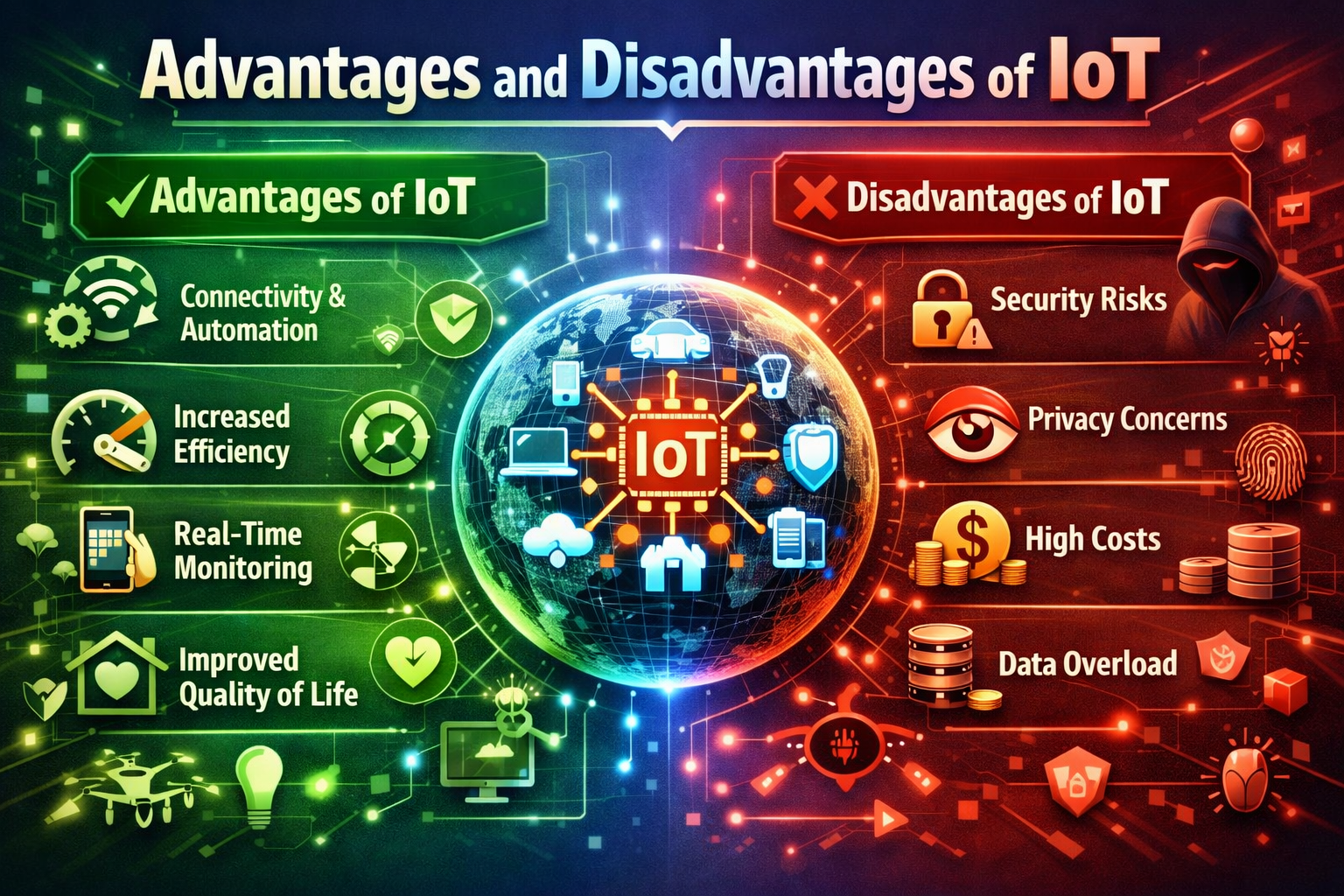
Advantages of IoT
IoT offers numerous benefits that improve efficiency, automation, and user experience across various domains. The major advantages of IoT are explained in the list of key benefits given below.
1. Improved Efficiency and Automation
IoT systems automate tasks and reduce human effort by enabling smart devices to operate independently.
- Automated Operations: Devices perform tasks without manual intervention
- Time Saving: Reduces time required for repetitive tasks
- Smart Decision-Making: Systems respond based on real-time data
- Example: Smart thermostats adjust temperature automatically
2. Real-Time Data Monitoring and Analysis
IoT allows continuous monitoring of systems and environments through sensors and connected devices.
- Live Data Collection: Sensors gather real-time information
- Instant Insights: Quick decision-making based on current data
- Better Control: Monitor systems remotely
- Example: Health monitoring devices track patient vitals
3. Cost Reduction and Resource Optimization
IoT helps in reducing operational costs by optimizing resource usage and minimizing waste.
- Energy Efficiency: Smart devices reduce energy consumption
- Reduced Maintenance: Predictive maintenance avoids costly repairs
- Optimized Resources: Efficient use of materials and equipment
- Example: Smart lighting systems reduce electricity bills
4. Enhanced Connectivity and Communication
IoT enables seamless communication between devices, systems, and users across the globe.
- Device Integration: Connect multiple devices in one system
- Remote Access: Control devices from anywhere
- Cloud Connectivity: Store and process data online
- Example: Smart home systems controlled via mobile apps
5. Improved Quality of Life
IoT improves daily life by providing convenience, safety, and better services.
- Smart Homes: Automated lighting, security, and appliances
- Healthcare Support: Remote patient monitoring
- Safety Features: Alerts and emergency notifications
- Example: Wearable fitness trackers improve health awareness
6. Better Decision Making
IoT systems provide accurate and data-driven insights that support informed decision-making.
- Data-Driven Decisions: Analyze large amounts of data
- Predictive Analytics: Forecast future trends
- Business Intelligence: Improve operational strategies
- Example: Smart agriculture uses data to improve crop yield
7. Scalability and Flexibility
IoT systems can easily expand and adapt to changing requirements.
- Easy Expansion: Add more devices without major changes
- Flexible Systems: Adapt to different environments
- Cloud Support: Scalable infrastructure
- Example: Businesses scale IoT systems as they grow
Disadvantages of IoT
Despite its benefits, IoT also introduces challenges related to security, privacy, and complexity. The major disadvantages of IoT are explained in the list of key limitations given below.
1. Security Risks and Cyber Threats
IoT devices are vulnerable to hacking and cyberattacks due to weak security measures.
- Data Breaches: Unauthorized access to sensitive data
- Device Hacking: Control of devices by attackers
- Weak Encryption: Many devices lack strong security
- Example: Smart cameras being hacked
2. Privacy Concerns
IoT devices collect large amounts of personal data, raising privacy issues.
- Personal Data Exposure: Sensitive information can be leaked
- Tracking Risks: Continuous monitoring of users
- Lack of Control: Users may not know how data is used
- Example: Smart assistants recording conversations
3. High Implementation Cost
Setting up IoT infrastructure can be expensive for individuals and organizations.
- Device Cost: Smart devices are often costly
- Installation Expense: Setup and integration require investment
- Maintenance Cost: Ongoing system management
- Example: Smart city infrastructure requires huge investment
4. Complexity and Integration Challenges
IoT systems can be complex due to the involvement of multiple devices and technologies.
- System Integration Issues: Compatibility between devices
- Technical Complexity: Requires skilled professionals
- Difficult Management: Handling large-scale IoT networks
- Example: Integrating different smart devices in a factory
5. Dependence on Internet Connectivity
IoT systems rely heavily on stable internet connections for proper functioning.
- Network Dependency: Devices stop working without internet
- Latency Issues: Delays in communication
- Limited Access: Poor connectivity affects performance
- Example: Smart home devices fail during internet outage
6. Data Overload and Management Issues
IoT generates huge volumes of data that can be difficult to manage and analyze.
- Big Data Challenges: Handling massive data streams
- Storage Issues: Requires large storage systems
- Processing Complexity: Need for advanced analytics tools
- Example: Industrial IoT generates continuous machine data
7. Lack of Standardization
IoT lacks universal standards, leading to compatibility and interoperability issues.
- Different Protocols: Devices use different communication methods
- Vendor Lock-In: Dependence on specific providers
- Limited Compatibility: Devices may not work together
- Example: Smart devices from different brands may not connect
Comparison Table: Advantages vs Disadvantages of IoT
| Aspect | Advantages of IoT | Disadvantages of IoT |
|---|---|---|
| Efficiency | Automation and time saving | Complexity in system management |
| Data Usage | Real-time insights and analytics | Data overload and processing issues |
| Cost | Long-term savings | High initial investment |
| Connectivity | Remote access and integration | Internet dependency |
| Security | Improved monitoring systems | Security risks and cyber threats |
| Scalability | Easy expansion and flexibility | Lack of standardization |
Real-World Examples of IoT Advantages and Disadvantages
Real-world applications of IoT clearly show both its benefits and challenges in practical scenarios.
1. Smart Homes
Smart home systems provide automation but also raise privacy and security concerns.
- Advantage: Convenience and energy efficiency
- Disadvantage: Risk of hacking and data privacy issues
2. Healthcare Systems
IoT improves patient care but involves sensitive data handling challenges.
- Advantage: Remote monitoring and quick diagnosis
- Disadvantage: Data security and privacy risks
3. Industrial IoT (IIoT)
IoT enhances industrial productivity but requires complex system management.
- Advantage: Predictive maintenance and efficiency
- Disadvantage: High implementation cost and complexity
4. Smart Cities
IoT improves urban living but requires significant infrastructure investment.
- Advantage: Traffic management and energy optimization
- Disadvantage: High cost and data management challenges
Conclusion
The advantages and disadvantages of IoT highlight both its transformative potential and its challenges. While IoT improves efficiency, automation, and decision-making, it also introduces risks such as security issues, privacy concerns, and system complexity. Understanding these aspects helps students and professionals use IoT effectively while addressing its limitations.