










Industrial Revolution and IoT Development (Industry 4.0)
The Industrial Revolution and IoT Development, also known as Industry 4.0, represent a major transformation in how industries operate using smart technologies. It combines automation, data exchange, and intelligent systems to improve efficiency, productivity, and innovation.
Evolution of Industrial Revolutions
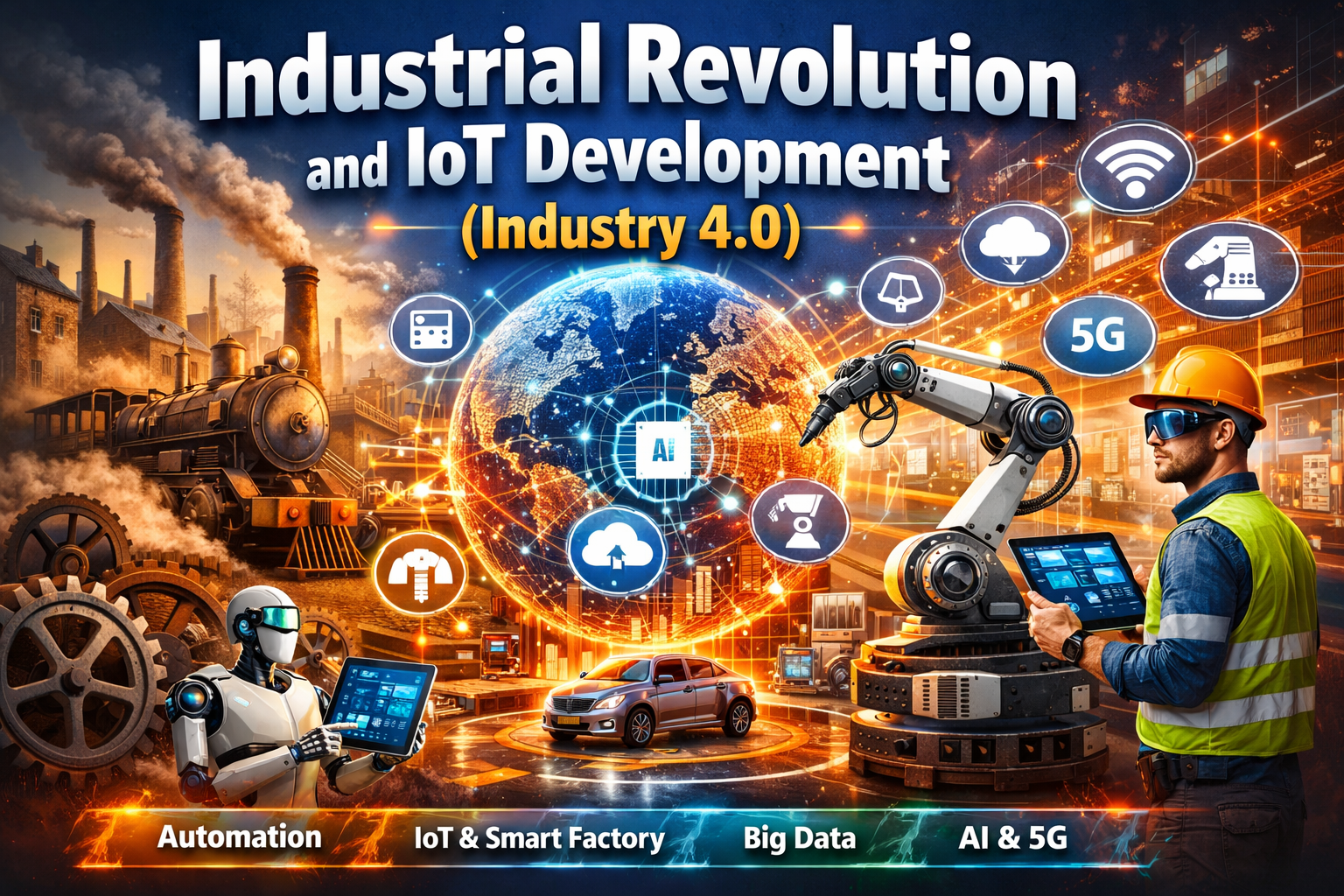
The journey from manual production to intelligent automation defines the evolution of industrial revolutions. Below is the list of key industrial revolutions that led to Industry 4.0.
1. First Industrial Revolution (Industry 1.0)
This revolution introduced mechanical production powered by water and steam engines, transforming agriculture-based economies into industrial ones.
- Steam Power: Enabled machines to operate faster than human labor
- Textile Industry Growth: Automated weaving and spinning processes
- Shift to Factories: Production moved from homes to centralized factories
- Transportation Development: Railways and steamships improved trade
2. Second Industrial Revolution (Industry 2.0)
Industry 2.0 introduced electricity and mass production, making manufacturing more efficient and scalable.
- Electric Power: Replaced steam engines for better efficiency
- Assembly Lines: Enabled mass production of goods
- Steel and Chemical Industries: Expanded industrial capabilities
- Communication Advances: Telegraph and telephone improved connectivity
3. Third Industrial Revolution (Industry 3.0)
Also known as the digital revolution, it introduced electronics, computers, and automation in industries.
- Computers and IT Systems: Enabled digital control of machines
- Automation: Use of programmable logic controllers (PLCs)
- Internet Introduction: Improved communication and data exchange
- Robotics: Increased precision and reduced human effort
4. Fourth Industrial Revolution (Industry 4.0)
Industry 4.0 focuses on smart systems where machines communicate and make decisions using IoT and AI technologies.
- Smart Factories: Fully automated and interconnected systems
- IoT Integration: Devices communicate in real time
- Artificial Intelligence: Machines analyze data and optimize processes
- Big Data Analytics: Data-driven decision-making
- Cyber-Physical Systems: Integration of physical and digital systems
What is Industry 4.0?
Industry 4.0 refers to the integration of IoT, AI, cloud computing, and automation into industrial processes. Below is the list of core aspects of Industry 4.0.
- Interconnectivity: Machines, sensors, and systems communicate seamlessly
- Automation: Reduced human intervention through intelligent machines
- Real-Time Data: Continuous monitoring and analysis of operations
- Smart Decision-Making: Systems make autonomous decisions
- Efficiency and Productivity: Optimized resource utilization
Role of IoT in Industry 4.0
IoT plays a central role in enabling smart communication between devices and systems in Industry 4.0. Below is the list of key roles of IoT in industrial development.
1. Machine-to-Machine Communication (M2M)
M2M allows devices to communicate directly without human involvement, improving automation and efficiency.
- Real-Time Communication: Machines share data instantly
- Reduced Human Errors: Automated interactions minimize mistakes
- Faster Decision-Making: Immediate response to system changes
- Operational Efficiency: Smooth workflow without interruptions
2. Smart Manufacturing
IoT enables smart manufacturing where production systems are connected and self-optimized.
- Automated Production Lines: Machines adjust based on demand
- Predictive Maintenance: Sensors detect issues before failures
- Quality Control: Real-time monitoring ensures product quality
- Flexible Manufacturing: Quick adaptation to market needs
3. Data Collection and Analysis
IoT devices collect massive amounts of data, which is analyzed for better decision-making.
- Sensors and Devices: Capture temperature, pressure, and usage data
- Cloud Integration: Store and process large datasets
- Analytics Tools: Identify patterns and trends
- Performance Optimization: Improve system efficiency
4. Remote Monitoring and Control
IoT allows industries to monitor and control operations from anywhere in the world.
- Remote Access: Control machines via internet
- Real-Time Alerts: Immediate notifications for issues
- Reduced Downtime: Quick response to problems
- Global Operations: Manage multiple factories centrally
Key Technologies Behind Industry 4.0
Industry 4.0 is powered by multiple advanced technologies working together. Below is the list of important technologies driving this transformation.
1. Internet of Things (IoT)
IoT connects devices and systems, enabling communication and data exchange in real time.
- Connected Devices: Sensors and smart machines
- Data Sharing: Seamless communication across systems
- Automation Support: Enables intelligent processes
- Real-Time Insights: Immediate access to data
2. Artificial Intelligence (AI)
AI helps machines learn from data and make intelligent decisions without human intervention.
- Machine Learning: Systems improve over time
- Predictive Analysis: Forecast future trends
- Automation Intelligence: Smart decision-making
- Process Optimization: Enhance efficiency
3. Cloud Computing
Cloud computing provides storage, computing power, and services over the internet.
- Scalable Resources: Easily adjust computing power
- Data Storage: Secure and accessible data management
- Remote Access: Access systems from anywhere
- Cost Efficiency: Pay only for used resources
4. Big Data and Analytics
Big Data helps industries process and analyze large volumes of data for insights.
- Data Processing: Handle massive datasets
- Insights Generation: Identify patterns and trends
- Decision Support: Data-driven strategies
- Performance Monitoring: Continuous improvement
5. Cyber-Physical Systems (CPS)
CPS integrates physical machines with digital systems for intelligent operations.
- Real-Time Interaction: Physical and digital systems communicate
- Automation: Reduced manual control
- System Integration: Seamless operation across platforms
- Smart Control Systems: Autonomous functioning
Comparison of Industrial Revolutions
The following table shows a comparison of different industrial revolutions for better understanding.
| Industrial Revolution | Key Technology | Main Feature | Impact |
|---|---|---|---|
| Industry 1.0 | Steam Power | Mechanization | Increased production |
| Industry 2.0 | Electricity | Mass Production | Faster manufacturing |
| Industry 3.0 | Computers | Automation | Reduced human effort |
| Industry 4.0 | IoT & AI | Smart Systems | Intelligent industries |
Benefits of Industry 4.0 and IoT
Industry 4.0 offers multiple advantages by combining IoT and advanced technologies. Below is the list of major benefits.
- Improved Efficiency: Automated processes reduce time and effort
- Cost Reduction: Optimized resource usage lowers expenses
- Better Decision-Making: Data-driven insights improve outcomes
- Increased Productivity: Faster and smarter operations
- Enhanced Quality: Continuous monitoring ensures better products
- Flexibility: Systems adapt to changing demands
- Global Connectivity: Connect operations worldwide
Challenges in Industry 4.0 Implementation
Despite its benefits, Industry 4.0 faces several challenges that industries must address. Below is the list of common challenges.
1. Security and Privacy Issues
As systems become interconnected, the risk of cyber threats increases significantly.
- Data Breaches: Sensitive information may be exposed
- Cyber Attacks: Systems can be targeted by hackers
- Network Vulnerabilities: Weak security points in connected devices
- Privacy Concerns: Protection of user and business data
2. High Implementation Cost
Adopting Industry 4.0 technologies requires significant investment.
- Infrastructure Setup: Cost of hardware and software
- Technology Integration: Combining new and old systems
- Maintenance Costs: Ongoing expenses for system management
- Training Costs: Educating workforce
3. Skill Gap in Workforce
Industries require skilled professionals to manage advanced technologies.
- Technical Knowledge: Need for expertise in IoT and AI
- Training Requirements: Continuous learning needed
- Workforce Transition: Shift from manual to technical roles
- Talent Shortage: Limited availability of skilled professionals
4. Integration Complexity
Integrating different technologies and systems can be challenging.
- Compatibility Issues: Old systems may not support new technologies
- Data Integration: Combining data from multiple sources
- System Coordination: Managing interconnected systems
- Operational Disruption: Changes in workflow
Real-World Examples of Industry 4.0
Industry 4.0 is already transforming various industries across the world. Below is the list of real-world applications.
- Smart Factories: Automated manufacturing with IoT-enabled machines
- Healthcare Systems: Remote patient monitoring using IoT devices
- Smart Agriculture: Sensors for soil monitoring and irrigation control
- Logistics and Supply Chain: Real-time tracking of goods
- Energy Management: Smart grids for efficient power distribution
Future of Industry 4.0 and IoT
The future of Industry 4.0 and IoT is highly promising as technologies continue to evolve and integrate.
- Advanced Automation: Fully autonomous systems
- AI Integration: Smarter and more predictive systems
- Edge Computing: Faster data processing near devices
- 5G Connectivity: High-speed communication
- Sustainable Solutions: Energy-efficient and eco-friendly systems
Conclusion
Industry 4.0 represents the next phase of industrial evolution, driven by IoT, AI, and smart technologies. It is transforming industries into intelligent systems that are more efficient, connected, and responsive. Understanding its concepts, benefits, and challenges helps students and professionals prepare for the future of digital transformation.