









Evolution of Sensors and IoT Hardware Devices
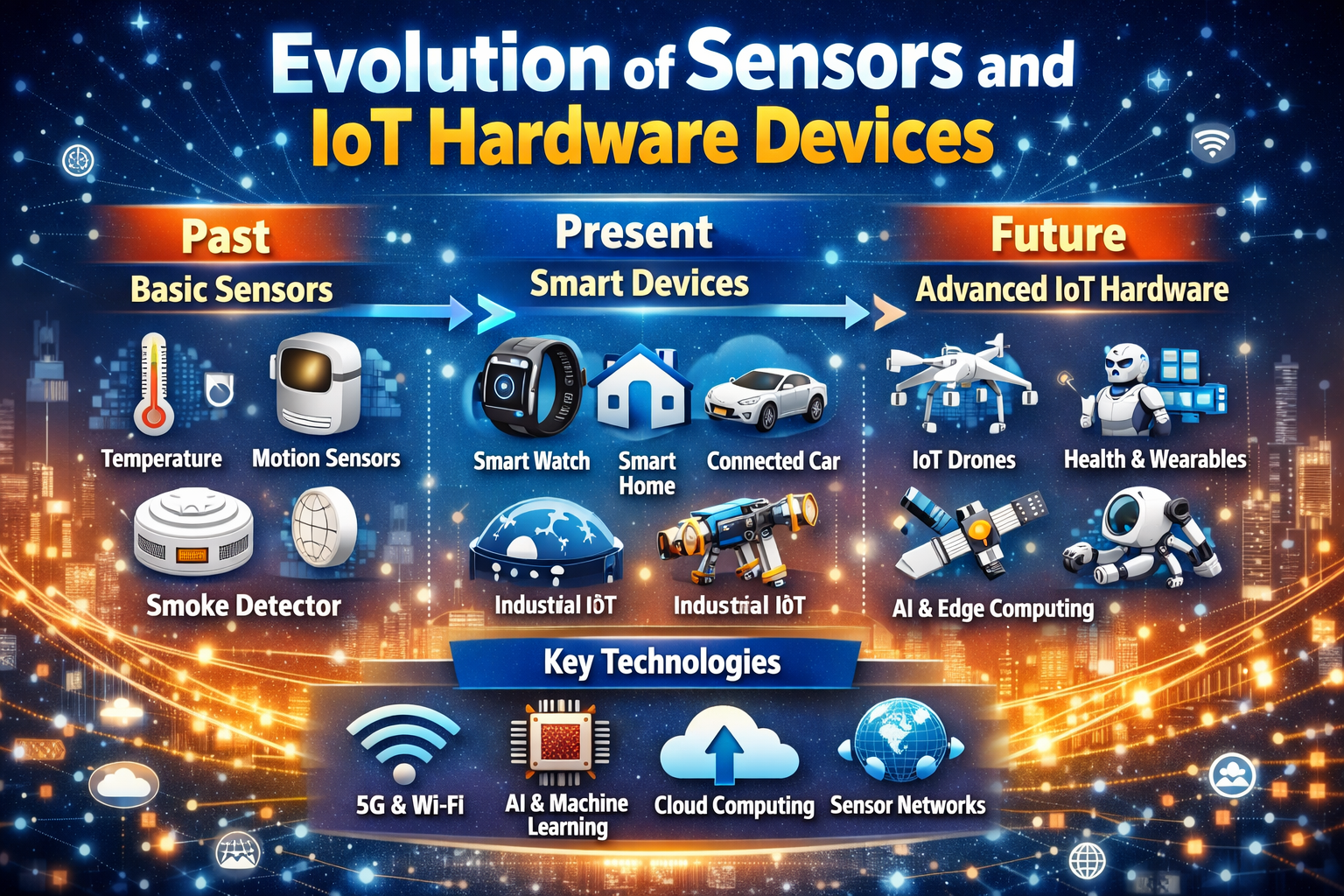
The evolution of sensors and IoT hardware devices has transformed modern technology by enabling smart systems, automation, and real-time data processing. Understanding this evolution helps students grasp how IoT systems work and how devices have become smarter over time.
Introduction to Sensors and IoT Hardware Devices
Sensors and IoT hardware devices are the foundation of IoT systems, enabling communication between the physical and digital worlds. This section explains the core concepts and components, list of key elements is given below.
1. What Are Sensors in IoT?
Sensors are devices that detect physical or environmental changes and convert them into digital signals for processing in IoT systems.
They act as the primary data source for smart devices and applications.
- Data Collection: Sensors capture real-world data like temperature, humidity, and motion
- Signal Conversion: Convert physical signals into electrical signals
- Real-Time Monitoring: Enable continuous tracking of environmental conditions
- Automation Support: Help trigger automatic actions in IoT systems
2. What Are IoT Hardware Devices?
IoT hardware devices are physical components that include sensors, actuators, processors, and communication modules.
They work together to collect, process, and transmit data across networks.
- Embedded Systems: Small computing units integrated into devices
- Connectivity Modules: Wi-Fi, Bluetooth, Zigbee for communication
- Processing Units: Microcontrollers and microprocessors
- Actuators: Perform actions based on sensor data
Historical Evolution of Sensors and IoT Hardware
The development of sensors and IoT hardware has evolved from simple mechanical devices to advanced smart systems. This section covers the timeline and major technological shifts, list of stages is given below.
1. Early Mechanical Sensors
Early sensors were simple mechanical devices used to measure physical properties without digital processing.
These devices were limited in functionality and accuracy.
- Examples: Thermometers, pressure gauges
- Manual Operation: Required human interaction
- Low Accuracy: Limited precision and response time
- No Connectivity: Could not transmit data
2. Analog Electronic Sensors
Analog sensors introduced electrical signals for measuring physical parameters, improving accuracy and usability.
They laid the foundation for modern sensor technologies.
- Continuous Signals: Output in analog form
- Improved Accuracy: Better than mechanical sensors
- Basic Automation: Used in industrial control systems
- Limited Integration: Difficult to connect with digital systems
3. Digital Sensors Development
Digital sensors marked a major shift by providing output in digital form, making them easier to integrate with computers.
This stage enabled the growth of embedded systems.
- Digital Output: Easy processing and storage
- Higher Precision: More reliable data
- Integration: Compatible with microcontrollers
- Reduced Noise: Better signal quality
4. Smart Sensors Emergence
Smart sensors include processing capabilities and can analyze data locally before sending it to the cloud.
They support advanced IoT applications and automation.
- Built-in Processing: Perform local computations
- Self-Calibration: Adjust automatically for accuracy
- Energy Efficiency: Designed for low power usage
- Connectivity Support: Integrated communication features
5. IoT-Enabled Sensor Devices
Modern IoT sensors are connected devices capable of real-time communication and cloud integration.
They play a key role in smart homes, healthcare, and industries.
- Cloud Integration: Data stored and processed remotely
- Wireless Communication: Use internet-based protocols
- Scalability: Support large IoT networks
- Real-Time Analytics: Enable instant decision-making
Evolution of IoT Hardware Devices
IoT hardware devices have evolved alongside sensors, becoming more powerful, compact, and efficient. This section explains the major hardware advancements, list of developments is given below.
1. Microcontrollers and Embedded Systems
Microcontrollers became the core of IoT devices, enabling processing and control within small hardware units.
They are widely used in smart devices and automation systems.
- Compact Design: Small size with integrated functions
- Low Power Consumption: Ideal for IoT devices
- Real-Time Processing: Immediate response to inputs
- Examples: Arduino, ESP32
2. Development of Communication Modules
Communication technologies allow IoT devices to connect and exchange data over networks.
These modules enable seamless connectivity across devices.
- Wireless Technologies: Wi-Fi, Bluetooth, Zigbee, LoRa
- Long-Range Communication: Suitable for IoT networks
- Interoperability: Devices communicate across platforms
- Secure Transmission: Encryption and authentication
3. Integration of Edge Computing Hardware
Edge computing hardware allows data processing near the data source instead of sending everything to the cloud.
This reduces latency and improves system performance.
- Low Latency: Faster response time
- Reduced Bandwidth Usage: Less data sent to cloud
- Local Decision Making: Quick actions without delay
- Enhanced Privacy: Sensitive data processed locally
4. Miniaturization of IoT Devices
Advancements in hardware design have led to smaller, more efficient IoT devices.
Miniaturization enables wearable devices and smart gadgets.
- Compact Size: Easy to deploy in various environments
- Portability: Used in wearable technology
- Cost Reduction: Cheaper manufacturing
- Energy Efficiency: Longer battery life
5. Integration of AI in IoT Hardware
Modern IoT hardware now includes AI capabilities, enabling intelligent decision-making within devices.
This combination is known as AIoT (Artificial Intelligence of Things).
- Smart Processing: Analyze data locally
- Predictive Analytics: Forecast future events
- Automation: Reduce human intervention
- Learning Capability: Improve performance over time
Comparison of Traditional vs Modern Sensors and IoT Hardware
Understanding the difference between traditional and modern devices helps students analyze technological advancements and real-world applications.
| Feature | Traditional Sensors/Devices | Modern IoT Sensors/Devices |
|---|---|---|
| Connectivity | No connectivity | Internet-enabled |
| Data Processing | Manual or limited | Real-time processing |
| Accuracy | Low to moderate | High precision |
| Size | Large and bulky | Compact and miniaturized |
| Power Usage | High | Energy-efficient |
| Automation | Minimal | Fully automated |
| Intelligence | None | AI-enabled |
Key Technologies Driving Evolution
The rapid evolution of sensors and IoT hardware devices is driven by multiple emerging technologies. This section highlights the key innovations, list of technologies is given below.
1. Wireless Communication Technologies
Wireless technologies have enabled seamless connectivity between IoT devices and cloud systems.
They play a critical role in IoT ecosystem growth.
- Wi-Fi and Bluetooth: Short-range communication
- LoRa and NB-IoT: Long-range, low-power communication
- 5G Technology: High-speed data transfer
- Global Connectivity: Supports smart cities and industries
2. Semiconductor Technology Advancements
Improved semiconductor design has made IoT devices faster, smaller, and more efficient.
This advancement supports large-scale IoT deployment.
- High Integration: Multiple functions on a single chip
- Low Power Chips: Extend device battery life
- Cost Efficiency: Affordable hardware production
- High Performance: Faster processing capabilities
3. Cloud Computing Integration
Cloud platforms enable storage, processing, and management of IoT data at scale.
They provide flexibility and scalability for IoT systems.
- Data Storage: Large-scale data handling
- Remote Access: Access data from anywhere
- Scalability: Handle millions of devices
- Analytics Tools: Advanced data insights
4. Artificial Intelligence and Machine Learning
AI and ML enhance IoT devices by enabling intelligent data analysis and decision-making.
They are essential for smart automation and predictive systems.
- Pattern Recognition: Identify trends in data
- Automation: Reduce manual intervention
- Predictive Maintenance: Prevent system failures
- Smart Applications: Enable intelligent systems
Real-World Applications of Evolved Sensors and IoT Hardware
Modern sensors and IoT hardware devices are widely used across industries to improve efficiency and automation. This section explores practical applications, list of examples is given below.
1. Smart Homes
Smart home devices use sensors and IoT hardware to automate daily tasks and improve convenience.
They enhance user comfort and energy efficiency.
- Smart Thermostats: Control temperature automatically
- Security Systems: Motion sensors and cameras
- Lighting Systems: Automated lighting control
- Voice Assistants: Smart device integration
2. Healthcare Systems
IoT sensors are used in healthcare for monitoring patients and improving medical services.
They enable remote healthcare and real-time monitoring.
- Wearable Devices: Track health parameters
- Remote Monitoring: Continuous patient tracking
- Emergency Alerts: Immediate response systems
- Data Analysis: Improve diagnosis
3. Industrial Automation (IIoT)
Industries use advanced sensors and IoT hardware for automation and efficiency.
This improves productivity and reduces operational costs.
- Predictive Maintenance: Monitor machine health
- Process Automation: Reduce manual work
- Quality Control: Detect defects in real-time
- Energy Management: Optimize resource usage
4. Smart Agriculture
IoT sensors help farmers monitor crops and optimize agricultural processes.
They improve productivity and reduce resource wastage.
- Soil Sensors: Monitor moisture and nutrients
- Weather Monitoring: Predict climate conditions
- Automated Irrigation: Smart watering systems
- Livestock Monitoring: Track animal health
Challenges in the Evolution of Sensors and IoT Hardware
Despite rapid advancements, there are several challenges in developing and deploying IoT hardware devices. This section explains the key issues, list of challenges is given below.
1. Power Consumption Issues
IoT devices require efficient power management to operate continuously in remote environments.
Battery limitations remain a major concern.
- Limited Battery Life: Frequent replacements needed
- Energy Efficiency: Need for low-power designs
- Renewable Solutions: Use of solar power
- Optimization Techniques: Reduce energy usage
2. Security and Privacy Concerns
Security is a major challenge due to the large number of connected devices.
Protecting data and devices is critical in IoT systems.
- Data Breaches: Risk of unauthorized access
- Weak Authentication: Vulnerabilities in devices
- Encryption Needs: Secure data transmission
- Device Protection: Prevent hacking
3. Interoperability Challenges
Different devices and platforms often struggle to work together seamlessly.
Standardization is required for better integration.
- Multiple Protocols: Compatibility issues
- Lack of Standards: Difficult integration
- Vendor Lock-in: Limited flexibility
- System Complexity: Hard to manage networks
4. Cost and Scalability Issues
Scaling IoT systems can be expensive and complex for organizations.
Cost management is essential for large deployments.
- High Initial Investment: Setup costs
- Maintenance Costs: Ongoing expenses
- Scalability Complexity: Managing large networks
- Infrastructure Needs: Advanced hardware requirements
Future Trends in Sensors and IoT Hardware Devices
The future of sensors and IoT hardware devices is focused on intelligence, efficiency, and large-scale connectivity. This section highlights upcoming trends, list of trends is given below.
1. Ultra-Low Power Sensors
Future sensors will consume minimal energy, enabling long-term operation without frequent battery replacement.
This is essential for remote and wearable devices.
- Energy Harvesting: Use environmental energy
- Long Battery Life: Reduced maintenance
- Efficient Design: Optimized hardware
- Sustainable IoT: Eco-friendly solutions
2. Flexible and Wearable Sensors
New sensor designs focus on flexibility and integration into wearable devices.
These sensors are used in healthcare and fitness tracking.
- Flexible Materials: Bendable electronics
- Wearable Technology: Smart clothing and devices
- Health Monitoring: Continuous tracking
- User Comfort: Lightweight design
3. AI-Powered Edge Devices
Edge devices with AI capabilities will become more common in IoT systems.
They will process data locally for faster decisions.
- Real-Time Intelligence: Immediate analysis
- Reduced Latency: Faster response
- Improved Efficiency: Less cloud dependency
- Autonomous Systems: Self-operating devices
4. Massive IoT and 5G Integration
The integration of 5G will enable massive IoT deployments with high-speed connectivity.
This will support smart cities and advanced applications.
- High-Speed Communication: Faster data transfer
- Low Latency Networks: Real-time applications
- Large Device Connectivity: Millions of devices
- Smart Infrastructure: Connected environments
Conclusion
The evolution of sensors and IoT hardware devices has played a critical role in shaping modern technology and smart systems. From simple mechanical sensors to AI-powered IoT devices, this journey highlights continuous innovation, improved efficiency, and enhanced connectivity, making IoT a key driver of future technological advancements.