












Rise of Machine to Machine (M2M) Communication
Machine to Machine (M2M) communication is a key technology that enables devices to communicate automatically without human intervention. It plays a major role in the development of IoT, smart systems, and modern automation.
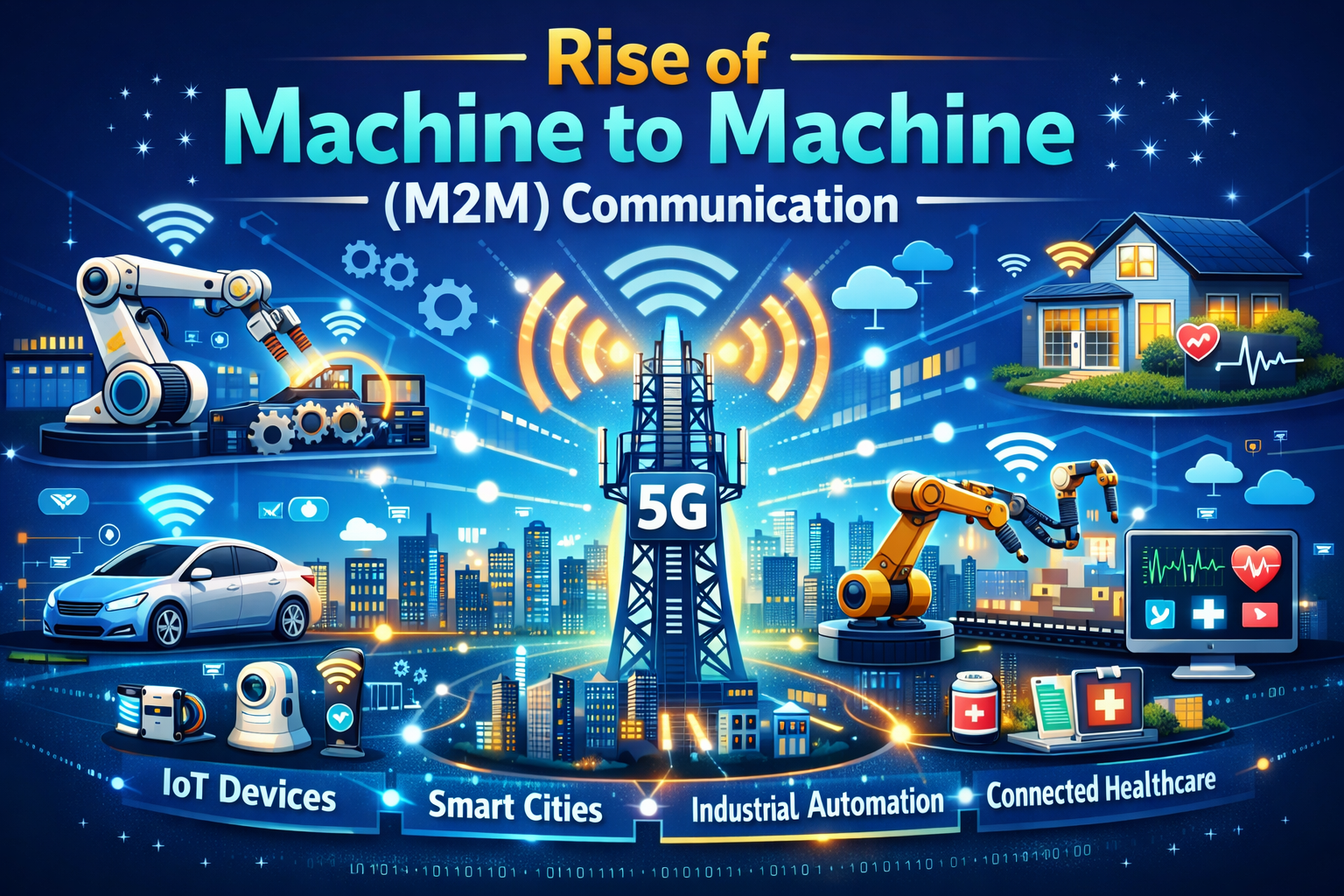
What is Machine to Machine (M2M) Communication?
M2M communication refers to direct communication between devices using wired or wireless networks. It allows machines to exchange data, monitor systems, and perform actions automatically without human involvement.
Below is the list of key concepts, components, and working of M2M communication explained in detail.
- Definition: Communication between devices without human interaction
- Purpose: Automate processes and improve efficiency
- Usage: Widely used in IoT, smart cities, healthcare, and industries
Evolution of M2M Communication
M2M communication has evolved over time from simple wired systems to advanced wireless and cloud-based networks.
Below is the list of different stages in the evolution of M2M communication.
1. Early Wired Communication Systems
Early M2M systems used wired connections like telephone lines for communication between machines.
- Limited Connectivity: Devices were connected through physical cables
- Basic Data Transfer: Only simple data signals were transmitted
- High Cost: Installation and maintenance were expensive
2. Introduction of Cellular Networks
The use of cellular networks enabled remote communication between machines over long distances.
- Wireless Connectivity: Devices could communicate without cables
- Wide Coverage: Communication became possible across cities and countries
- Improved Reliability: Better network stability than wired systems
3. Internet-Based M2M Communication
The integration of the internet allowed devices to communicate globally using IP-based networks.
- Global Connectivity: Devices connected through the internet
- Real-Time Data: Instant data transmission and monitoring
- Scalability: Easy to connect large numbers of devices
4. Integration with Cloud Computing
Cloud computing enhanced M2M by providing storage, processing, and analytics capabilities.
- Data Storage: Large volumes of data stored in the cloud
- Processing Power: Advanced analytics and automation
- Remote Access: Systems can be managed from anywhere
5. Transition to IoT Systems
M2M communication became the foundation of IoT, enabling smart devices and intelligent systems.
- Smart Devices: Sensors and actuators connected to networks
- Automation: Systems respond automatically to data
- Interconnectivity: Multiple devices communicate in an ecosystem
Key Components of M2M Communication
M2M communication consists of several essential components that work together to enable device interaction.
Below is the list of main components involved in M2M communication systems.
1. Devices (Sensors and Actuators)
Devices are responsible for collecting and acting on data in M2M systems.
- Sensors: Collect environmental data such as temperature, humidity, and motion
- Actuators: Perform actions like switching, controlling, or adjusting systems
- Embedded Systems: Combine hardware and software for automation
2. Communication Network
The network enables data transmission between devices and systems.
- Wired Networks: Ethernet, DSL connections
- Wireless Networks: Cellular, Wi-Fi, Bluetooth
- Low Power Networks: Zigbee, LoRaWAN for IoT devices
3. Data Processing System
Data processing systems analyze and interpret data collected from devices.
- Local Processing: Edge devices process data locally
- Cloud Processing: Central servers analyze large datasets
- Real-Time Analytics: Immediate decision-making based on data
4. Application Layer
The application layer provides user interfaces and system control.
- Monitoring Systems: Display device data and status
- Control Systems: Allow users to manage devices
- Automation Software: Executes predefined actions
How M2M Communication Works
M2M communication follows a structured process where devices collect, transmit, and act on data automatically.
Below is the list of steps explaining how M2M communication works.
1. Data Collection
Devices collect data from the environment using sensors.
- Input Data: Temperature, pressure, location, etc.
- Continuous Monitoring: Data is collected regularly
2. Data Transmission
Collected data is transmitted through communication networks.
- Wireless Transmission: Using cellular or Wi-Fi
- Secure Channels: Data encryption ensures safety
3. Data Processing
The transmitted data is processed to generate meaningful insights.
- Filtering Data: Removing unnecessary information
- Analyzing Data: Identifying patterns and conditions
4. Decision Making and Action
Based on processed data, the system takes appropriate action automatically.
- Automation: Systems respond without human input
- Alerts: Notifications sent if needed
- Control Actions: Devices adjust operations
Advantages of M2M Communication
M2M communication offers several benefits that improve efficiency and productivity in various industries.
Below is the list of key advantages of M2M communication.
1. Automation and Efficiency
M2M systems reduce manual work and improve operational efficiency.
- Automatic Processes: No need for human intervention
- Time Saving: Faster operations and responses
- Reduced Errors: Minimizes human mistakes
2. Real-Time Monitoring
M2M enables continuous monitoring of systems and environments.
- Instant Updates: Real-time data availability
- Better Control: Immediate response to changes
- Improved Decision Making: Accurate data insights
3. Cost Reduction
M2M reduces operational and maintenance costs.
- Lower Labor Costs: Less human involvement
- Efficient Resource Use: Optimized operations
- Predictive Maintenance: Avoids unexpected failures
4. Scalability
M2M systems can easily expand to include more devices.
- Flexible Systems: Easy to add new devices
- Large Networks: Supports thousands of devices
- Adaptability: Suitable for different applications
Challenges of M2M Communication
Despite its benefits, M2M communication faces several challenges that need to be addressed.
Below is the list of common challenges in M2M communication.
1. Security and Privacy Issues
M2M systems are vulnerable to cyber threats and data breaches.
- Data Security Risks: Unauthorized access to data
- Device Vulnerabilities: Weak security in devices
- Encryption Needs: Secure communication required
2. Connectivity Issues
Reliable network connectivity is essential for M2M systems.
- Network Failures: Communication interruptions
- Limited Coverage: Issues in remote areas
- Bandwidth Limitations: High data traffic problems
3. Interoperability Problems
Different devices and systems may not work together easily.
- Lack of Standards: Different communication protocols
- Compatibility Issues: Integration challenges
- Complex Systems: Difficult to manage diverse devices
4. Data Management Challenges
Handling large volumes of data is a major issue in M2M systems.
- Big Data Handling: Massive data generation
- Storage Issues: Need for scalable storage solutions
- Data Processing Complexity: Requires advanced analytics
M2M vs IoT: Key Differences
M2M and IoT are closely related but have distinct differences in their approach and capabilities.
Below is the list of key differences between M2M and IoT communication.
| Feature | M2M Communication | IoT |
|---|---|---|
| Communication Type | Device-to-device | Device-to-cloud and device-to-user |
| Network | Cellular or wired | Internet-based (IP networks) |
| Scalability | Limited | Highly scalable |
| Integration | Isolated systems | Integrated ecosystem |
| Data Usage | Limited data exchange | Big data and analytics |
| User Interaction | Minimal | High user interaction |
Real-World Applications of M2M Communication
M2M communication is widely used in different industries to automate processes and improve efficiency.
Below is the list of common real-world applications of M2M communication.
1. Smart Metering
M2M enables automatic monitoring of electricity, gas, and water usage.
- Remote Monitoring: No manual meter reading
- Accurate Billing: Real-time usage tracking
- Energy Efficiency: Better resource management
2. Industrial Automation
Industries use M2M for monitoring machines and optimizing production.
- Machine Monitoring: Real-time performance tracking
- Predictive Maintenance: Detect issues early
- Improved Productivity: Automated operations
3. Healthcare Systems
M2M supports remote patient monitoring and medical device communication.
- Patient Monitoring: Track health data remotely
- Emergency Alerts: Immediate notifications
- Improved Care: Better treatment decisions
4. Transportation and Logistics
M2M improves fleet management and tracking systems.
- Vehicle Tracking: GPS-based monitoring
- Route Optimization: Efficient transportation
- Safety Monitoring: Detect issues in vehicles
Future of M2M Communication
The future of M2M communication is closely linked with IoT, AI, and advanced networks like 5G.
Below is the list of future trends in M2M communication.
1. Integration with 5G Networks
5G will enhance M2M communication with faster speed and low latency.
- High Speed: Faster data transmission
- Low Latency: Instant communication
- Massive Connectivity: Support for many devices
2. AI and Data Analytics Integration
AI will improve decision-making in M2M systems.
- Smart Decisions: Automated intelligent actions
- Predictive Analysis: Forecast future trends
- Enhanced Automation: Reduced human involvement
3. Expansion of Smart Systems
M2M will continue to grow in smart cities, homes, and industries.
- Smart Cities: Intelligent infrastructure
- Smart Homes: Automated home systems
- Industrial IoT: Advanced manufacturing systems
Conclusion
Machine to Machine (M2M) communication is a foundational technology that has enabled the growth of IoT and modern automation systems. It allows devices to communicate, process data, and take actions without human intervention, improving efficiency, reducing costs, and enabling real-time monitoring. As technologies like 5G, AI, and cloud computing continue to evolve, M2M communication will play an even more critical role in shaping the future of connected systems and smart environments.