












Early Examples of IoT Devices in History
The concept of the Internet of Things (IoT) did not appear suddenly; it evolved over decades through innovative devices that connected machines and systems. Understanding early IoT devices helps students learn how modern smart technologies developed from simple automated systems.
What Are Early IoT Devices?
Early IoT devices refer to machines that could communicate, monitor, or automate tasks using networks or embedded systems before the term “IoT” became popular. Below is the list of foundational early IoT devices in history.
1. ARPANET Connected Devices (1960s–1970s)
These were the first network-connected machines that enabled communication between computers, laying the foundation for IoT.
- Early Networking: Devices connected through ARPANET could share data remotely.
- Basic Machine Communication: Computers communicated without human intervention.
- Foundation of Internet: Enabled future IoT systems based on connectivity.
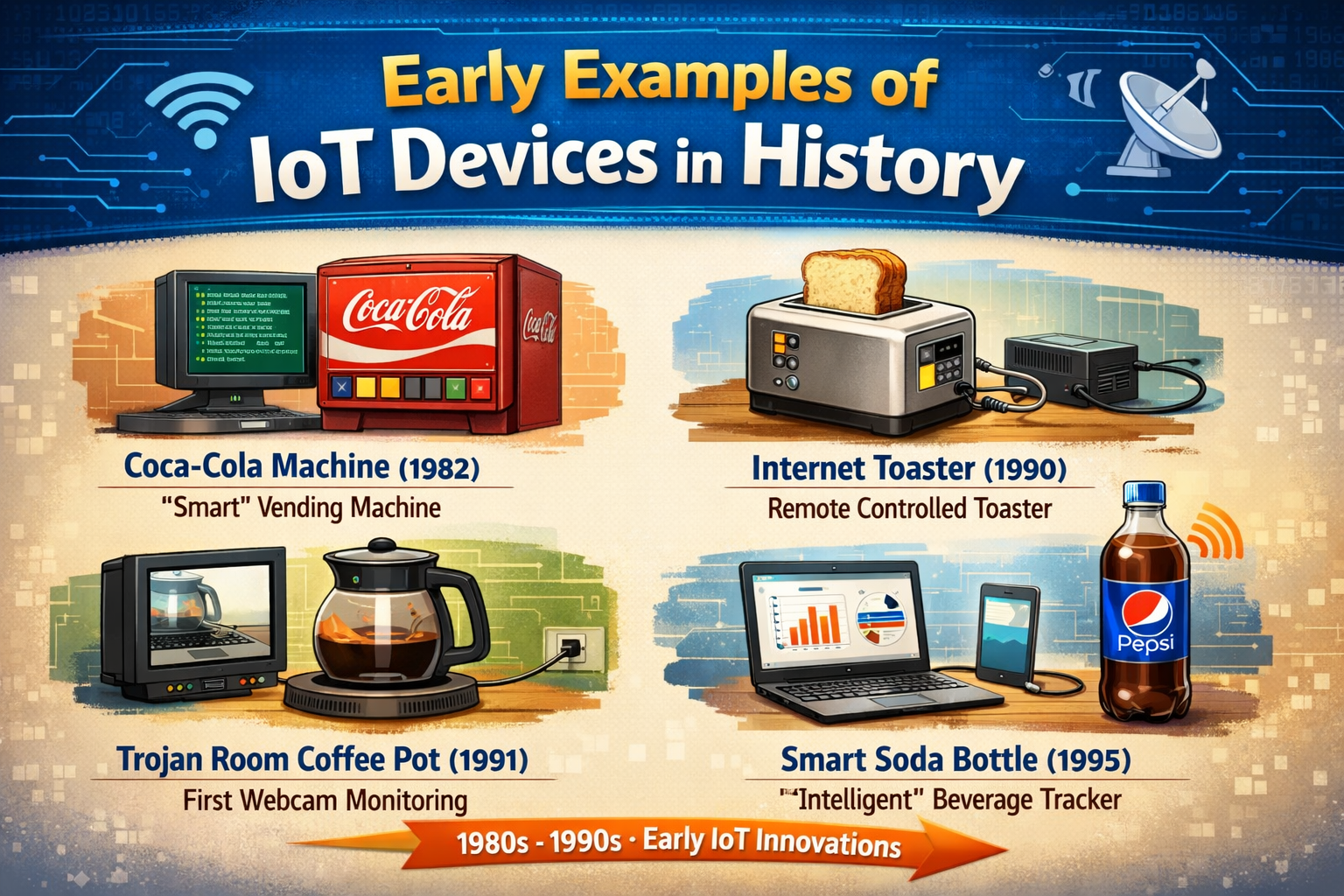
2. Vending Machine at Carnegie Mellon University (1982)
This is considered the first true IoT device, as it could report its status over a network.
- Remote Monitoring: Users could check if drinks were available.
- Temperature Reporting: It showed whether beverages were cold.
- Real-Time Data: Provided live updates using network connectivity.
3. Internet-Controlled Toaster (1990)
A demonstration device that could be turned on/off using the internet.
- Remote Control: Users could control the toaster via computer.
- Early Smart Device: Showed how appliances could connect to the internet.
- Innovation Concept: Introduced idea of smart home automation.
4. Trojan Room Coffee Pot (1991)
A coffee pot at Cambridge University was connected to a camera and network.
- Live Monitoring: Users could check coffee availability remotely.
- Camera Integration: One of the first uses of visual IoT monitoring.
- Convenience Factor: Reduced unnecessary trips for coffee.
5. RFID Technology (1990s)
Radio Frequency Identification allowed objects to be tracked and identified automatically.
- Object Identification: Tags used to track items in supply chains.
- Automation: Reduced manual tracking efforts.
- Foundation for IoT Tracking: Used in logistics, retail, and security.
6. Smart Home Systems (1990s)
Early home automation systems started connecting devices within homes.
- Central Control: Controlled lighting, temperature, and appliances.
- Wired Systems: Initially used wired connections.
- Convenience and Efficiency: Improved energy usage and comfort.
7. GPS Tracking Devices (1990s)
Devices that used satellite communication to track location in real time.
- Location Tracking: Used in vehicles and logistics.
- Real-Time Data: Provided live position updates.
- Navigation Systems: Helped in route planning and monitoring.
Key Features of Early IoT Devices
Early IoT devices introduced basic concepts that are still used in modern IoT systems. Below is the list of key features of early IoT devices.
1. Connectivity
Connectivity allowed devices to communicate with each other or central systems.
- Network-Based Communication: Devices connected through early internet or private networks.
- Data Sharing: Enabled remote access to device information.
- Foundation for IoT: Core feature of all IoT systems.
2. Automation
Automation reduced the need for human intervention in performing tasks.
- Self-Operating Systems: Devices performed tasks automatically.
- Efficiency Improvement: Reduced manual work.
- Early Smart Functionality: Basic automation in appliances.
3. Remote Monitoring
Users could monitor device status without being physically present.
- Real-Time Updates: Devices sent live information.
- User Convenience: Allowed remote checking of systems.
- Improved Decision Making: Users could act based on data.
4. Data Collection
Devices collected and transmitted data for analysis.
- Sensor-Based Input: Devices gathered environmental or operational data.
- Data Transmission: Sent information over networks.
- Foundation for Analytics: Enabled future IoT data processing.
Evolution Comparison: Early IoT vs Modern IoT
Understanding the difference between early and modern IoT helps students see how technology has advanced over time.
| Feature | Early IoT Devices | Modern IoT Devices |
|---|---|---|
| Connectivity | Limited networks (ARPANET, wired) | High-speed internet, 5G, Wi-Fi |
| Intelligence | Basic automation | AI-driven smart systems |
| Data Processing | Minimal processing | Cloud and edge computing |
| Scalability | Limited devices | Millions of connected devices |
| User Interface | Simple interfaces | Mobile apps, dashboards |
Importance of Early IoT Devices in Technology Development
Early IoT devices played a critical role in shaping modern connected systems. Below is the list of their importance in technology evolution.
1. Foundation of Smart Technology
Early devices introduced the concept of machine-to-machine communication.
- Innovation Start: Created base for smart devices.
- Concept Development: Inspired future IoT advancements.
- Technology Evolution: Led to modern smart ecosystems.
2. Development of Networking Systems
These devices required reliable communication networks.
- Internet Growth: Helped expand networking technologies.
- Protocol Development: Improved communication standards.
- Global Connectivity: Enabled worldwide device interaction.
3. Introduction of Automation Concepts
Automation became a key feature in modern systems.
- Efficiency Boost: Reduced manual operations.
- Smart Systems: Led to intelligent automation.
- Industrial Impact: Influenced manufacturing and industries.
4. Data-Driven Decision Making
Early IoT devices introduced the use of data for decision-making.
- Real-Time Insights: Enabled quick responses.
- Data Importance: Highlighted role of information.
- Analytics Foundation: Built base for big data and AI.
Real-World Learning Example
Understanding early IoT becomes easier with simple examples.
- Vending Machine Example: Checking drink availability remotely shows how IoT saves time.
- Coffee Pot Example: Monitoring coffee status reduces effort and improves convenience.
- RFID Example: Tracking products in stores shows how automation improves efficiency.
Conclusion
Early examples of IoT devices in history demonstrate how simple connected systems evolved into today’s advanced smart technologies. From vending machines to RFID systems, these innovations introduced key concepts like connectivity, automation, and remote monitoring. Understanding these early developments helps students build a strong foundation in IoT and appreciate how modern systems continue to evolve from these basic ideas.