












Challenges in IoT Implementation Explained
The Internet of Things (IoT) is transforming industries by connecting devices and enabling smart systems, but implementing IoT solutions comes with several technical and operational challenges. Understanding these challenges helps students and professionals design efficient, secure, and scalable IoT systems.
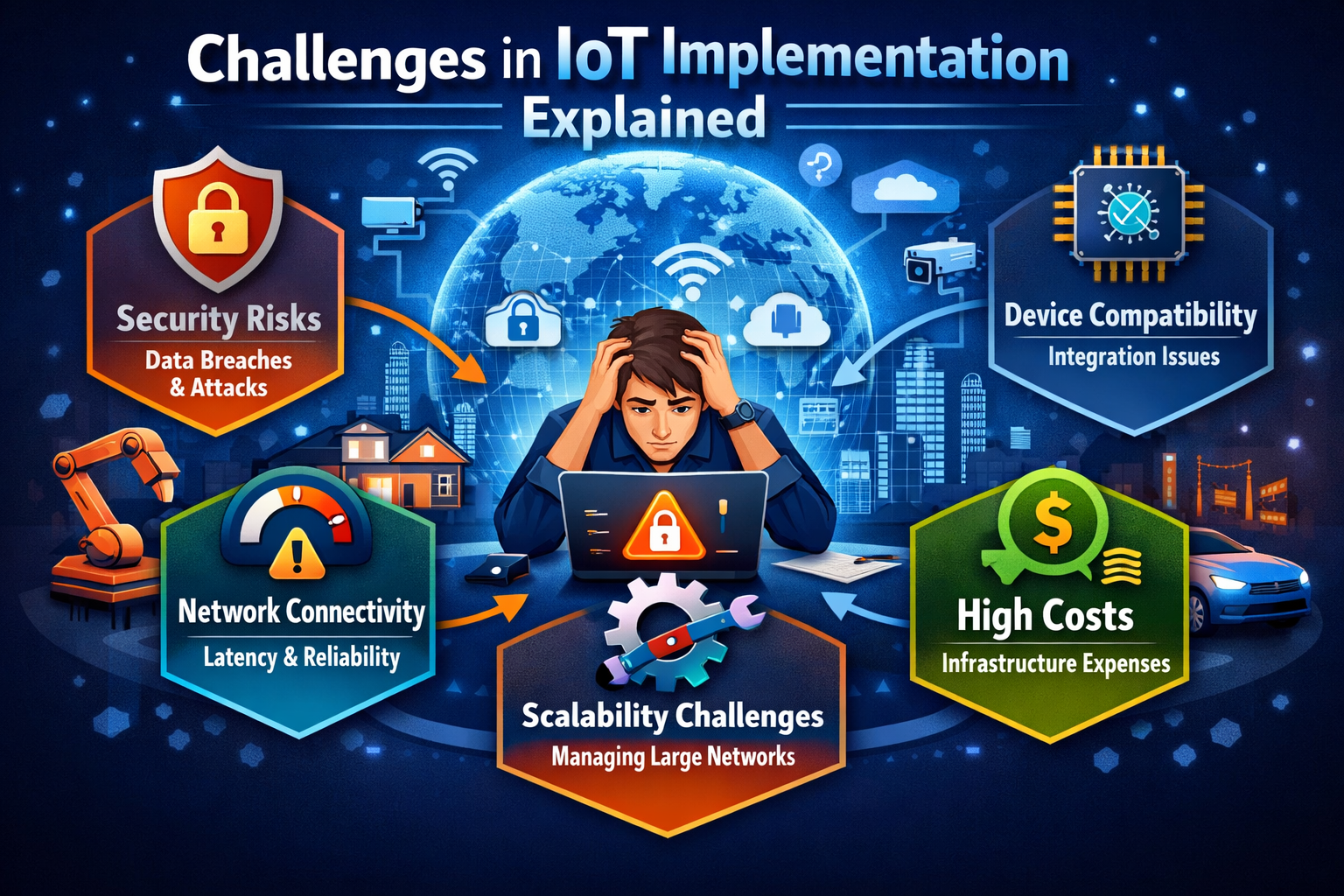
Introduction to IoT Implementation Challenges
IoT implementation involves integrating devices, networks, and cloud systems, which creates complexity in real-world environments. Below is the list of key challenges in IoT implementation explained in detail.
1. Security Challenges in IoT Systems
IoT devices are often vulnerable to cyber threats due to weak security mechanisms and large attack surfaces.
- Weak Authentication: Many IoT devices lack strong login mechanisms, making unauthorized access easier.
- Data Breaches: Sensitive data transmitted between devices can be intercepted if not encrypted.
- Device Hijacking: Hackers can take control of devices, leading to misuse or system failure.
- Lack of Updates: Many devices do not receive regular security patches, increasing risk over time.
2. Privacy Concerns in IoT
IoT systems collect massive amounts of personal and sensitive data, raising privacy concerns.
- Personal Data Exposure: Devices like smart cameras and wearables collect user data continuously.
- Unauthorized Data Sharing: Data may be shared with third parties without user consent.
- User Tracking: Continuous monitoring can lead to privacy violations.
- Lack of User Control: Users often cannot fully control how their data is used.
3. Connectivity and Network Issues
Reliable connectivity is essential for IoT systems, but it is not always guaranteed.
- Network Latency: Delays in communication can affect real-time applications.
- Bandwidth Limitations: Large numbers of devices can overload networks.
- Unstable Connections: Devices may lose connectivity in remote or crowded areas.
- Protocol Compatibility: Different communication protocols may not work together smoothly.
4. Data Management and Storage Challenges
IoT generates huge volumes of data that must be processed and stored efficiently.
- Big Data Handling: Managing large datasets requires advanced storage systems.
- Real-Time Processing: Processing data instantly is difficult but necessary for many applications.
- Data Integration: Combining data from multiple devices and sources is complex.
- Storage Costs: Storing large amounts of data can be expensive.
5. Interoperability Issues
IoT devices from different manufacturers often use different standards and technologies.
- Lack of Standardization: No universal standards for device communication.
- Compatibility Problems: Devices may not work together properly.
- Vendor Lock-In: Organizations may depend on a single vendor’s ecosystem.
- Integration Complexity: Connecting multiple platforms increases system complexity.
6. Scalability Challenges
IoT systems must handle growth in devices, users, and data efficiently.
- Device Expansion: Adding more devices increases system load.
- Infrastructure Limitations: Existing infrastructure may not support large-scale deployments.
- Performance Degradation: System performance may decrease as scale increases.
- Management Complexity: Managing thousands of devices becomes difficult.
7. Power and Energy Management
Many IoT devices operate on limited power sources like batteries.
- Battery Life Limitations: Devices need long-lasting power for continuous operation.
- Energy Efficiency: Optimizing power consumption is challenging.
- Frequent Maintenance: Battery replacement increases operational costs.
- Remote Device Issues: Devices in remote areas are harder to maintain.
8. Device Management and Maintenance
Managing a large number of IoT devices is a major operational challenge.
- Device Monitoring: Continuous tracking of device status is required.
- Firmware Updates: Updating devices remotely can be complex.
- Fault Detection: Identifying and fixing issues quickly is difficult.
- Lifecycle Management: Managing devices from deployment to retirement is complex.
9. High Implementation Cost
IoT implementation requires significant investment in hardware, software, and infrastructure.
- Initial Setup Cost: Purchasing devices and infrastructure is expensive.
- Maintenance Cost: Ongoing costs include updates, repairs, and monitoring.
- Skilled Workforce: Hiring experts increases operational expenses.
- Integration Cost: Connecting IoT with existing systems requires additional investment.
10. Regulatory and Compliance Issues
IoT systems must follow legal and regulatory requirements, which vary by region.
- Data Protection Laws: Compliance with privacy regulations is necessary.
- Industry Standards: Different industries have specific requirements.
- Cross-Border Data Issues: Data transfer across countries may be restricted.
- Compliance Complexity: Managing compliance across multiple regions is challenging.
Comparison of Major IoT Implementation Challenges
This table helps students understand how different challenges impact IoT systems and their solutions.
| Challenge | Impact on IoT System | Example | Possible Solution |
|---|---|---|---|
| Security | Data theft, device control | Smart home hacking | Encryption, strong authentication |
| Privacy | User data misuse | Wearable tracking data | Data anonymization |
| Connectivity | System delays | Smart traffic systems | 5G, improved networks |
| Data Management | Storage overload | Industrial sensors | Cloud storage, edge computing |
| Interoperability | Device incompatibility | Multi-brand smart home | Standard protocols |
| Scalability | Performance issues | Smart cities | Cloud scaling |
| Power Management | Device downtime | Remote sensors | Low-power devices |
| Device Management | Maintenance difficulty | Large IoT networks | Device management platforms |
| Cost | Budget constraints | Enterprise IoT setup | Cost optimization strategies |
| Compliance | Legal risks | Healthcare IoT | Regulatory frameworks |
Real-World Example of IoT Implementation Challenges
In a smart city project, thousands of sensors are used for traffic, pollution, and energy management. These systems face challenges such as network congestion, data overload, and security risks. For example, if traffic sensors lose connectivity, real-time traffic management fails, causing delays and inefficiency. Similarly, if security is weak, attackers can manipulate data, leading to incorrect decisions.
How to Overcome IoT Implementation Challenges
Organizations can reduce IoT challenges by using proper strategies and technologies.
- Strong Security Measures: Use encryption, authentication, and regular updates.
- Standardization: Adopt common protocols for better interoperability.
- Scalable Infrastructure: Use cloud computing for flexible scaling.
- Edge Computing: Process data near devices to reduce latency.
- Efficient Device Management: Use centralized platforms for monitoring and updates.
- Energy Optimization: Design low-power devices and use efficient batteries.
- Compliance Planning: Follow legal regulations from the beginning.
Conclusion
IoT implementation offers great benefits, but it also introduces multiple challenges such as security, scalability, and data management. By understanding these issues and applying effective solutions, organizations can build reliable, secure, and efficient IoT systems that deliver real value in real-world applications.