











IoT Architecture Overview Explained
The Internet of Things (IoT) architecture defines how connected devices, systems, and services work together to collect, process, and deliver data efficiently. Understanding IoT architecture helps students and developers design scalable, secure, and intelligent IoT systems for real-world applications.
What is IoT Architecture?
IoT architecture is a structured framework that explains how IoT devices, networks, data processing units, and applications interact to provide smart services. It ensures smooth communication, data flow, and system performance across connected environments, and the list of core architectural elements is given below.
- System Structure: Defines how components like sensors, cloud, and applications are organized
- Data Flow Management: Controls how data moves from devices to users
- Scalability: Supports growth in number of devices and data
- Security Integration: Protects devices, data, and communication
Layers of IoT Architecture
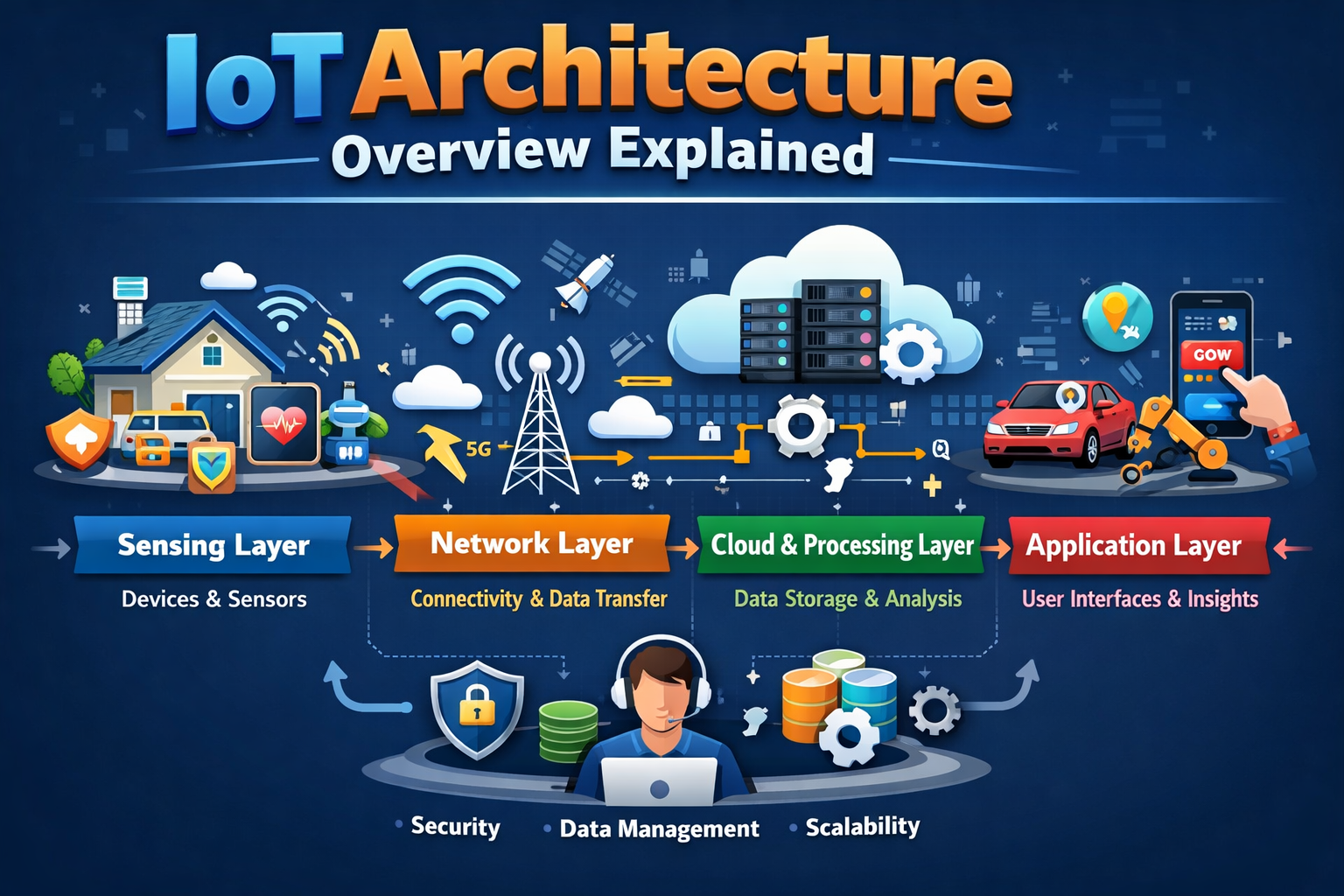
IoT architecture is commonly divided into multiple layers, each responsible for specific tasks in the system. These layers ensure proper communication, data processing, and service delivery, and the list of IoT architecture layers is given below.
1. Perception Layer (Device Layer)
The perception layer is the physical layer of IoT architecture that collects data from the environment using sensors and devices. It acts as the foundation of the entire IoT system.
- Sensors: Collect environmental data like temperature, humidity, motion
- Actuators: Perform actions based on commands (e.g., turning on a fan)
- RFID & Devices: Identify and track objects
- Real-Time Data Collection: Continuously gathers data from surroundings
2. Network Layer (Communication Layer)
The network layer is responsible for transmitting data from devices to processing systems using wired or wireless communication technologies. It ensures reliable and secure data transfer.
- Connectivity Technologies: Wi-Fi, Bluetooth, Zigbee, cellular networks
- Data Transmission: Sends data from devices to servers or cloud
- Protocols: MQTT, HTTP, CoAP for communication
- Gateway Devices: Connect local devices to the internet
3. Processing Layer (Middleware Layer)
The processing layer analyzes and processes the collected data using cloud computing or edge computing technologies. It plays a key role in decision-making.
- Data Processing: Filters, analyzes, and processes large data
- Cloud Integration: Stores and manages data in cloud platforms
- Edge Computing: Processes data closer to devices for faster response
- Data Analytics: Converts raw data into useful insights
4. Application Layer
The application layer delivers services and user interfaces based on processed data. It allows users to interact with IoT systems and receive meaningful information.
- User Interfaces: Mobile apps, dashboards, web platforms
- Smart Services: Healthcare monitoring, smart homes, agriculture systems
- Data Visualization: Displays data in graphs and reports
- User Interaction: Enables control and monitoring of devices
5. Business Layer
The business layer manages the overall IoT system, including business logic, data analysis, and decision-making. It ensures that IoT systems provide value to organizations.
- Business Models: Defines how IoT solutions generate value
- Data Insights: Supports strategic decisions
- System Monitoring: Tracks performance and usage
- Policy Management: Ensures compliance and governance
Components of IoT Architecture
IoT architecture consists of several key components that work together to build a complete system. These components help in data collection, communication, processing, and service delivery, and the list of essential IoT components is given below.
1. Sensors and Devices
Sensors and devices are the primary components that interact with the physical environment and collect data. They are the starting point of any IoT system.
- Temperature Sensors: Measure heat levels
- Motion Sensors: Detect movement
- Smart Devices: Smartwatches, smart appliances
- Environmental Monitoring: Track air quality, humidity
2. Connectivity
Connectivity enables communication between IoT devices and systems through networks and protocols. It ensures seamless data transmission.
- Wireless Networks: Wi-Fi, Bluetooth, LoRaWAN
- Internet Connectivity: Enables global access
- Protocols: MQTT, HTTP, CoAP
- Gateways: Bridge between devices and cloud
3. Data Processing Units
Data processing units analyze the data collected from devices and convert it into meaningful information. These units can be located in the cloud or at the edge.
- Cloud Servers: Handle large-scale data processing
- Edge Devices: Process data locally
- Data Filtering: Removes unnecessary data
- Real-Time Processing: Enables quick decisions
4. User Interface
The user interface allows users to interact with IoT systems and monitor or control devices. It plays a crucial role in user experience.
- Mobile Applications: Control devices remotely
- Web Dashboards: Display system data
- Alerts and Notifications: Inform users about events
- Control Panels: Manage IoT operations
Types of IoT Architecture
IoT architecture can be classified into different types based on complexity and system design. These architectures help in building systems according to application requirements, and the list of IoT architecture types is given below.
1. Three-Layer Architecture
The three-layer architecture is the basic model of IoT systems, suitable for simple applications and small-scale deployments.
- Perception Layer: Data collection
- Network Layer: Data transmission
- Application Layer: Service delivery
2. Five-Layer Architecture
The five-layer architecture is an advanced model that includes additional layers for better data processing and business management.
- Perception Layer
- Transport Layer (Network)
- Processing Layer (Middleware)
- Application Layer
- Business Layer
3. Cloud-Based Architecture
Cloud-based IoT architecture uses cloud platforms for data storage, processing, and analytics. It supports scalability and global access.
- Cloud Storage: Stores large volumes of data
- Remote Access: Access from anywhere
- High Scalability: Easily handles large systems
- Cost Efficiency: Pay-as-you-go model
4. Edge-Based Architecture
Edge-based architecture processes data closer to devices, reducing latency and improving performance.
- Low Latency: Faster response time
- Local Processing: Reduces data transmission
- Improved Efficiency: Handles real-time applications
- Reduced Bandwidth Usage: Saves network resources
Comparison of IoT Architecture Models
Different IoT architectures offer various advantages depending on system requirements. The table below compares common IoT architecture models.
| Architecture Type | Complexity | Processing Location | Scalability | Use Case Example |
|---|---|---|---|---|
| Three-Layer | Low | Basic | Limited | Simple IoT systems |
| Five-Layer | Medium | Distributed | High | Smart cities |
| Cloud-Based | High | Cloud | Very High | Global applications |
| Edge-Based | Medium | Local (Edge) | High | Real-time systems |
Data Flow in IoT Architecture
IoT architecture follows a structured data flow process that ensures smooth communication between devices and users. This process helps convert raw data into useful insights, and the list of IoT data flow steps is given below.
1. Data Collection
Data is collected from sensors and devices in the physical environment. This step is the starting point of IoT operations.
- Sensor Input: Captures environmental data
- Continuous Monitoring: Real-time data collection
- Device Interaction: Devices communicate with sensors
2. Data Transmission
Collected data is transmitted through networks to processing systems. This step ensures connectivity and communication.
- Network Transfer: Data sent via internet or local network
- Protocols: MQTT, HTTP, CoAP
- Secure Communication: Encryption and authentication
3. Data Processing
Data is processed and analyzed to extract meaningful information. This step enables intelligent decision-making.
- Filtering: Removes unnecessary data
- Analytics: Identifies patterns and insights
- Cloud/Edge Processing: Based on system design
4. Data Visualization and Action
Processed data is presented to users and used to perform actions. This step completes the IoT workflow.
- Dashboards: Display results visually
- Automation: Devices take actions automatically
- User Decisions: Helps in informed decision-making
Benefits of IoT Architecture
A well-designed IoT architecture provides multiple benefits in building efficient and scalable systems. These benefits improve system performance and user experience, and the list of advantages is given below.
- Scalability: Easily supports more devices and users
- Flexibility: Adapts to different applications
- Efficiency: Optimizes resource usage
- Real-Time Monitoring: Enables instant insights
- Cost Optimization: Reduces operational costs
Challenges in IoT Architecture
Despite its advantages, IoT architecture also faces several challenges due to system complexity and large-scale deployments. Understanding these challenges helps in designing better systems, and the list of challenges is given below.
- Security Risks: Vulnerability to cyber attacks
- Data Management: Handling large volumes of data
- Interoperability Issues: Compatibility between devices
- Network Reliability: Dependence on stable connectivity
- Scalability Complexity: Managing large systems
Conclusion
IoT architecture is the backbone of smart systems, enabling seamless communication between devices, networks, and applications. By understanding its layers, components, and data flow, students and professionals can design efficient, scalable, and secure IoT solutions for real-world applications.