












How IoT Works Step by Step
Understanding how IoT works step by step is essential for beginners to learn how smart devices communicate, process data, and perform automated actions. This guide explains the complete IoT working process in a simple and structured way with clear concepts.
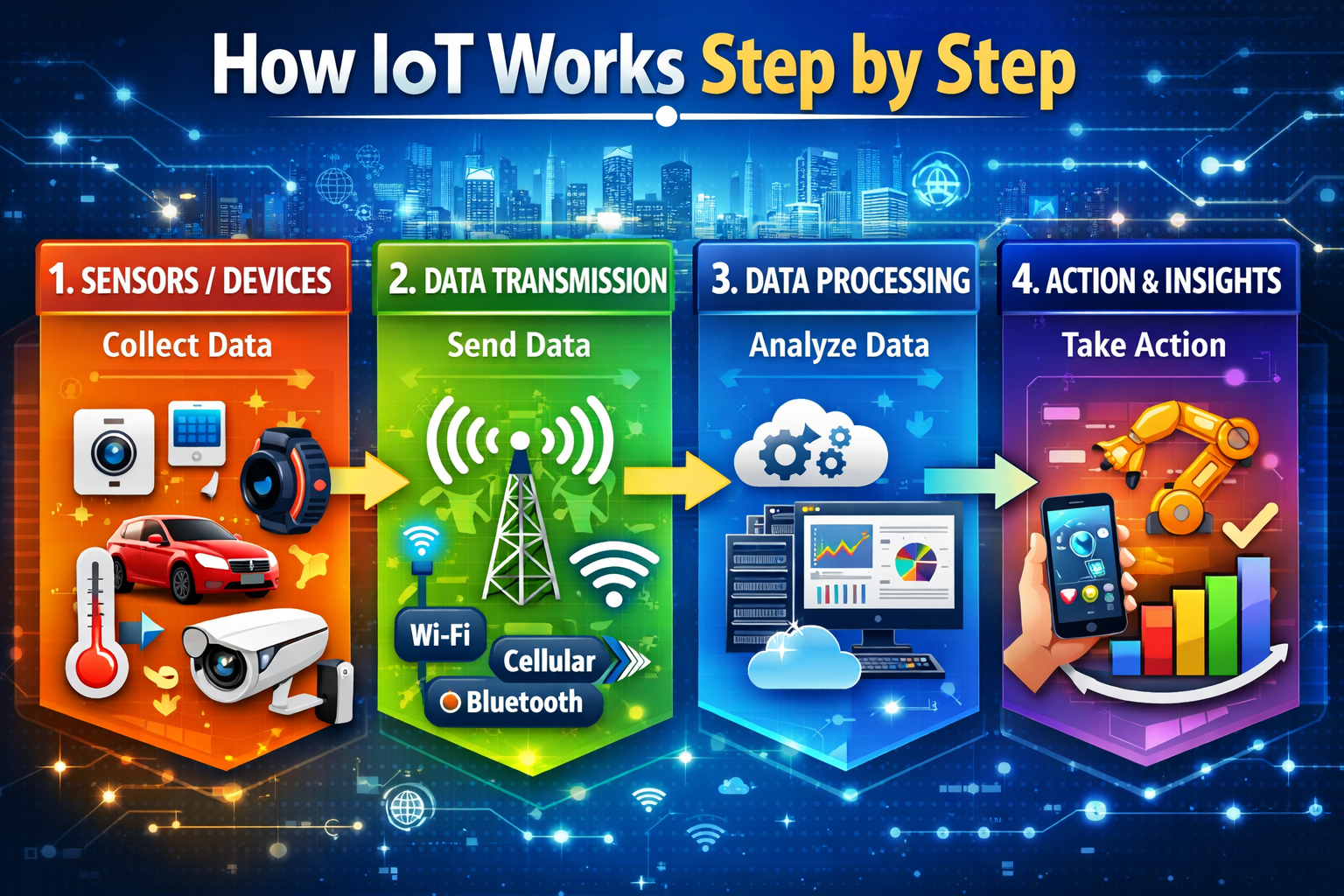
Introduction to IoT Working Process
The IoT working process is a continuous cycle where devices collect data, send it for processing, and take actions based on intelligent decisions. This process enables automation and real-time responses in smart systems.
What Happens Inside an IoT System
IoT systems operate through multiple stages where data flows between devices, networks, and processing systems to generate useful outcomes.
- Data Flow: Information moves from sensors to cloud systems
- Real-Time Interaction: Devices respond instantly
- Automation Cycle: Continuous sensing and acting
- User Feedback: Results are shared with users
Step-by-Step Working of IoT
IoT follows a structured sequence of steps that transform real-world data into actionable results. Each step plays a critical role in ensuring smooth system operation.
1. Data Collection (Sensing Stage)
This is the first step where IoT devices collect data from the physical environment using sensors.
- Sensors Capture Data: Temperature, humidity, motion, light, location
- Continuous Monitoring: Data is collected in real time
- Raw Data Generation: Data is unprocessed and basic
- Examples: Smart thermostat measuring room temperature
2. Data Transmission (Sending Stage)
In this step, collected data is sent from devices to processing systems through communication networks.
- Wireless Communication: Wi-Fi, Bluetooth, cellular networks
- IoT Protocols: MQTT, HTTP, CoAP
- Secure Transfer: Data encryption ensures safety
- Fast Communication: Enables real-time updates
3. Data Reception (Receiving Stage)
The transmitted data is received by cloud platforms or edge devices for further processing.
- Cloud Servers: Store and manage large data volumes
- Edge Devices: Process data closer to source
- Reliable Delivery: Ensures accurate data transfer
- Data Storage: Temporary or permanent storage
4. Data Processing (Analysis Stage)
This stage converts raw data into meaningful insights using processing systems and analytics.
- Data Analysis: Identify patterns and conditions
- Decision Making: Determine next actions
- Automation Logic: Trigger responses automatically
- AI Integration: Advanced systems use machine learning
5. Action Execution (Response Stage)
After processing, the system performs actions based on the analyzed data and predefined rules.
- Automatic Actions: Devices respond without human input
- Control Systems: Turn devices on/off or adjust settings
- Real-Time Response: Immediate execution of commands
- Examples: Turning on a fan when temperature rises
6. User Notification (Inform Stage)
IoT systems provide feedback to users through notifications, alerts, or dashboards.
- Mobile Alerts: Notifications on smartphones
- System Updates: Status and performance reports
- User Interaction: Manual control if needed
- Real-Time Monitoring: Continuous updates
7. Continuous Feedback Loop (Repeat Cycle)
IoT systems operate continuously by repeating the process to ensure updated data and actions.
- Ongoing Monitoring: Sensors keep collecting data
- Adaptive Behavior: System adjusts based on new data
- Improved Accuracy: Learning from previous data
- Automation Cycle: Repeats without interruption
Detailed IoT Working Flow
The IoT working flow shows how all steps are connected in a complete system. It helps students visualize the entire process clearly.
Complete IoT Data Flow
The IoT system follows a structured flow from data collection to action execution and feedback.
- Step 1: Sensors collect data
- Step 2: Data is sent through networks
- Step 3: Cloud/edge systems receive data
- Step 4: Data is processed and analyzed
- Step 5: Actions are performed
- Step 6: Users receive information
Real-World Example of IoT Working
Real-world examples help students understand how IoT works in practical scenarios by connecting theory with real-life applications.
1. Smart Home System Example
A smart home system uses IoT to automate household tasks based on environmental conditions.
- Step 1: Temperature sensor detects room temperature
- Step 2: Data is sent to cloud system
- Step 3: System analyzes temperature
- Step 4: Decision is made to turn on AC
- Step 5: AC is activated automatically
- Step 6: User receives notification
2. Healthcare IoT Example
IoT devices in healthcare monitor patient conditions and provide real-time alerts.
- Step 1: Wearable device collects heart rate data
- Step 2: Data is transmitted to healthcare system
- Step 3: Data is analyzed for abnormalities
- Step 4: Alert is generated if needed
- Step 5: Doctor receives notification
Role of Cloud and Edge Computing in IoT
Cloud and edge computing play a major role in processing and managing IoT data efficiently. They ensure fast, reliable, and scalable operations.
1. Cloud Computing in IoT
Cloud computing provides centralized storage and advanced processing capabilities.
- Large Data Storage: Handles massive data
- Advanced Analytics: Performs complex analysis
- Remote Access: Access data from anywhere
- Scalability: Easily expand resources
2. Edge Computing in IoT
Edge computing processes data near the device to reduce delay and improve speed.
- Low Latency: Faster response time
- Local Processing: Data processed near source
- Reduced Bandwidth: Less data sent to cloud
- Real-Time Actions: Immediate decisions
IoT Communication Technologies
Communication technologies enable IoT devices to connect and exchange data effectively. Choosing the right technology is essential for system performance.
1. Common IoT Communication Methods
Different communication methods are used based on application needs.
- Wi-Fi: High-speed internet connectivity
- Bluetooth: Short-range communication
- Cellular Networks: Long-distance connectivity
- Zigbee: Low-power communication
2. IoT Communication Protocols
Protocols define how data is transmitted and understood between devices.
- MQTT: Lightweight and efficient protocol
- HTTP: Standard web communication
- CoAP: Designed for low-power devices
- AMQP: Reliable messaging protocol
Benefits of Step-by-Step IoT Working
Understanding the step-by-step working of IoT helps students and developers design efficient and reliable systems.
Key Benefits of IoT Workflow
The structured workflow of IoT provides several advantages in real-world applications.
- Automation: Reduces manual intervention
- Efficiency: Improves system performance
- Accuracy: Minimizes errors
- Scalability: Supports system expansion
- Real-Time Monitoring: Instant updates
Challenges in IoT Working Process
IoT systems face several challenges during their working process that can affect performance and security.
Major Challenges in IoT Workflow
These challenges highlight the complexity of managing IoT systems.
- Data Security Risks: Vulnerable to cyber attacks
- Network Issues: Connectivity problems
- High Data Volume: Difficult to manage large data
- System Complexity: Integration challenges
- Latency Issues: Delay in processing
IoT Working Process Summary Table
The following table summarizes the complete IoT working process in a simple format for better understanding.
| Step | Stage | Description | Example |
|---|---|---|---|
| 1 | Sensing | Collect data from environment | Temperature sensor |
| 2 | Sending | Transmit data via network | Wi-Fi transfer |
| 3 | Receiving | Data received by cloud/edge | Cloud server |
| 4 | Processing | Analyze data and decide | AI analysis |
| 5 | Action | Perform task automatically | Turn on AC |
| 6 | Informing | Notify user | Mobile alert |
| 7 | Repeat | Continuous cycle | Real-time monitoring |
Conclusion
The step-by-step working of IoT explains how devices collect data, communicate, process information, and perform actions automatically. By understanding each stage—from sensing to action—students can build a strong foundation in IoT concepts. This structured workflow enables smart systems to operate efficiently, making IoT a key technology in modern automation and digital transformation.