












IoT Connectivity and Communication Protocols
IoT connectivity and communication protocols are essential for enabling seamless interaction between devices, sensors, and cloud platforms. They define how data is transmitted, ensuring reliable, secure, and efficient communication across IoT systems.
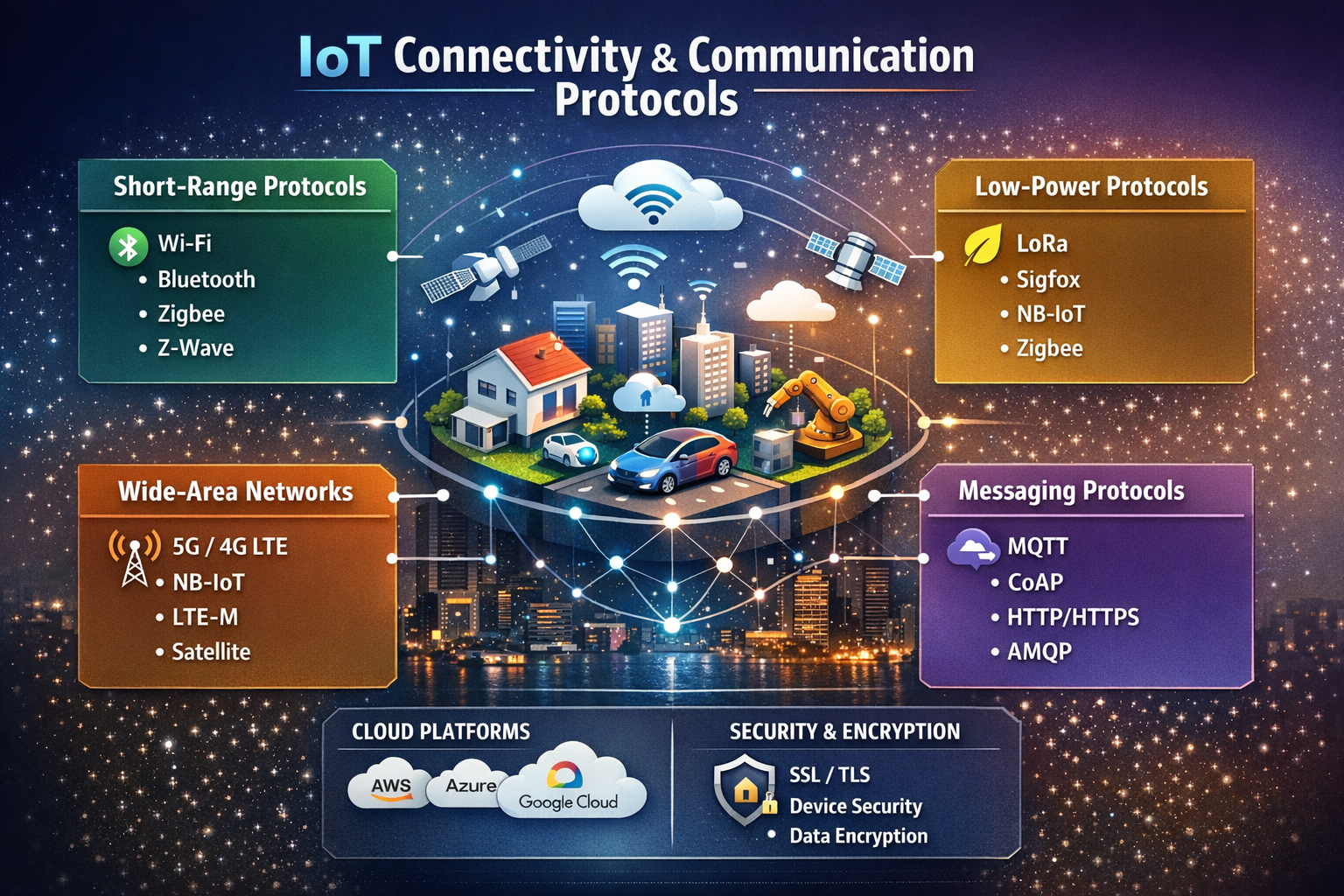
What Is IoT Connectivity?
IoT connectivity refers to the methods and technologies used to connect devices to each other and to central systems such as cloud platforms. It enables data exchange, remote control, and real-time monitoring of IoT devices.
What Are Communication Protocols in IoT?
Communication protocols are standardized rules that define how data is transmitted between devices in an IoT network. These protocols ensure compatibility, data integrity, and efficient communication.
Types of IoT Connectivity
IoT systems use different connectivity options depending on range, power consumption, and data requirements.
1. Short-Range Connectivity
Short-range technologies are used for communication over small distances with low power consumption.
- Bluetooth: Enables short-range communication between devices with low energy usage, commonly used in wearable devices.
- Wi-Fi: Provides high-speed internet connectivity for devices within a local network.
- Zigbee: Low-power communication protocol used in smart home systems and automation.
2. Long-Range Connectivity
Long-range technologies are used for communication over large distances.
- Cellular (4G/5G): Supports wide-area connectivity and real-time data transmission across long distances.
- LPWAN: Designed for low-power, long-range communication, ideal for sensors and remote monitoring systems.
- Satellite Communication: Used in remote areas where traditional networks are unavailable.
3. Wired Connectivity
Wired connections provide stable and reliable communication for IoT systems.
- Ethernet: High-speed and reliable network connection for industrial IoT systems.
- Serial Communication: Used for direct communication between devices in embedded systems.
Common IoT Communication Protocols
IoT protocols are designed to ensure efficient and secure data exchange between devices and platforms.
1. MQTT (Message Queuing Telemetry Transport)
MQTT is a lightweight messaging protocol designed for low-bandwidth and high-latency networks.
- Publish/Subscribe Model: Devices send and receive messages through a broker.
- Low Overhead: Suitable for devices with limited resources.
- Efficient Communication: Ideal for real-time IoT applications.
2. HTTP/HTTPS
HTTP is a widely used protocol for web-based communication, while HTTPS adds security through encryption.
- Request/Response Model: Devices communicate directly with servers.
- Easy Integration: Works with web applications and APIs.
- Secure Communication: HTTPS ensures data protection.
3. CoAP (Constrained Application Protocol)
CoAP is designed for resource-constrained devices and low-power networks.
- Lightweight Protocol: Uses minimal resources.
- UDP-Based Communication: Faster than traditional protocols.
- Efficient for IoT Devices: Ideal for sensors and embedded systems.
4. AMQP (Advanced Message Queuing Protocol)
AMQP is a messaging protocol designed for reliable and secure communication.
- Message Queuing: Ensures reliable data delivery.
- High Security: Supports encryption and authentication.
- Enterprise Use: Common in large-scale IoT systems.
5. WebSockets
WebSockets provide real-time, full-duplex communication between devices and servers.
- Continuous Connection: Enables instant data exchange.
- Low Latency: Suitable for real-time applications.
- Efficient Communication: Reduces overhead compared to HTTP.
Key Features of IoT Communication Protocols
Communication protocols provide essential features that ensure efficient IoT system performance.
1. Low Power Consumption
Protocols are designed to minimize energy usage, which is crucial for battery-powered devices.
2. Lightweight Communication
Efficient data transmission reduces bandwidth usage and improves performance.
3. Scalability
Protocols support large numbers of devices and high data volumes without performance issues.
4. Reliability
Ensures data is delivered accurately and consistently, even in unstable network conditions.
5. Security
Protocols include encryption, authentication, and secure data transmission mechanisms.
Benefits of IoT Connectivity and Protocols
These technologies provide several advantages for IoT systems.
1. Seamless Device Communication
Enable devices to connect and exchange data efficiently across networks.
2. Real-Time Data Transmission
Support instant data exchange for monitoring and automation.
3. Flexibility
Allow the use of different connectivity options and protocols based on application needs.
4. Cost Efficiency
Optimize resource usage and reduce communication costs.
5. Wide Range of Applications
Support various use cases such as smart homes, healthcare, industrial automation, and smart cities.
Challenges in IoT Connectivity and Protocols
IoT connectivity and communication protocols also face several challenges.
1. Compatibility Issues
Different devices and protocols may not work seamlessly together due to lack of standardization.
2. Security Risks
Data transmission over networks can be vulnerable to cyber threats if not properly secured.
3. Network Reliability
Unstable or weak network connections can affect communication and system performance.
4. Power Constraints
Many IoT devices have limited battery life, requiring energy-efficient communication methods.
5. Scalability Challenges
Managing communication across a large number of devices can be complex.
Conclusion
IoT connectivity and communication protocols are fundamental to the success of IoT systems. They enable devices to communicate efficiently, securely, and reliably across different environments. By selecting the appropriate connectivity options and protocols, developers can build scalable and high-performance IoT solutions for real-world applications.
IoT Connectivity and Communication Protocols – Subtopics
Explore IoT Connectivity and Communication Protocols to understand how devices connect, share data, and communicate efficiently in IoT systems. Learn about key protocols like MQTT, HTTP, and CoAP, and how they enable reliable, low-latency, and scalable communication between devices. Subtopics of IoT Connectivity and Communication Protocols are listed below
- IoT Connectivity Explained for Beginners
- Types of IoT Communication Protocols Explained
- Top IoT Communication Protocols List and Comparison
- MQTT Protocol in IoT Explained with Examples
- HTTP vs MQTT vs CoAP in IoT Comparison
- CoAP Protocol in IoT Systems Explained
- AMQP Protocol in IoT Explained
- Zigbee vs Bluetooth vs WiFi in IoT Connectivity
- LPWAN Technologies in IoT (LoRaWAN, NB-IoT)
- IoT Network Architecture and Communication Layers
- Wireless Communication Technologies in IoT
- Short Range vs Long Range Communication in IoT
- IoT Data Transmission Methods Explained
- Device to Device Communication in IoT Systems
- IoT Gateway and Protocol Translation Explained
- Secure Communication Protocols in IoT Systems
- IoT Connectivity Challenges and Solutions
- Real World Examples of IoT Communication Systems
- Choosing the Right IoT Protocol for Projects
- Future Trends in IoT Connectivity and Protocols