












Multilevel Feedback Queue (MLFQ) Scheduling in OS
Multilevel Feedback Queue (MLFQ) Scheduling is a CPU scheduling algorithm used by operating systems to manage multiple processes efficiently. It uses multiple ready queues with different priority levels and allows processes to move between queues based on their CPU usage and behavior.
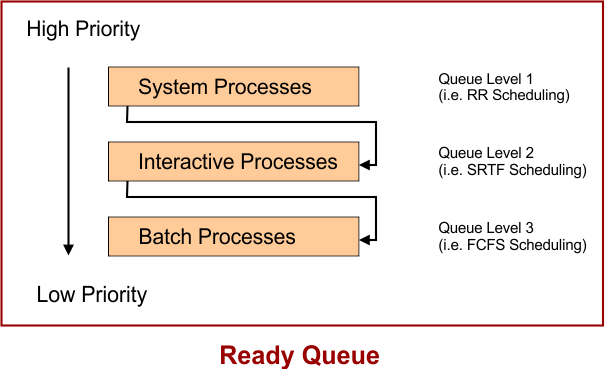
Unlike Multilevel Queue (MLQ) Scheduling, where processes are usually permanently assigned to a queue, MLFQ Scheduling allows processes to move between queues. This makes MLFQ more flexible and responsive for systems with different types of processes.
What is Multilevel Feedback Queue Scheduling?
Multilevel Feedback Queue Scheduling is a preemptive CPU scheduling algorithm that organizes processes into multiple queues with different priorities.
Each queue may use a different scheduling algorithm. For example:
- High-priority queue: Round Robin (RR)
- Medium-priority queue: Round Robin (RR) with a larger time quantum
- Low-priority queue: First-Come, First-Served (FCFS)
The main feature of MLFQ is that a process can move from one queue to another depending on its CPU requirements.
How Does MLFQ Scheduling Work?
MLFQ scheduling generally works as follows:
- A new process enters the highest-priority queue.
- The process receives CPU time according to that queue’s scheduling algorithm.
- If the process uses its entire time quantum, it may be moved to a lower-priority queue.
- If a process waits for a long time, it may be promoted to a higher-priority queue.
- The CPU normally selects a process from the highest-priority non-empty queue.
- This process continues until it finishes, is preempted, or moves to another queue.
Example of MLFQ Scheduling
Consider three queues:
| Queue | Priority | Scheduling Algorithm | Time Quantum |
|---|---|---|---|
| Q0 | Highest | Round Robin | 4 ms |
| Q1 | Medium | Round Robin | 8 ms |
| Q2 | Lowest | FCFS | — |
Suppose a process P1 enters Q0.
- P1 gets 4 ms of CPU time.
- If P1 still needs CPU time, it moves to Q1.
- In Q1, P1 receives up to 8 ms.
- If P1 still does not finish, it can move to Q2.
- Q2 handles P1 using FCFS.
This allows short or interactive processes to receive quick CPU service while CPU-intensive processes gradually move to lower-priority queues.
Key Features of MLFQ Scheduling
The important features of Multilevel Feedback Queue Scheduling include:
- Multiple priority queues: Processes are divided among several queues.
- Dynamic queue assignment: Processes can move between queues.
- Different scheduling algorithms: Each queue can use a different scheduling method.
- Preemptive scheduling: A higher-priority process can preempt a lower-priority process.
- Priority adjustment: Process priority can change according to its behavior.
- Starvation prevention: Aging can be used to move waiting processes to higher-priority queues.
Advantages of MLFQ Scheduling
MLFQ Scheduling provides several benefits because it can dynamically adjust process priorities.
- Flexible scheduling: Processes can move between queues according to their CPU behavior.
- Better response time: Interactive and short processes can receive CPU time quickly.
- Supports different process types: CPU-bound and I/O-bound processes can be handled differently.
- Reduces starvation: Aging can be used to increase the priority of processes that wait for a long time.
- Efficient CPU utilization: It can provide a good balance between responsiveness and CPU utilization.
Disadvantages of MLFQ Scheduling
Despite its flexibility, MLFQ Scheduling also has some disadvantages.
- More complex to implement than simple algorithms such as FCFS and Round Robin.
- Choosing the number of queues can be difficult.
- Selecting suitable time quantums for each queue requires careful planning.
- Starvation can still occur if priority adjustment or aging is not properly implemented.
- Scheduling rules are more complicated because processes can move between queues.
MLFQ vs MLQ Scheduling
The main difference between MLFQ and MLQ Scheduling is whether processes can move between queues.
| Feature | MLQ | MLFQ |
|---|---|---|
| Full Name | Multilevel Queue | Multilevel Feedback Queue |
| Queue Assignment | Usually fixed | Dynamic |
| Process Movement | Normally not allowed | Allowed |
| Priority | Usually fixed | Can change |
| Flexibility | Lower | Higher |
| Complexity | Simpler | More complex |
| Starvation | Possible | Can be reduced using aging |
MLFQ Scheduling and Starvation
Starvation occurs when a low-priority process waits for a very long time because higher-priority processes continuously receive CPU time.
MLFQ can reduce starvation by using aging. If a process remains in a lower-priority queue for too long, its priority can be increased and it can be moved to a higher-priority queue.
MLFQ Scheduling and Aging
Aging is a technique used to gradually increase the priority of a waiting process.
For example, if a process remains in a low-priority queue for a long time, the operating system can promote it to a higher-priority queue. This gives the process an opportunity to receive CPU time and helps prevent starvation.
When is MLFQ Scheduling Useful?
MLFQ Scheduling is particularly useful in systems where processes have different CPU requirements. It is commonly associated with interactive and time-sharing systems, where quick response for interactive tasks is important while CPU-intensive tasks still need to make progress.
Conclusion
Multilevel Feedback Queue (MLFQ) Scheduling is a flexible and powerful CPU scheduling algorithm in operating systems. It uses multiple priority queues and allows processes to move between queues based on their behavior and CPU usage. By combining different scheduling algorithms, dynamic priorities, and techniques such as aging, MLFQ can provide good response time while reducing starvation.