












NOT Gate Truth Table
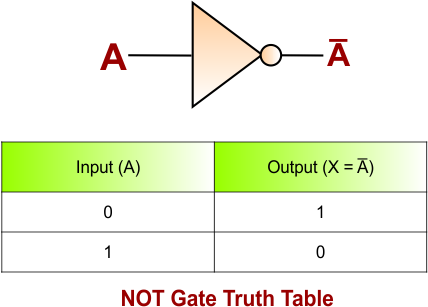
A NOT logic gate is also called an inverter. It takes a single input and generates a reversed output. In simple terms, we can say that
- If the input is HIGH (1), then the output will be LOW (0).
- If the input is LOW (0), then the output will be HIGH (1).
A NOT logic gate can be represented through a Boolean expression, logic symbol, and truth table. The following diagram explains it
Note
- In symbol representation: A triangle with a circle at the output represents the NOT gate.
- In variable representation: The bar (
¯) or apostrophe (') over a variable indicates NOT or complement.
Truth Table of NOT Gate
Truth tables show all possible input combinations and their corresponding outputs for any logic gate. The formula 2ⁿ is used to calculate total possible input combinations in a truth table, where n is the number of inputs. As there is only a single input in NOT gate so,
- For 1 input, combinations will be 21 = 2
NOT gate can be used with other logic gates to reverse the output of that logic gate. Let’s explain NOT logic gates and truth tables with other logic gates: OR, AND, NOR, NAND, XOR, and XNOR.
NOT Gate Truth Table with OR Gate
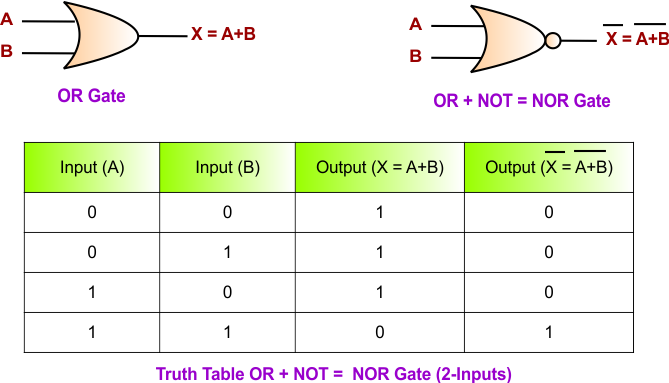
When NOT gate is applied to the output of OR gate, the result is a NOR gate. The symbol and truth table of NOR gate are given below
NOT Gate Truth Table with AND Gate
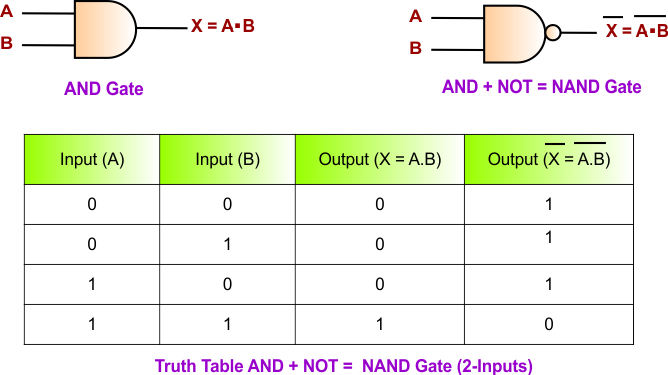
When NOT gate is applied to the output of AND gate, the result is a NAND gate. The symbol and truth table of NAND gate are given below
NOT Gate Truth Table with XOR Gate
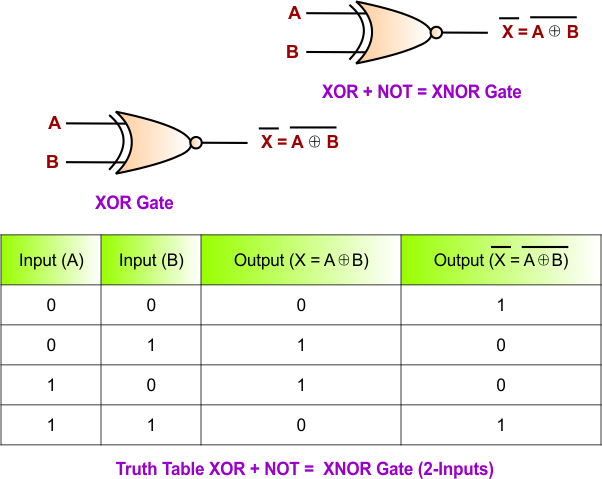
When NOT gate is applied to the output of XOR gate, the result is a XNOR gate. The symbol and truth table of XNOR gate are given below
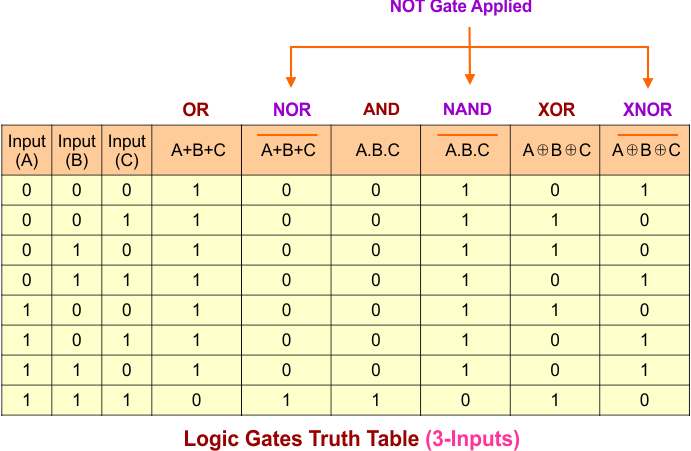
NOT Gate Truth Table with other Logic Gates using 3 inputs
Here is the truth table of NOT gate with other logic gates (OR, AND, and XOR) using three inputs.
|
Important: A three-input XOR can also be implemented using two 2-input XOR gates:
You can remember as follows:
|
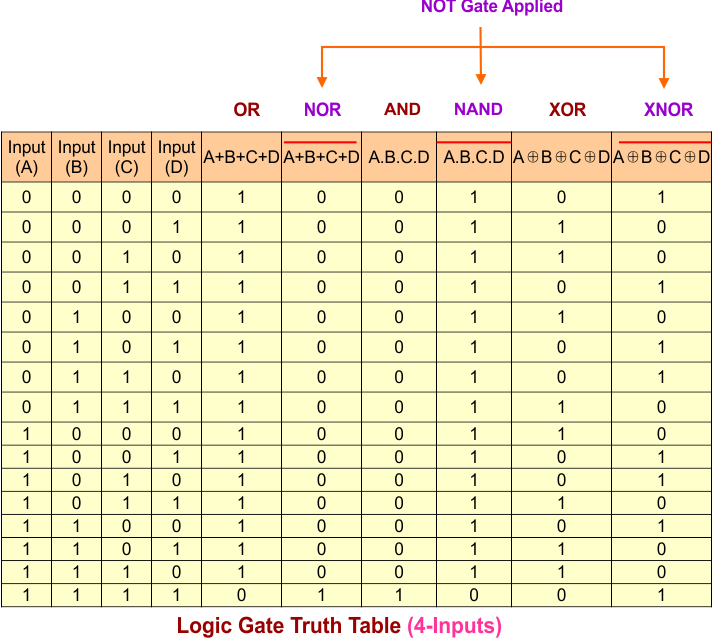
NOT Gate Truth Table with other Logic Gates using 4 inputs
Here is the truth table of NOT gate with other logic gates (OR, AND, and XOR) using four inputs.
|
Important: A four-input XOR can also be implemented using two 2-input XOR gates:
You can remember as follows: For 4-input XOR:
|