











Priority Scheduling Examples
Priority Scheduling is a CPU scheduling algorithm in which each process is assigned a priority, and the CPU always executes the process with the highest priority first. Priority is a numeric value, depending on the OS or scheduling policy; sometimes a smaller number indicates a higher priority, and sometimes a higher number indicates a higher priority
Priority scheduling can be Preemptive or non-preemptive.
- In non-preemptive scheduling, once a process gets the CPU, it continues until it completes. A new incoming process never interrupts the currently executing process.
- In preemptive scheduling, once a process gets the CPU, it may be interrupted by the arrival of a higher-priority process. The higher-priority process immediately gets the CPU.
We will see various examples of priority preemptive and non-preemptive scheduling
Non-Preemptive Priority Scheduling Example 1
Consider the following relation which includes the Processes ID, Arrival time, and burst time.
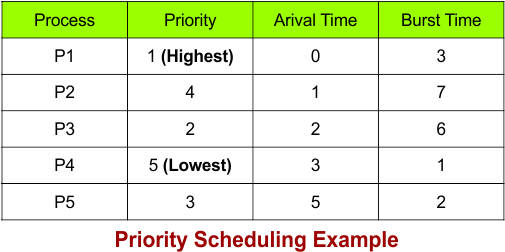
Gannt. Chart of the preemptive priority scheduling example 1 is given below, which shows the process when
- it gets the CPU for the first time
- and completes its execution

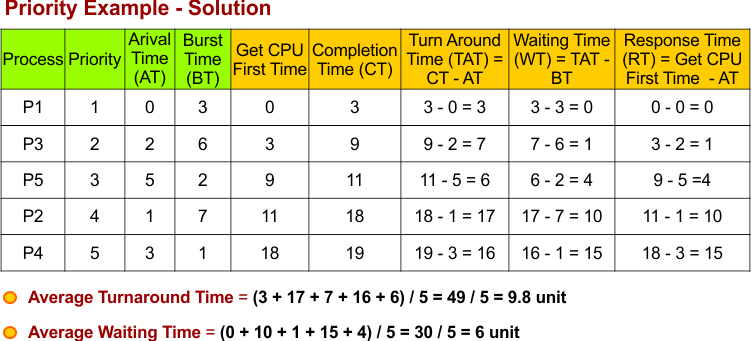
Let’s calculate the When a process gets the CPU first time, Completion Time (CT), Waiting Time (WT), Turnaround Time (TAT), Average Waiting Time (AWT), Average Turnaround Time (ATAT), and Response Time (RT) of example 1
Process ID is set according to Priority to solve Example 1
Non-Preemptive Priority Scheduling Example 2
Consider the following relation, which includes the Process ID, Arrival time, and burst time.
Gannt. Chart of the preemptive priority scheduling example 1 is given below, which shows the process when
- it gets the CPU for the first time
- and completes its execution

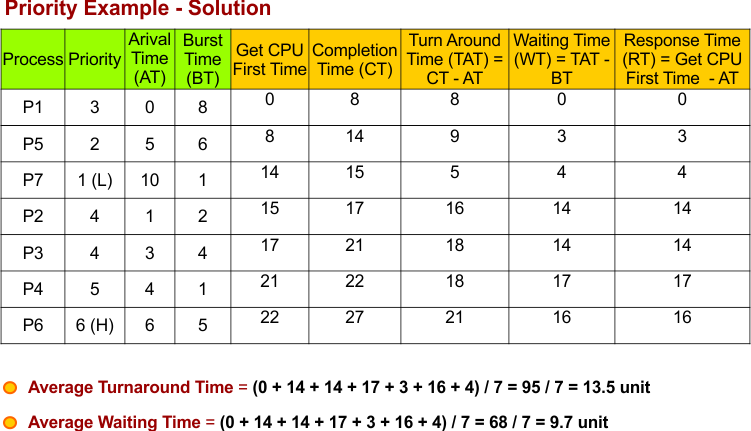
Let’s calculate when a process gets the CPU for the first time, Completion Time (CT), Waiting Time (WT), Turnaround Time (TAT), Average Waiting Time (AWT), Average Turnaround Time (ATAT), and Response Time (RT) of example 2
Process ID is set according to Priority to solve Example 2
Non-Preemptive Priority Scheduling Example 3
Consider the following relation, which includes the Process ID, Arrival time, and burst time.
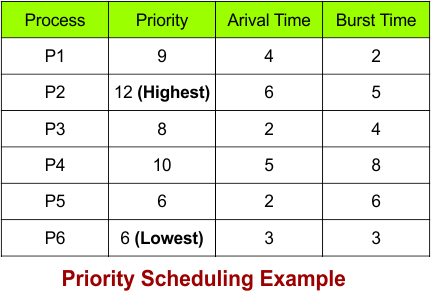
Gannt. Chart of the preemptive priority scheduling example 1 is given below, which shows the process when
- it gets the CPU for the first time
- and completes its execution

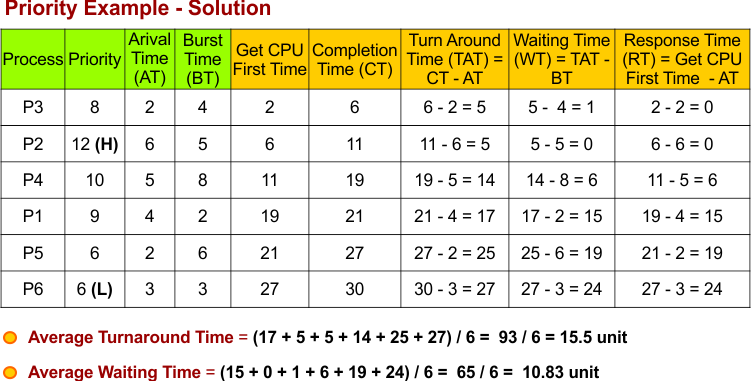
Let’s calculate when a process gets the CPU for the first time, Completion Time (CT), Waiting Time (WT), Turnaround Time (TAT), Average Waiting Time (AWT), Average Turnaround Time (ATAT), and Response Time (RT) of Example 3
Process ID is set according to Priority to solve Example 3
Non-Preemptive Priority Scheduling Example 4
Consider the following relation, which includes the Process ID, Arrival time, and burst time.
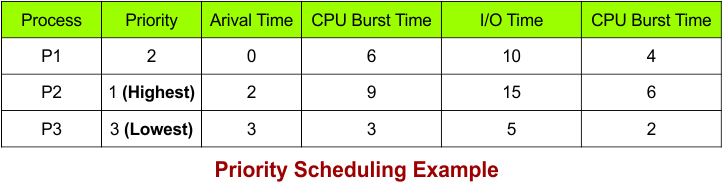
Gannt. Chart of the preemptive priority scheduling example 4 is given below, which shows the process when
- it gets the CPU for the first time
- and completes its execution

Note: Time 22 to 23 and 25 to 30 is CPU idle time in Gantt. Chart
Let’s calculate when a process gets the CPU for the first time, Completion Time (CT), Waiting Time (WT), Turnaround Time (TAT), Average Waiting Time (AWT), Average Turnaround Time (ATAT), and Response Time (RT) of Example 4
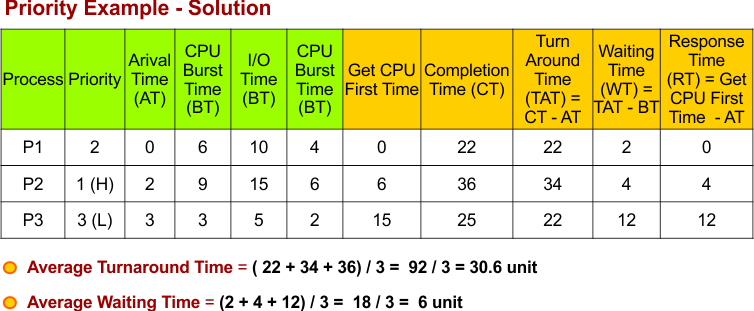
Note: we can calculate CPU utilization and Throughput using the following formulas
- CPU Utilization = (Total Time – Idle Time) / Total = 36 – 6/36 = 30/36
- Throughput = Number of Processes Completed / Total Time = 3/36
Note: Total time is the time from when the first process arrives to when the last process terminates in the Gantt chart.
Preemptive Priority Scheduling Example 1
Consider the following relation, which includes the Process ID, Arrival time, and burst time.
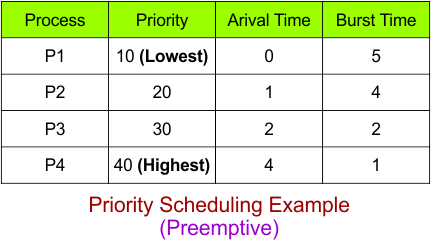
Gannt. Chart of the preemptive priority scheduling example 1 is given below, which shows the process when
- it gets the CPU for the first time
- and completes its execution

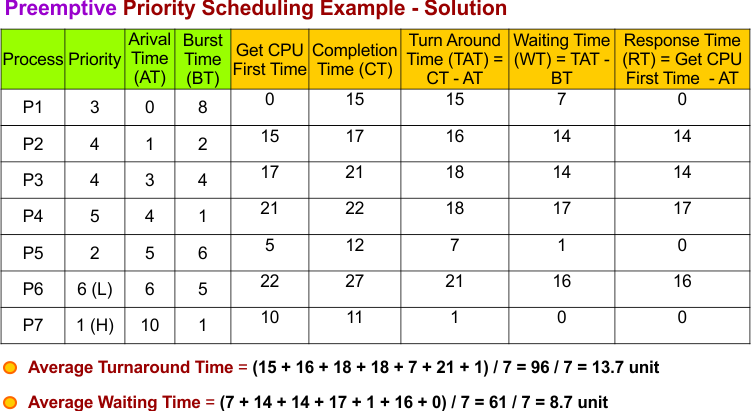
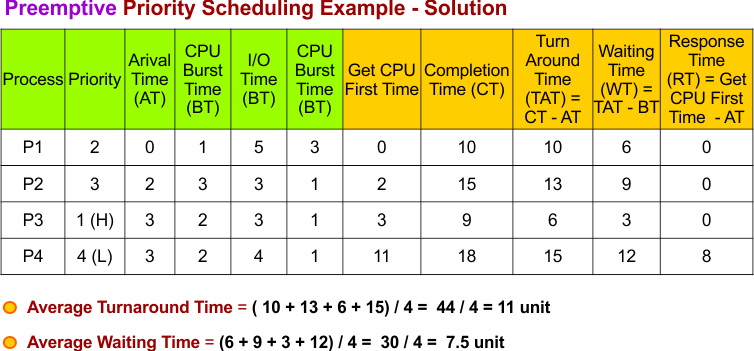
Let’s calculate when a process gets the CPU for the first time, Completion Time (CT), Waiting Time (WT), Turnaround Time (TAT), Average Waiting Time (AWT), Average Turnaround Time (ATAT), and Response Time (RT) of preemptive priority scheduling example 1
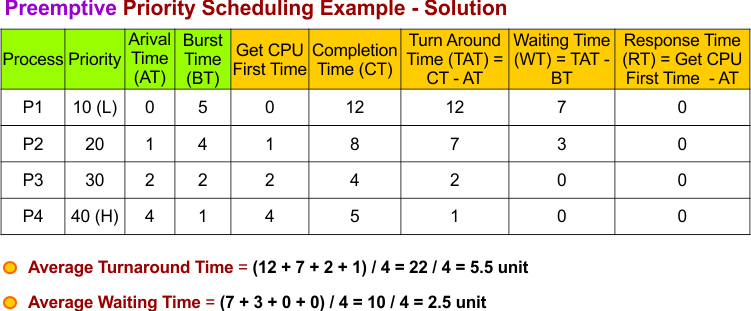
Preemptive Priority Scheduling Example 2
Consider the following relation, which includes the Process ID, Arrival time, and burst time.
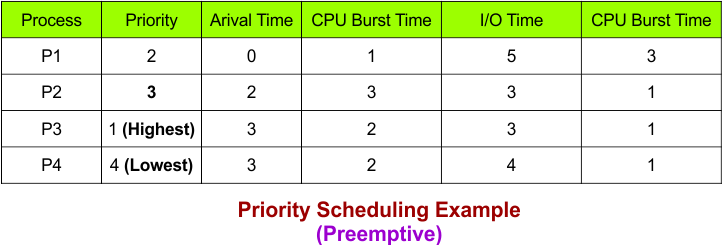
Gannt. Chart of the preemptive priority scheduling example 2 is given below, which shows the process when
- it gets the CPU for the first time
- and completes its execution

Let’s calculate when a process gets the CPU for the first time, Completion Time (CT), Waiting Time (WT), Turnaround Time (TAT), Average Waiting Time (AWT), Average Turnaround Time (ATAT), and Response Time (RT) of preemptive priority scheduling example 2
Preemptive Priority Scheduling Example 3
Consider the following relation, which includes the Process ID, Arrival time, and burst time.
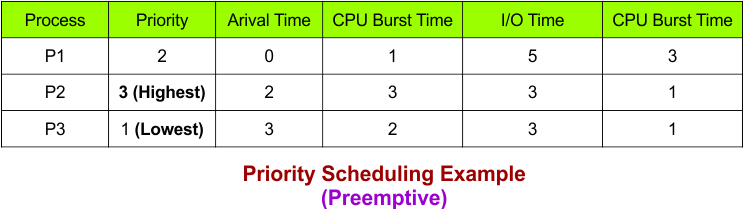
Gannt. Chart of the preemptive priority scheduling example 3 is given below, which shows the process when
- it gets the CPU for the first time
- and completes its execution

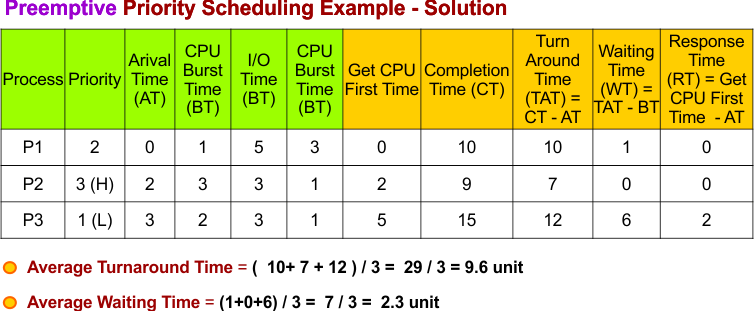
Let’s calculate when a process gets the CPU for the first time, Completion Time (CT), Waiting Time (WT), Turnaround Time (TAT), Average Waiting Time (AWT), Average Turnaround Time (ATAT), and Response Time (RT) of preemptive priority scheduling example 3
Preemptive Priority Scheduling Example 4
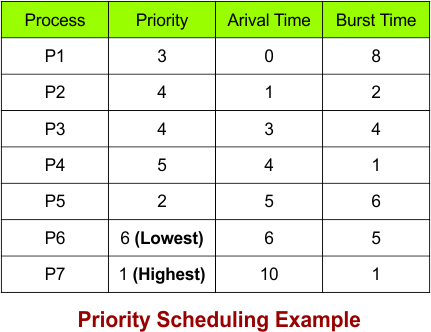
Consider the following relation, which includes the Process ID, Arrival time, and burst time.
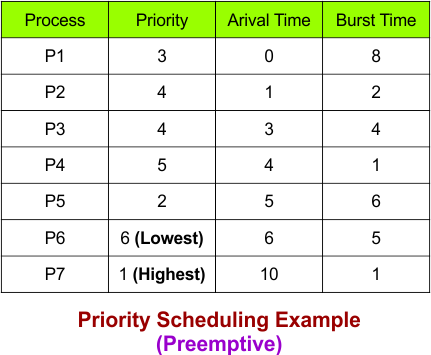
Let’s calculate when a process gets the CPU for the first time, Completion Time (CT), Waiting Time (WT), Turnaround Time (TAT), Average Waiting Time (AWT), Average Turnaround Time (ATAT), and Response Time (RT) of preemptive priority scheduling example 4

Let’s calculate when a process gets the CPU for the first time, Completion Time (CT), Waiting Time (WT), Turnaround Time (TAT), Average Waiting Time (AWT), Average Turnaround Time (ATAT), and Response Time (RT) of preemptive priority scheduling example 4