












Characteristics of Internet of Things (IoT)
The Internet of Things (IoT) is a powerful technology that connects devices, systems, and services to enable smart communication and automation. Understanding the key characteristics of IoT helps students clearly learn how IoT systems work efficiently in real-world environments.
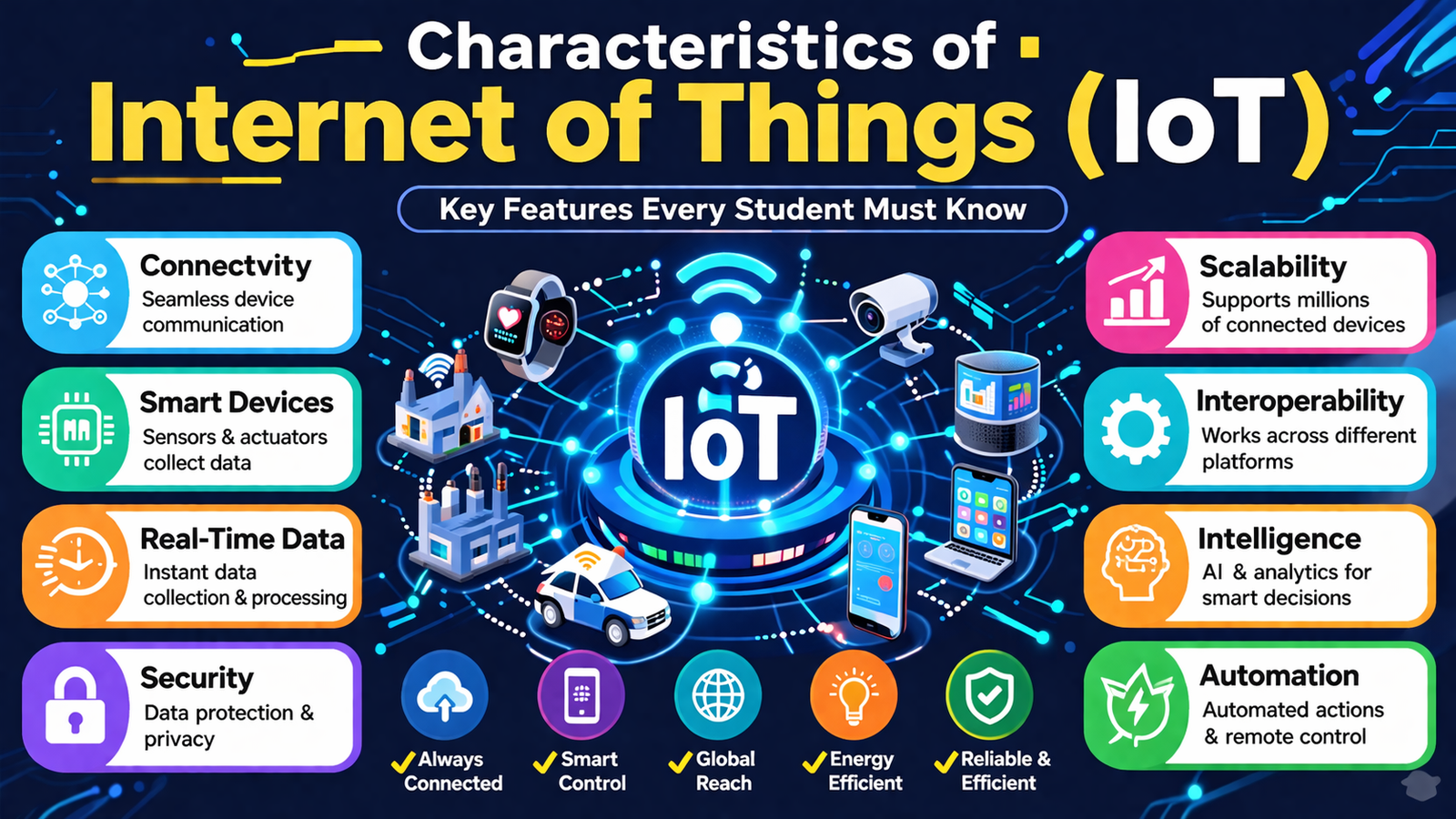
What Are the Characteristics of IoT?
IoT is defined by several core characteristics that make it intelligent, scalable, and highly efficient. These characteristics explain how devices interact, share data, and perform automated actions. The list of key characteristics of IoT is given below.
1. Connectivity
Connectivity is the backbone of IoT that allows devices to communicate and exchange data over networks.
- Network Communication: Devices connect through the internet or local networks
- Technologies Used: Wi-Fi, Bluetooth, Zigbee, cellular networks
- Seamless Integration: Enables interaction between different systems
- Remote Access: Users can control devices from anywhere
2. Intelligence and Automation
IoT systems use data and algorithms to make smart decisions and perform tasks automatically.
- Smart Decision-Making: Systems analyze data to take actions
- Automation: Reduces human intervention
- AI Integration: Enhances learning and prediction
- Example: Smart thermostat adjusting temperature automatically
3. Real-Time Data Processing
IoT systems process data instantly to provide quick responses and actions.
- Immediate Insights: Real-time monitoring and alerts
- Low Latency: Faster decision-making
- Continuous Updates: Data is constantly refreshed
- Example: Health monitoring systems tracking vital signs
4. Scalability
IoT systems can expand easily by adding more devices without affecting performance.
- Flexible Growth: Supports increasing number of devices
- Efficient Resource Use: Manages large networks smoothly
- Cloud Integration: Enables scalable storage and processing
- Example: Smart city systems expanding with more sensors
5. Heterogeneity
IoT includes a wide variety of devices with different hardware, software, and communication protocols.
- Device Diversity: Includes sensors, smartphones, machines
- Multiple Platforms: Works across different operating systems
- Protocol Variations: Uses different communication standards
- Interoperability: Devices work together despite differences
6. Dynamic Changes
IoT systems adapt to changing environments and conditions in real time.
- State Changes: Devices change status based on conditions
- Mobility Support: Devices can move and still stay connected
- Context Awareness: Systems respond to environmental changes
- Example: Smart traffic systems adjusting signals
7. Self-Configuration
IoT devices can automatically configure and set up themselves without manual intervention.
- Auto Setup: Devices connect and configure automatically
- Plug-and-Play: Easy installation and integration
- Minimal Human Effort: Reduces complexity
- Example: Smart home devices connecting automatically
8. Security and Privacy
Security ensures that IoT systems are protected from threats and unauthorized access.
- Data Protection: Secures sensitive information
- Authentication: Verifies users and devices
- Encryption: Protects data during transmission
- Privacy Control: Ensures user data safety
9. Energy Efficiency
IoT devices are designed to consume minimal power while maintaining performance.
- Low Power Consumption: Extends device life
- Efficient Communication: Reduces energy usage
- Battery Optimization: Supports long-term operation
- Example: IoT sensors working for months on batteries
10. Interoperability
Interoperability allows different IoT devices and systems to work together seamlessly.
- Cross-Platform Communication: Devices interact across systems
- Standard Protocols: Use common communication standards
- System Integration: Connects multiple applications
- Example: Smart home systems integrating multiple devices
Detailed Comparison of IoT Characteristics
Understanding IoT characteristics becomes easier with a structured comparison of their roles and functions. The comparison of key IoT characteristics is given below.
| Characteristic | Description | Example |
|---|---|---|
| Connectivity | Enables communication between devices | Wi-Fi connected smart devices |
| Intelligence | Makes smart decisions using data | Smart thermostat |
| Real-Time Processing | Provides instant response | Health monitoring system |
| Scalability | Supports system expansion | Smart cities |
| Heterogeneity | Supports diverse devices | Mixed IoT devices |
| Dynamic Changes | Adapts to environment | Traffic systems |
| Self-Configuration | Auto setup and configuration | Plug-and-play devices |
| Security | Protects data and systems | Encrypted communication |
| Energy Efficiency | Minimizes power consumption | Battery-powered sensors |
| Interoperability | Enables system integration | Smart home ecosystems |
Real-World Example of IoT Characteristics
IoT characteristics can be better understood through real-world applications where multiple features work together. The list of IoT characteristics in a practical system is given below.
Smart Home System
A smart home demonstrates how different IoT characteristics combine to create an intelligent environment.
- Connectivity: Devices connect through Wi-Fi
- Automation: Lights and appliances operate automatically
- Real-Time Processing: Instant response to user commands
- Scalability: Add more devices easily
- Security: Protects user data and access
Importance of IoT Characteristics
Understanding IoT characteristics helps in designing efficient, scalable, and secure IoT systems for various industries. The importance of IoT characteristics is given below.
1. Improved Efficiency
IoT characteristics help systems operate faster and more efficiently with minimal human effort.
- Automation: Reduces manual work
- Real-Time Insights: Improves decision-making
- Resource Optimization: Uses resources efficiently
2. Enhanced User Experience
IoT improves user experience by providing convenience and intelligent services.
- Ease of Use: Simple device interaction
- Remote Access: Control from anywhere
- Personalization: Customized user experience
3. Better Decision Making
IoT systems provide accurate and real-time data for smarter decisions.
- Data-Driven Insights: Supports informed decisions
- Predictive Analysis: Anticipates future events
- Efficiency Improvement: Enhances performance
Conclusion
The characteristics of Internet of Things (IoT) such as connectivity, intelligence, scalability, interoperability, and security define how IoT systems function effectively. These features enable smart devices to communicate, process data, and automate tasks, making IoT a key technology in modern digital transformation.