







Sensors, Actuators, and Devices in IoT
Sensors, actuators, and devices are the core building blocks of any Internet of Things (IoT) system. They enable interaction between the physical world and digital systems by collecting data, processing it, and performing actions based on that data.
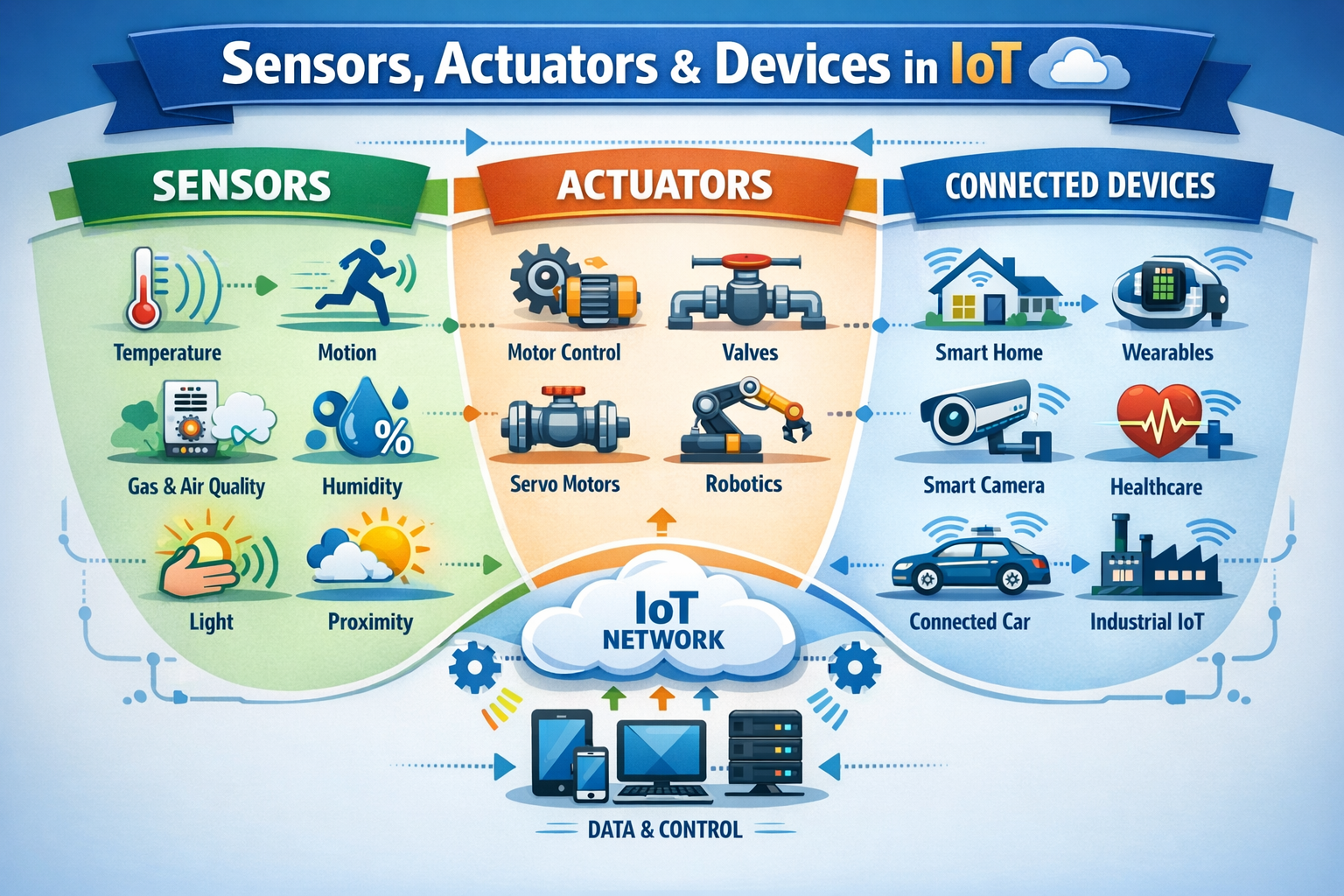
What Are Sensors in IoT?
Sensors are devices that detect and measure physical conditions from the environment and convert them into digital data. This data is then sent to IoT systems for processing and analysis.
1. Temperature Sensors
Temperature sensors measure heat levels in the environment and are widely used in smart homes, agriculture, and industrial systems. They help in maintaining optimal conditions and triggering automated responses like cooling or heating.
2. Motion Sensors
Motion sensors detect movement within a specific area. They are commonly used in security systems, automatic lighting, and smart surveillance applications.
3. Humidity Sensors
Humidity sensors measure the amount of moisture in the air. These are essential in agriculture, weather monitoring, and climate control systems.
4. Light Sensors
Light sensors detect the intensity of light in the environment. They are used in smart lighting systems to automatically adjust brightness based on ambient light conditions.
5. Proximity Sensors
Proximity sensors detect the presence of nearby objects without physical contact. They are used in smartphones, parking systems, and industrial automation.
Key Functions of Sensors
Sensors play a crucial role in IoT systems by continuously collecting and providing real-time data.
- Data Collection: Gather information from the physical environment such as temperature, motion, and light.
- Signal Conversion: Convert physical signals into digital data that can be processed by IoT systems.
- Continuous Monitoring: Enable real-time observation of environmental conditions.
What Are Actuators in IoT?
Actuators are devices that receive commands from IoT systems and perform physical actions based on processed data. They act as the output component of an IoT system.
1. Motors
Motors are used to create movement or mechanical action. They are commonly used in robotics, smart appliances, and industrial automation.
2. Relays and Switches
Relays and switches control electrical circuits by turning devices on or off. They are used in smart homes and industrial systems.
3. Valves
Valves control the flow of liquids or gases in systems such as irrigation and industrial pipelines.
4. Smart Lights
Smart lights adjust brightness or turn on/off automatically based on sensor data or user commands.
Key Functions of Actuators
Actuators enable IoT systems to interact with the physical environment by executing actions.
- Action Execution: Perform tasks such as turning devices on/off or adjusting settings.
- Automation: Enable automatic responses based on sensor data.
- System Control: Control physical processes in real time.
What Are IoT Devices?
IoT devices are smart objects that combine sensors, actuators, and connectivity to collect, process, and exchange data. These devices form the complete IoT system.
1. Smart Home Devices
Smart home devices include thermostats, smart lights, and security cameras that automate household tasks and improve convenience.
2. Wearable Devices
Wearables such as fitness trackers and smartwatches monitor health and activity data in real time.
3. Industrial IoT Devices
Industrial devices include sensors and machines used in manufacturing and automation systems to improve efficiency and productivity.
4. Environmental Monitoring Devices
These devices monitor environmental conditions such as air quality, pollution, and weather.
How Sensors, Actuators, and Devices Work Together
In an IoT system, sensors, actuators, and devices work together to create a complete cycle of data collection, processing, and action.
1. Data Collection by Sensors
Sensors collect real-time data from the environment and send it to the system.
2. Data Processing
The collected data is processed by IoT platforms or cloud systems to generate insights.
3. Decision Making
Based on the processed data, the system determines the appropriate action.
4. Action by Actuators
Actuators perform the required action, such as turning on a device or adjusting system settings.
5. Continuous Feedback Loop
The system continuously monitors and adjusts actions based on new data, creating an automated cycle.
Benefits of Sensors, Actuators, and Devices in IoT
These components provide significant advantages in modern IoT systems.
1. Automation
Enable automatic control of systems without human intervention.
2. Real-Time Monitoring
Provide continuous data for better decision-making.
3. Improved Efficiency
Optimize resource usage and system performance.
4. Enhanced User Experience
Provide convenience and smart control in daily life.
5. Cost Savings
Reduce operational costs through automation and efficient resource management.
Challenges in Sensors, Actuators, and Devices
Despite their importance, these components face several challenges.
1. Power Consumption
Many IoT devices rely on batteries, requiring energy-efficient design.
2. Security Risks
Devices can be vulnerable to cyberattacks if not properly secured.
3. Data Accuracy
Incorrect sensor data can lead to wrong decisions and actions.
4. Integration Issues
Different devices and technologies may not work seamlessly together.
5. Maintenance Requirements
Devices require regular updates and maintenance for optimal performance.
Conclusion
Sensors, actuators, and devices are fundamental components of IoT systems that enable interaction between the physical and digital worlds. By working together, they collect data, process information, and perform actions, making IoT systems intelligent, automated, and efficient for real-world applications.
Sensors, Actuators, and Devices in IoT – Subtopics
Explore Sensors, Actuators, and Devices in IoT to understand how physical data is collected, processed, and converted into real-world actions. Learn how sensors detect environmental changes, actuators perform actions, and devices work together to create smart and automated systems.
- Sensors and Actuators in IoT Explained for Beginners
- What Are IoT Devices and How They Work
- Types of Sensors Used in IoT Systems
- Temperature, Humidity, Motion Sensors in IoT
- Actuators in IoT Systems Explained with Examples
- Difference Between Sensors and Actuators in IoT
- Working Process of IoT Devices Step by Step
- Input and Output Devices in IoT Systems
- Smart Sensors and Intelligent Devices in IoT
- IoT Device Hardware Components Explained
- Embedded Systems in IoT Devices Explained
- Low Power Devices in IoT Systems
- Wireless Sensor Networks (WSN) in IoT
- Real World Examples of IoT Sensors and Devices
- Choosing the Right Sensors for IoT Projects
- IoT Device Communication with Sensors and Actuators
- Energy Efficient Sensors in IoT Systems
- Challenges in IoT Devices and Sensor Integration
- Calibration and Accuracy of IoT Sensors
- Future Trends in IoT Sensors and Smart Devices