











History and Evolution of Internet of Things (IoT)
The History and Evolution of Internet of Things (IoT) explains how connected devices have transformed from simple machine communication to intelligent, data-driven ecosystems. Understanding this journey helps students and professionals see how IoT became a key part of modern technology.
Introduction to IoT Evolution
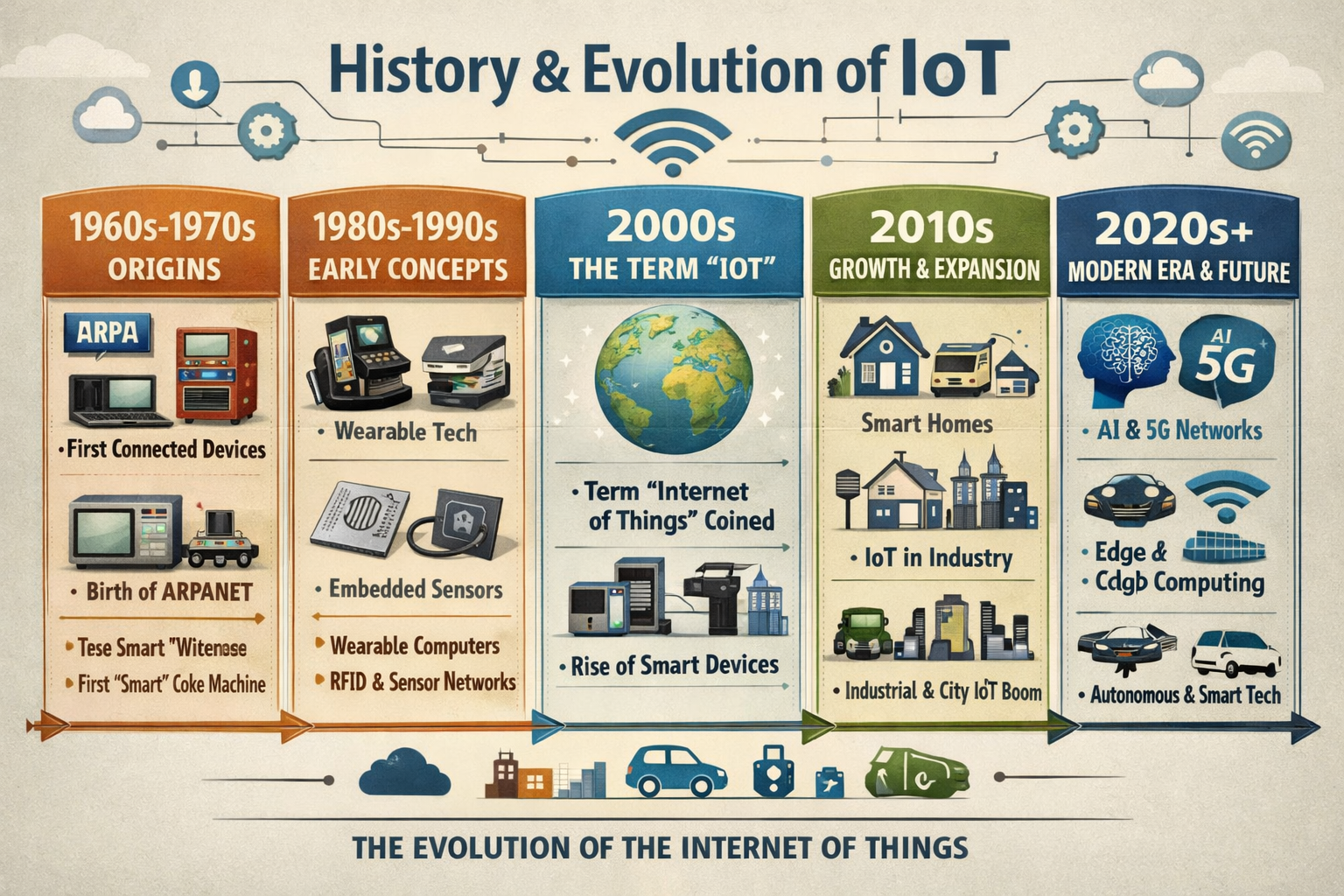
The evolution of IoT is a gradual process that started with basic communication between machines and has grown into a global network of smart devices. Today, IoT connects billions of devices, enabling automation, real-time monitoring, and intelligent decision-making.
Early Foundations of IoT (Pre-Internet Era)
Before the internet became widely available, the idea of connected devices already existed in simple forms. Early systems focused on communication between machines without human involvement.
Machine-to-Machine (M2M) Communication
M2M communication was the first step toward IoT, where devices could exchange data directly.
- Basic Connectivity: Devices communicated using wired networks or telephone lines
- Limited Functionality: Only simple data exchange was possible
- Industrial Use: Used in manufacturing and monitoring systems
This stage laid the groundwork for automated systems and remote monitoring.
Birth of the Internet and Connected Devices (1980s–1990s)
The development of the internet enabled devices to communicate over long distances, marking a major milestone in IoT history.
First Internet-Connected Devices
- Connected Machines: Early experiments connected devices like vending machines to the internet
- Remote Monitoring: Users could check device status from a distance
- Innovation Start: Researchers explored new possibilities of connected systems
This era introduced the concept of smart devices connected through networks.
Emergence of the Term “Internet of Things” (1999)
The term Internet of Things (IoT) was officially introduced by Kevin Ashton in 1999. This marked the beginning of IoT as a recognized concept.
Concept Development
- RFID Technology: Used to track objects using radio signals
- Automation Vision: Devices could identify and communicate without human input
- Data Integration: Physical objects could be connected to digital systems
This phase defined IoT as a system of interconnected physical devices.
Growth of IoT Technologies (2000–2010)
During this period, technological advancements made IoT more practical and accessible.
Key Technological Developments
- Wireless Communication: Wi-Fi and Bluetooth enabled device connectivity
- Sensor Technology: Sensors became smaller, cheaper, and more efficient
- Cloud Computing: Enabled storage and processing of large amounts of data
These improvements allowed IoT systems to become more scalable and efficient.
Rapid Expansion of IoT (2010–2020)
IoT experienced significant growth as internet access and smart devices became widespread.
Smart Devices and Applications
- Smart Homes: Devices like smart lights and thermostats
- Wearable Technology: Fitness trackers and smartwatches
- Industrial IoT (IIoT): Automation in factories and industries
Role of Big Data and Analytics
- Data Collection: Large volumes of data generated by devices
- Real-Time Analysis: Quick decision-making based on data
- Improved Efficiency: Better performance and reduced costs
This era transformed IoT into a mainstream technology used in everyday life.
Modern IoT Era (2020–Present)
Today, IoT is an advanced ecosystem that integrates multiple technologies to deliver intelligent solutions.
Integration with Advanced Technologies
- Artificial Intelligence (AI): Enables smart decision-making
- Edge Computing: Processes data closer to devices
- 5G Connectivity: Provides faster and more reliable communication
Key Characteristics of Modern IoT
- Automation: Devices perform tasks without human intervention
- Real-Time Monitoring: Instant tracking and updates
- Scalability: Supports billions of connected devices
- Interconnectivity: Seamless communication between systems
Modern IoT is used in smart cities, healthcare, agriculture, transportation, and many other fields.
Future Trends in IoT Evolution
The future of IoT is focused on making systems more intelligent, secure, and efficient.
Emerging Trends
- AI-Driven IoT: Smarter automation and predictive systems
- Enhanced Security: Stronger protection for connected devices
- Digital Twins: Virtual models of real-world systems
- Sustainable IoT: Energy-efficient and eco-friendly solutions
These trends will continue to shape the next generation of connected technologies.
Importance of Understanding IoT Evolution
Learning the history and evolution of IoT helps in understanding how current technologies work and where they are heading.
- Better Learning: Builds a strong conceptual foundation
- Technology Awareness: Understands modern digital systems
- Career Opportunities: Prepares for future tech roles
- Innovation Insight: Encourages development of new solutions
Conclusion
The history and evolution of IoT shows a clear journey from simple machine communication to highly intelligent connected systems. With continuous advancements in AI, cloud computing, and networking, IoT is becoming more powerful and essential in everyday life. Understanding this evolution helps learners and professionals adapt to future technological changes and innovations.