










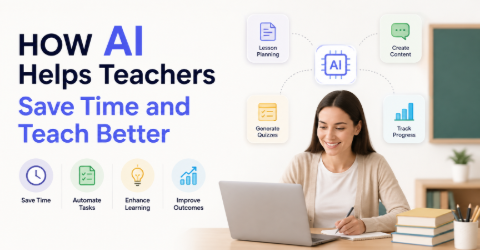
How AI Helps Teachers Save Time and Teach Better
“The average teacher works 5.9 hours a week. Only 46% of that is actually teaching.”
AI for teachers gives you those hours back. It helps in managing daily tasks like lesson planning, Assessment And Connect with students.
Essentially, artificial intelligence is a type of technology that makes it possible
for computers to take on and perform various tasks which would normally need human thought processes. It is not always perfect.
It can help out by answering questions, working through problems, and looking at information to make sense of it. This tec͏hnology is becoming a transformative force, and it is reshaping a number of different industries, including the education sector.
Within the education sector itself, AI comes into play as a kind of teacher’s assistant. The point is not for it to replace a teacher entirely.
In this article, I explain to you how AI helps teachers to perform their repetitive tasks for students in minutes. It is meant to help cut down on some of the repetitive work, so teachers have more opportunity to focus on the actual teaching, on mentoring, and connecting with their students.
How AI helps teachers save time
Artificial intelligence is becoming familiar in our daily lives, and the world of education is no exception. At digitalairole we analyze the different tools and software that transform daily workflows for teachers and students.
A research found 32% teachers use AI tools weekly to save time in lesson planning and activities.
While the idea of AI in the classroom might seem futuristic, many educators are already using it as a practical tool to work smarter, not harder. It helps Teachers to get their hours back.
Automate lesson planning
Lesson planning takes hours when teachers have to prepare content, set learning plans, or set goals. By using AI tools, teachers can easily handle the repetitive, time-consuming parts of creating a lesson. AI does not replace teachers, but it can act as an assistant. It gives you the skeleton. It can build the first version for you, and then you edit, personalize, and teach it.
It can also generate a topic into a complete lesson outline with an introduction and key concepts. It can also suggest clear learning objectives that students can easily
Understand. Teachers use these suggestions to match their curriculum.
Create Quizzes and AssessmentsFaster
Artificial intelligence creates quizzes and assessments for students as per the teacher’s requirements. This saves time for teachers and gives them more opportunity to assess the students. This is a very time-consuming task from the teachers’ point of view. It creates the following types of assessments:
- Multiple choice questions
- Short answer questions
- True or false statements
GENERATE TEACHING MATERIALS
Developing new materials for each lesson may prove to be extremely time-consuming
It can be a huge hassle to make new materials every lesson. It can generate:
- class activities
- Worksheets
- study guides
- practice exercises around a specific topic
It can also generate discussion questions that help students to think beyond rote learning. It can also be helpful in simplifying complex topics. Scientific, mathematical, or technical terms and concepts that are difficult can be restated in simpler terms.
Speed Up Grading and Feedback
Another task that can consume much of teachers’ time is grading.
It can also help to provide initial feedback on student work. It can provide insights on sentence structure, clarity, organization, or missing information, for instance. Teachers can then check and customize the feedback, share it with students, and repeat the process.
When multiple students have misunderstandings about the same concept, the teacher can discuss the misconception in a later lesson.
It is important that teachers verify that the feedback is accurate, fair, appropriate, and meaningful for the student.
How AI Helps Teachers to Teach Better?
Time-saving is just one AI advantage. With careful use, it can also enable teachers to offer more flexible and individualised learning experiences.
Personalized learning for students
All students are not learning at the same rate. Some need further explanation and practice, and others are able to move on to more complex material.
It can personalise explanations for each learning level. A teacher may request a more basic explanation of a concept for students who are having difficulty.
Teachers can create customized worksheets for a given skill or concept rather than making multiple extra worksheets.
For high-performing students, it can identify questions, research topics, case studies, or problem-solving exercises that are more challenging to engage them in deeper thinking.
Make lessons more engaging
Engaging students can be a challenge, especially for teaching complex or new concepts. Teachers can use AI to create quizzes, games, scenarios, story prompts, and discussion questions.
It can also recommend interactive learning activities, such as debates, simulations, role-play, and group challenges. These ideas can make the lessons more dynamic and help students engage in the lesson.
Support students with different learning needs
Students might require information to be presented in other formats. It can assist in breaking down complex language and creating materials that are easier to understand.
Teachers may utilize it to develop a progressive explanation of complicated processes. This can be especially helpful when students require extra help on multi-step assignments or tough concepts.
Use of AI Tools for Teachers
The best AI tools for teachers will depend on the type of task a teacher wishes to enhance. Some tools may be used to assist in lesson planning, others in creating assessments, presentations, or classroom materials.
AI Tools for Lesson Planning
Teachers need to consider features that assist them in planning, curriculum mapping, setting learning goals, and creating activities when selecting an AI tool for lesson planning.
A well-designed tool should enable teachers to give clear directions: what the subject is, which grade it is for, which lesson it is, and what the outcomes are.
The best tools will help you develop, modify, and improve lesson content based on classroom needs.
AI Tools for Quiz and Assessment Creation
AI assessment tools can aid in generating questions and assist teachers in crafting various question types, such as multiple-choice, short-answer, and practice questions.
One can also save much time in preparation by being able to tailor the difficulty and create questions from the lesson content. But always remember to verify accuracy and alignment with learning objectives before taking the quiz generated by AI.
AI tools for content and classroom Materials
AI can also contribute to the development of common teaching materials such as:
- Worksheets and practice exercises
- Outline of presentation and content of slides.
- Study guides and lesson summaries.
- Games and activities designed to facilitate learning.
- Questions for discussion/activity ideas for the classroom.
The right tool should make the creation of content easier, not more work. Materials should be allowed to be edited, exported, and adapted by the teacher for their classroom.
How to use the right AI tools for Teaching
There are numerous AI tools to choose from, and it can be overwhelming to decide which one is right for you. Teachers should not choose a tool because it is popular; they should go through the process of deciding what problem they wish to solve.
Identifying a Teaching task you want to improve
The first step is to determine the room or space in which you spend the most time. This might include:
- Lesson planning
- Assessment creation
- Content development
- Student engagement
- Administrative work
A teacher who is struggling with the grading task would require a different AI tool from a teacher who would like to make classroom presentations.
Check Accuracy and Educational Quality
Review the accuracy and educational value of the text. While AI can generate valuable content, it also has the potential to generate errors. However, it’s crucial to not simply copy and paste AI-generated content. All lessons, activities, assessments, and explanations must be checked before being given to students.
Consider Privacy and Student Data
Privacy must be a key consideration in the application of AI in education. Teachers should never place sensitive student information in tools unless they know how the information is being handled.
Personal identifiable student information and uploaded student work need to be handled with extra care by teachers.
Look for Ease of Use and Integrations
It is not always helpful if a powerful tool is not straightforward to operate. Find an easy-to-use interface that works easily in your workflow.
Other helpful features can be:
- The ability to integrate with learning management systems.
- Easy export options
- Easy editing and customization.
- The simplest tool to accomplish a genuine problem is typically the best.
How Teachers Can Use AI Responsibly
While AI has the potential to be beneficial in education, it must be used responsibly. For teachers, AI should be used as a tool to assist in their work, not as a system to make decisions on their behalf.
Keeps Teachers in Control
A teacher’s professional opinion should always prevail. AI can generate ideas and drafts, and detect patterns, but it cannot perceive a classroom the same way that a teacher can.
Teachers need to keep control of significant outputs and determine what is suitable for their students.
Check AI-Generated Content
Teachers should check the facts and thoroughly read AI-generated content before their use. Any mistakes should be corrected before the content is used in the classroom.
Teach Students how to use AI ethically
Educate Students on the ethical use of AI. Along with the rising prevalence of AI, there is also an increasing need for students to learn how to make responsible use of it. Teachers may be able to give context to the situations in which it can be useful, and when they should do it themselves.
Limitations of AI in Education
While AI can be a valuable tool for teaching, it is not a substitute for human interaction. Knowing how to use it with some limitations can make it more effective for the teacher.
AI Can Generate Incorrect Information
It can generate incorrect or incomplete information, or information that is outdated. Sometimes gives incorrect answers confidently, so the teacher needs to review.
AI can’t replace teacher-to-student relationships
Teaching is more than information. AI can give you information about any topic; it can suggest different ideas. But it can’t understand a student’s emotions. It is emotionless . But a teacher can understand students’ dynamics and weaknesses. Teachers motivate students for better outcomes, but AI can’t.
AI may Produce Generic Learning Material
It can potentially create uniform learning content. It may produce generic learning materials
If left unguided, AI-generated content may be too broad, or might lack alignment with the teacher’s curriculum and classroom context. Teachers can enhance the outcomes by offering guiding prompts and following them up with tailoring the results.
Teachers still need to review AI outputs
The teacher is responsible for checking the outputs to ensure that they are accurate, relevant, fair, and age-appropriate. It is not to seek to fully automate the teaching process. It is to minimize repeat tasks for teachers, to enable them to use their time effectively.
The Future of AI-Assisted Teaching.
Personalization and automation will likely be a key component of the future of AI in education. It can be used to support teachers in continuing to customize lesson plans, create practice problems, and identify common learning difficulties.
The best approach is to use it as a classroom assistant rather than a teacher.
Conclusion
For teachers, AI can perform repetitive tasks like creating quizzes, developing teaching materials, and providing preliminary feedback, effectively reducing time spent on these activities. It can also provide educators with the ability to customize learning, develop interesting activities, and present challenging concepts in various ways.
The real impact is in leveraging AI and not merely taking it at face value. Teachers must have control, check the output of AI, respect student privacy, and exercise their professional judgment throughout the process.
In the end, AI can take care of routine duties, and teachers can concentrate on teaching, mentoring, and establishing significant connections with their students.