










How CRM Software Is Transforming Student Management in Educational Institutions
Educational institutions today manage far more than classrooms, academic schedules… and the like. I mean, from student inquiries and admissions to communication engagement feedback and even alumni ties, institutions end up handling this constant stream of student data. When people try to run it all through spreadsheets, email threads, and disconnected systems it can quickly turn into communication gaps, plus extra admin headaches.
And this is where CRM software starts to matter a lot more in modern education. A good, well-designed education CRM can centralize student information, automate those repetitive actions, improve how messages are exchanged, and it also gives the institution a clearer view of the entire student journey.
Since competition keeps rising between schools, colleges, universities, coaching centers, and online education providers, investing in CRM software development can let institutions build a more organized, student-first management ecosystem. Honestly, it’s like getting the whole process to finally stay in one rhythm.
What Is CRM Software for Educational Institutions?
CRM software for education is basically a centralized platform made to manage interactions and relationships with students, prospective students, parents, staff, and alumni.
Unlike classic customer relationship management tools that were mostly created for sales teams, education-oriented CRM solutions work around the student lifecycle. They help institutions manage prospective student inquiries, admission applications enrollment, communication, engagement, support requests, and the relationships after graduation.
Instead of keeping information spread across several spreadsheets, forms, and stand-alone applications, staff can pull the relevant student details from one custom team collaboration software with CRM support.
Why Are Educational Institutions Adopting CRM Solutions?
The student journey involves numerous touchpoints. A prospective student may first discover an institution through a website, submit an inquiry, communicate with an admissions counselor, attend an orientation session, complete an application, and eventually enroll.
Without a centralized system, information can become scattered across email accounts, spreadsheets, messaging applications, and departmental databases.
A CRM provides a connected view of these interactions. Admissions teams can track inquiries, counselors can follow up with prospects, administrators can monitor applications, and support teams can access communication history.
This creates a smoother experience for both students and staff.
Key Ways CRM Software Is Transforming Student Management
1. Centralizing Student Information
One of the most notable upsides of CRM software is that it gives centralized data management, kind of all in one place, even if people forget the details. Institutions can keep student profiles with contact data, application status, communication history, preferences, documents, day to day interactions, plus other useful context.
Then authorized staff can open the most recent version without having to keep asking students for the same details over and over, which cuts duplication and creates a smoother , more consistent student management process.
2. Improving Student Recruitment and Admissions
During busy enrollment seasons admissions teams may deal with hundreds or even thousands of inquiries. If it’s all handled manually, tracking every prospect can be messy and follow-ups get missed, and opportunities can slip away.
With CRM software, leads can be collected automatically from websites, landing pages social media campaigns, and other places where people show interest. Admissions teams can sort these prospects by programs, interests, location, or by where they are in the application stage.
Automated nudges and follow up sequences also help counselors stay in touch with prospective students at the right moment , not too late, not too early.
3. Automating Routine Administrative Tasks
Administrative groups usually spend a lot of time on repeating chores like sending reminders updating records, arranging follow-ups, and preparing reports. CRM automation reduces that burden.
For instance, when a prospective student submits an application the CRM can automatically route the inquiry to an admissions counselor, send a confirmation message, make a follow-up reminder, and revise the student’s status.
That means staff can focus more on the parts that actually need human judgment and conversation, instead of tedious coordination.
4. Personalizing Student Communication
Students kind of expect institutions to deliver timely, and relevant communication. It’s rarely effective when you send the exact same generic note to everyone, like that.
A CRM helps institutions split students into segments, based on things like academic program, where they are in enrollment, what they’re interested in , their location, or even their engagement history.
For instance, prospective students who have started but not finished an application can get reminders that actually talk about the next steps, not just “please apply.” Meanwhile, existing students might receive suitable updates about upcoming events, important deadlines, or academic support resources.
That kind of personal touch can boost engagement and also shrink those annoying communication gaps.
5. Strengthening Student Support
Student management doesn’t really stop once enrollment is done. Institutions have to keep supporting students through the whole academic journey.
CRM platforms let staff follow up on student questions, support requests, complaints, and past interactions. So when a student contacts the institution, staff can quickly grasp the situation instead of restarting the conversation from zero.
This tends to create a more reactive support experience, and it also helps institutions spot repeating problems sooner.
6. Monitoring Student Engagement
A CRM can offer useful visibility into how students are interacting.
Institutions can observe activities like event sign ups, email engagement, application progress, support requests, and even how students respond to messages.
These insights help administrators notice students who might need extra attention. Like, if engagement starts dropping, advisors can reach out proactively, instead of waiting for the student to ask for help.
7. Making Data-Driven Decisions
Educational instutitions create huge volumes of data every single day. the real challenge is not just collecting it, but sort of turning that stuff into insights that people can actually use , yknow in practice.
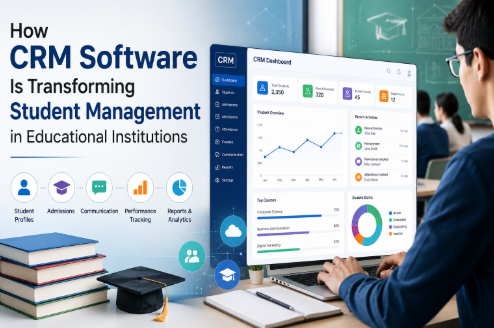
CRM dashboards can support administrators in keeping an eye on different metrics, like admissions, enrollment, inquiries, campaign results , student participation, and day to day communications.
Rather than leaning only on manually prepared reports, decision-makers can tap into centralized data to spot emerging trends and judge how well various initiatives are performing.
Important Features of an Education CRM
The precise features vary based on what each institution needs, but a solid education CRM often includes things such as
- student and prospect profile management
- lead and inquiry management
- admission pipeline management
- automated communication
- email and SMS integration
- task and follow-up management
- application tracking
- event and campaign management
- student support ticketing
- analytics and reporting
- role-based access control
- third party integrations
- mobile accessibility
Institutions can also connect CRM platforms with learning management systems, student information systems , payment gateways, communication tools, and other educational technologies.
How CRM Software Benefits Different Teams
CRM software value kinda reaches across a bunch of departments, not just one. Like admissions teams can organize inquiries and track applications more efficiently , with less headache. Counselors are able to keep communication histories and handle follow ups without losing the thread.
Administrative teams can cut down on manual data entry and those repetitive routines that keep coming back. Marketing teams can segment audiences and assess campaign performance in a cleaner way too. And management teams can pull up centralized reports, then keep an eye on key performance indicators, as they happen.
All that cross functional visibility is arguably one of the strongest advantages you get from adopting CRM technology .
Custom CRM vs Off-the-Shelf Solutions
Educational institutions can choose between a ready made CRM platform, or they can go for some custom-built one kinda idea. In a lot of situations off the shelf software works fine for schools with normal or standard requirements, and they only need a couple tweaks. But if an organization has more complicated workflows, very specialized admission pathways, multiple campuses, or it already has its own tech ecosystem set up, then a custom CRM solution may end up fitting a lot better.
When an institution collaborates with seasoned CRM software development companies, it’s way simpler to shape the platform around their own internal processes, not just force their workflows into a generic system that’s almost right but never quite there, if you know what I mean. Also, when you build a custom CRM, you get extra room for integrations, different types of user roles, automation tools, deeper reporting, and even potential future growth… which helps when new requirements pop up later and don’t turn into a massive headache.
What Does the Future Hold for Education CRM?
The future of student management is getting more smart, more personalized, bit by bit. CRM platforms are set to lean into AI-powered analytics, chatty conversational assistants, predictive insights, recommendation engines, plus workflow automation that kind of quietly keeps things moving.
For instance, AI might help spot students who are likely to lose interest, then it can summarize the student interactions for counselors, answer those basic admission questions, or point prospective students toward programs that actually fit what they want.
Still, the tech part should support—not fully replace the real human connections that make education work. The best institutions will use CRM systems to give staff clearer context and extra breathing room so they can concentrate on students.
Conclusion
CRM software is reshaping student management by tying together admissions, communication, engagement, support, and data handling into one connected setup. Instead of juggling unrelated tools or depending on slow manual work, educational institutions can use CRM technology to craft a more orderly and individualized student path.
And for schools looking at digital change, CRM software development is a chance to design systems that match their own educational priorities. With the right strategy and help from an experienced CRM software development company, institutions can raise operational efficiency while also offering a more responsive experience to students at each stage of the journey.