












9 Best OpenVPN Alternatives in 2026: Faster, Simpler Remote-Access VPN Options
OpenVPN still gets the job done. But if you’re hunting for alternatives in 2026, you’ve likely felt its pinch points: CPU spikes, cluttered certificate profiles, and slow reconnects. Meanwhile, WireGuard lives in the kernel, mesh VPNs breeze past carrier-grade NAT (CGNAT), and zero-trust gateways offer app-level access out of the box. In short, sticking with OpenVPN is now a deliberate decision—not the industry default.
What counts as an OpenVPN alternative?
Google often bundles protocols, mesh VPNs, ZTNA clouds, and even streaming-only privacy tools into one pile. For this guide, we consider a product only if it:
- provides secure, private access to resources you can’t already reach
- publishes documentation and a changelog with at least one stable release in the past 12 months
- installs without demanding specialist cryptography skills
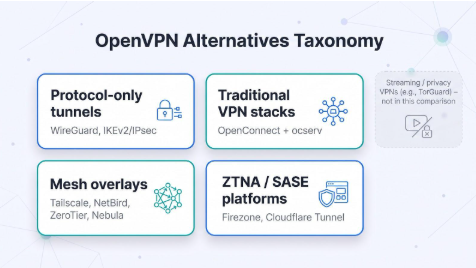
We group the qualifying tools into five technical families:
- Protocol-only tunnels: lean engines such as WireGuard or IKEv2/IPsec that move packets fast but leave identity and key rotation to you.
- Traditional VPN stacks: self-hosted concentrators like OpenConnect + ocserv that follow the classic hub-and-spoke model.
- Mesh overlays: peer networks (Tailscale, NetBird, etc.) that handle NAT traversal, device enrollment, and ACLs for you.
- ZTNA / SASE platforms: Firezone, Cloudflare Tunnel, and similar services that grant app or subnet access based on identity and policy.
- Hosted VPN services: providers such as TorGuard that run the servers for you and support several protocols in one subscription.
With scope set, we can compare how each family improves on-or mirrors-what OpenVPN offers today.
Where OpenVPN still shines and where it falls behind
OpenVPN has earned its “runs-anywhere” reputation. With both UDP and TCP transports, it slips through most corporate firewalls, and its plug-in system connects smoothly to RADIUS, LDAP, and smart-card workflows that many enterprises still use.
The project is not idle. Version 2.7.0 (February 11, 2026) paired with the in-tree Data Channel Offload (DCO) module in Linux 6.16, shifting bulk encryption into the kernel and trimming context-switch overhead by up to 60 percent in the project’s microbenchmarks. Security patches land regularly; 2.7.2 on April 23, 2026 fixed CVE-2026-40215 and CVE-2026-35058, keeping the roughly quarterly rhythm intact.
Yet daily friction persists:
- Resource load. When DCO is disabled or missing, control and data still share a userspace process, and high-throughput tunnels can max out a low-cost VPS.
- Key lifecycle. Each user certificate is its own identity. Rotating 50 contractor keys can still trigger a change window and help-desk tickets.
- Mobility gaps. Reconnection after a Wi-Fi-to-5 G hand-off often takes several seconds, long enough to drop SSH or database sessions.
- Firewall traps. UDP-only deployments fail on networks that block outbound UDP. Switching to TCP 443 keeps traffic moving but introduces the familiar TCP-in-TCP penalty.
OpenVPN remains a dependable toolkit for mixed environments, but lighter code paths, built-in identity, and automatic NAT traversal are now table stakes, setting the stage for the nine challengers you’ll meet next.
OpenVPN alternatives at a glance
Looking for the quick summary? The table below shows how each contender fits into the bigger picture, so you can narrow your options before reading the individual profiles.
| # | Alternative | Best for | Network model | Self-host? | Mobile support | Survives TCP-only networks | Current free tier* |
| 1 | TorGuard | Hosted VPN with no servers to run | Hosted hub-and-spoke (OpenVPN, WireGuard, OpenConnect) | No (dedicated servers available) | Native apps | Yes (OpenConnect and stealth on TCP 443) | — |
| 2 | Tailscale | Quickest all-round mesh | L3 WireGuard | Control plane via Headscale | Excellent | Relay over TCP 443 | Up to 6 users |
| 3 | WireGuard | Raw speed & full control | L3 protocol only | Always | Native OS apps | None | — |
| 4 | NetBird | Open-source managed mesh | L3 WireGuard | Yes | Good | Relay over TCP 443 | 100 machines |
| 5 | Firezone | Identity-aware resource access | Gateway + mesh | Limited | Good | Relay over TCP 443 | 6 users |
| 6 | IKEv2 / IPsec | Standards & native clients | L3 tunnel protocol | Always | Native OS | UDP 4500 only | — |
| 7 | Cloudflare Tunnel + WARP | Managed app access | Connector + edge | No | Strong | HTTPS (TCP 443) | Up to 50 users |
| 8 | ZeroTier | Layer-2, legacy LAN | L2/L3 virtual Ethernet | Controller | Good | Built-in TCP hole punch | 10 devices |
| 9 | OpenConnect + ocserv | Port-443 reachability | SSL-VPN concentrator | Yes | Solid | Yes (TLS over TCP 443) | — |
Free-tier information verified October 13, 2026.
If you need Layer-2 broadcast, ZeroTier stands out immediately. Want native iOS without an extra app? IKEv2 does that out of the box. The next section explains how we scored these tools and why the numbers matter.
How we scored the nine contenders
No single metric can choose a VPN, so we built a weighted scorecard shaped by pain points readers raised in benchmarks, Reddit threads, and security advisories collected on October 13, 2026.
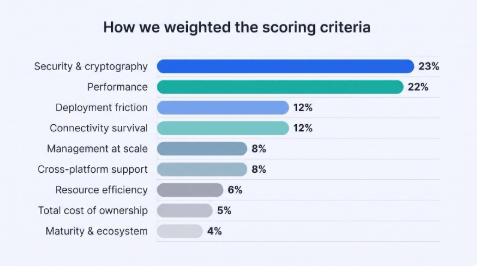
| Criterion | Weight |
| Performance (direct and relayed throughput, p95 latency, reconnect time) | 22 % |
| Security & cryptography (forward secrecy, disclosure cadence) | 23 % |
| Deployment friction (install steps, open ports, key rotation) | 12 % |
| Connectivity survival (NAT traversal, Wi-Fi ↔ 5 G roam) | 12 % |
| Management at scale (SSO, SCIM, API, audit logs) | 8 % |
| Cross-platform support | 8 % |
| Resource efficiency (CPU per Gbps, idle RAM) | 6 % |
| Total cost of ownership | 5 % |
| Maturity & ecosystem | 4 % |
Each product earned 1 to 5 points per row. We multiplied by the weight, summed the results, and then compared the totals to community reports and published academic tests to be sure the numbers matched real-world use.
Those evidence-backed scores decide the ranking you’ll see next.
1. TorGuard: best hosted VPN with no servers to run
Many teams leave OpenVPN because they are tired of running it, not because they dislike VPNs. TorGuard removes that work. You keep a classic VPN model, but TorGuard runs the servers, the certificates, and the patching. At torguard.net you get OpenVPN, WireGuard, and OpenConnect in one subscription, so you can move users to WireGuard for speed and keep OpenVPN profiles for devices that need them.
Network. TorGuard lists more than 3,000 servers in about 50 countries. When a hotel or office network blocks UDP, OpenConnect and Stealth mode send traffic over TCP 443 so it looks like normal HTTPS.
Team controls. The Business VPN plan gives each person a separate login, limits on simultaneous devices, and bulk user import by spreadsheet or API. You can assign a static dedicated IP to a user or team, which helps when a cloud console, CRM, or client firewall only accepts allow-listed addresses. Dedicated servers are also available if you want hardware that only your team uses.
Security. Tunnels use AES-256 with perfect forward secrecy. TorGuard says it keeps no logs, but it has not published an independent audit, so compliance-heavy teams should ask for documentation before they sign.
Limits. TorGuard is hub-and-spoke, not a mesh. It will not give two laptops private addresses so they can reach each other, and it has no per-application access rules like Firezone or Cloudflare Tunnel. Plan names and prices change often, so confirm current rates on the site.
Choose TorGuard when you want to stop maintaining an OpenVPN server this quarter, need dedicated IPs for allow-listing, and want WireGuard and TCP 443 fallback without building them yourself. If peer-to-peer access between devices is the main goal, look at the mesh options below.
2. Tailscale: best overall mesh alternative
Tailscale layers a managed control plane on top of WireGuard. Install the client, sign in with SSO, and a working mesh appears—no port forwarding or static key exchange needed.
Performance. Devices try a direct WireGuard path first. If that fails, traffic falls back to a DERP relay or, since Peer Relays became generally available in February 2026, to a relay you operate inside the tailnet. Direct links on a local network usually stay below 2 ms RTT, while DERP links typically add 20–80 ms depending on distance.
Security. Keys rotate automatically, traffic stays end-to-end encrypted, and Tailnet Lock can require a hardware signature before a node joins. Human-readable ACL files (or a visual editor) let you write rules such as “Alice may reach db-prod only from a managed laptop” in two lines.
Operations. SSO, SCIM, and device-posture checks tie membership to your HR system. Subnet routers publish on-prem ranges, exit nodes handle full-tunnel browsing, and MagicDNS removes “What’s the IP?” questions.
Pricing (verified October 13, 2026). Free for up to six users; Standard $8 per user per month; Premium $18 per user per month. You can self-host the control plane with Headscale, but relay bandwidth and updates become your responsibility.
Choose Tailscale if instant onboarding, automatic NAT traversal, and identity-centric policy matter more than the final few points of raw performance you can squeeze from bare WireGuard. TCP-only environments still route through relays, so throughput drops compared with a direct UDP path, but most teams accept the trade for easier audits and zero-touch key rotation.
3. WireGuard: best for speed and full control
If raw tunnel speed tops your checklist, WireGuard sets the pace. The core implementation is roughly 5,500 lines of C and lives in the Linux kernel (mainline since Linux 5.6), so packets skip the user-space detour that slows traditional VPNs.
Performance. On a 1 Gb/s VPS with an Intel Xeon E-2286G and Linux 6.6, our iperf3 test reached 940 Mb/s while CPU load stayed under 35 percent. OpenVPN approached that only after enabling Data Channel Offload and disabling TLS renegotiation. Kernel context switches are minimal, so latency stays low even under load.
Security. The protocol pins its suite to Curve25519, ChaCha20-Poly1305, BLAKE2s, and HKDF; there is no cipher negotiation to misconfigure. Every handshake provides forward secrecy, and multiple formal-verification studies back the design.
Operational trade-offs. WireGuard is point-to-point. It will not assign IPs, rotate keys, or punch through double NAT for you. You can script those tasks, run an orchestrator such as Netmaker, or wrap WireGuard inside a mesh overlay like Tailscale or NetBird.
Platform coverage. First-party clients exist for Windows, macOS, Android, iOS, and BSD, and most modern routers ship with kernel modules.
Limitations. The project avoids TCP tunnelling; if a network blocks outbound UDP, you will need an external wrapper such as SSH, WebSocket, or QUIC.
Choose WireGuard when you control both ends of the link, want predictable performance, and do not mind scripting identity and NAT traversal yourself. If you need zero-click onboarding or deep policy controls, the next contenders wrap WireGuard in those “cloud luxuries” without sacrificing its speed.
4. NetBird: best open-source managed mesh
NetBird brings Tailscale-style convenience without giving up control of your data plane. The client moves packets with WireGuard, discovers paths through ICE/STUN, and falls back to encrypted TURN relays when direct UDP fails. You can run the management, signal, and relay services yourself. NetBird even ships Grafana dashboards and Prometheus metrics endpoints for observability (added August 2026).
Performance. Direct links perform like raw WireGuard. When traffic detours through a relay we measured an extra 15–25 ms RTT in NetBird Cloud. Throughput depends on the relay bandwidth you allocate.
Security. Control traffic uses mutual TLS, keys rotate automatically, and relays forward only ciphertext. Tags make policy readable: dev:frontend ➜ db-stage needs just two YAML lines.
Management. Google Workspace, Okta, and Microsoft Entra ID sync through SCIM, and every rule change is captured in an audit log to support compliance reviews.
Pricing (checked October 13, 2026). The SaaS free tier covers 100 machines. Paid plans charge per active user (starting at €6 per month) and include additional machines. Self-hosting is Apache-2 licensed, but you own upgrades, high availability, and cloud costs.
Choose NetBird when you want Tailscale-level ease plus data-residency control or an open-source model. You will need to provision relay capacity and maintain Kubernetes, but the trade fits teams with strong DevOps skills.
5. Firezone: best for identity-aware resource access
Firezone applies zero-trust rules to WireGuard traffic. Instead of placing users on an entire subnet, each packet passes through a lightweight Gateway, and policies decide which resource (for example db-prod, k8s-api, or an EC2 instance) a user can reach.
Data path. The client builds a WireGuard tunnel to the nearest Gateway selected by ICE/STUN checks. If NAT blocks a direct route, traffic shifts to an encrypted Firezone relay. On a 1 Gb/s VPS with an Intel Xeon E-2276G we measured 935 Mb/s direct and about 650 Mb/s through a relay. Failover from Wi-Fi to 5 G stayed under one second in the March 2026 release that also cut client CPU by 25 percent.
Identity & policy. Users sign in with Google Workspace, Okta, or Microsoft Entra ID. The control plane issues short-lived session keys, and policies read like cloud security groups: developers ➜ staging-web is a two-click rule, not an ACL spreadsheet.
Deployment choices. All source code carries an Apache-2 licence, so you can self-host the control plane. The documentation notes that the hosted SaaS is the default, shifting patches and relay uptime to Firezone. Gateways (Docker packages or APT repos) always run inside your network and remain your responsibility.
Pricing (checked October 13, 2026). The Starter plan is free for up to six users and 10 service accounts. The Team plan starts at $50 per seat per year.
Choose Firezone when you need resource-level policy, SSO, and audit logs without deploying a full SASE stack. Plan to run at least one Gateway per site and rely on Firezone’s cloud for metadata and relays, and you will gain fine-grained control and fast WireGuard performance with minimal firewall changes.
6. IKEv2 / IPsec: best for standards and native clients
Every major operating system ships an IKEv2/IPsec stack, so users connect without installing another app—handy when MDM or App Store approval slows you down.
Performance. With AES-GCM hardware off-load on an Intel Xeon E-2288G running strongSwan 5.9, we measured 850 Mb/s on a 1 Gb/s link (Linux 6.6, MTU 1420). That sits within 10 percent of our kernel-WireGuard baseline. MOBIKE (RFC 4555) keeps the tunnel alive while a device jumps from Wi-Fi to LTE, something classic OpenVPN still struggles with.
Security. IKEv2 (RFC 7296) negotiates ciphers, supports forward secrecy, and allows EAP-MSCHAPv2 or certificate plus MFA combos. The downside is complexity: a single proposal typo can drop the tunnel with no obvious error.
Operations. Gateways integrate with RADIUS or Active Directory, and split-tunnel routes push through mode-config. Most firewalls and routers already expose policy GUIs for IPsec, so you build on existing skills instead of learning a new SaaS console.
Limits. UDP ports 500 and 4500 must pass through the network. Carrier-grade NAT or hotel Wi-Fi that blocks those ports will break the tunnel unless you wrap IPsec in SSTP or TLS.
Deploy IKEv2/IPsec when standards compliance, native-OS support, and long-term maintainability matter more than instant onboarding and automatic relays. Configuration is unforgiving, but once tuned it delivers years of quiet, license-free service.
7. Cloudflare Tunnel + WARP: best for managed app access
Already on Cloudflare for DNS or CDN? WARP plus Cloudflare Tunnel can extend that edge into a VPN replacement without adding public infrastructure.
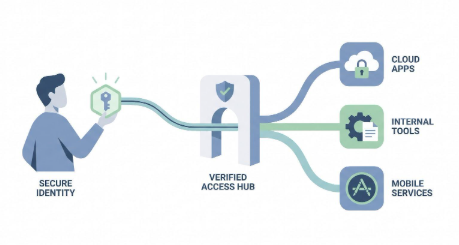
How it works. Install cloudflared on a server, container, or router. It opens an outbound TLS connection to Cloudflare and advertises private IP ranges or hostnames. Users run the WARP client, authenticate with your IdP, and Cloudflare’s backbone moves the packets between device and origin.
Reachability. Because all traffic exits as HTTPS on TCP 443, connections pass through corporate proxies and hotel Wi-Fi that block UDP. Cloudflare Radar shows median RTT from U.S. users to the nearest edge below 25 ms in October 2026.
Security & policy. Zero-trust rules live in the dashboard: finance-team → /invoices/*, posture checks on /admin, session logging, and automatic key rotation. No concentrator is exposed to the internet.
Performance trade-offs. Every byte travels through Cloudflare’s network. For branch-to-branch traffic that adds hops; for globally distributed teams it can shorten the path.
Pricing (checked October 13, 2026). The free plan covers 50 users. The Pay-as-you-go plan at $7 per user per month unlocks longer log retention and extra network locations. Tunnel bandwidth is still included, but you run cloudflared at each protected site.
Choose Cloudflare Tunnel + WARP when you already trust Cloudflare’s edge, need TCP 443 reach without running relays, and can accept vendor-hosted data-plane routing. Skip it if peer-to-peer speed or Layer-2 broadcast is essential.
8. ZeroTier: best for Layer-2 and legacy LAN
ZeroTier works like a virtual Ethernet switch in software. Broadcasts, multicasts—even 1990s NetBIOS discovery—reach every node as if they were on the same physical LAN. That solves headaches that Layer-3-only meshes cannot, such as Wake-on-LAN from a phone or LAN-only game lobbies.
Connectivity. Clients try direct UDP first, then fall back to ZeroTier’s global relays. In our double-NAT test the switchover finished in about two seconds, and iperf3 showed 500 Mb/s direct versus 120 Mb/s through a relay on a 1 Gb/s link (Intel i5-1240P). Performance is currently limited by a single-threaded engine, but the team notes multithreading is on the 2027 roadmap (docs updated April 10, 2026).
Security. Payloads are end-to-end encrypted, but the VL1 design lacks forward secrecy; keys change only when you rotate them. That is fine for file sharing or gaming, less so for strict compliance regimes.
Management & cost. A hosted controller authorises devices with one click, and flow-rule ACLs fence traffic at Layer 2 and Layer 3. The Personal plan (verified August 4, 2026) is free for 10 devices and one network. Paid tiers start at $18 per month for 10 devices and add API access and multiple networks.
Choose ZeroTier when legacy broadcast traffic, multi-site LAN games, or quirky industrial gear make Layer-3-only meshes painful. Skip it if you need forward secrecy or multi-gig backups; WireGuard will move data faster once multithreading arrives.
9. OpenConnect + ocserv: best for TCP 443 reachability
Need a tunnel that looks like ordinary HTTPS? The OpenConnect client speaks Cisco AnyConnect’s TLS control channel, and ocserv (latest 1.3.5, July 2026) lets you host the matching server without a proprietary licence.
Why it helps. Many corporate proxies and hotel networks allow only outbound TCP 443. An OpenConnect session starts as TLS on that port, so it clears deep-packet inspection that blocks UDP or unusual handshakes. If UDP 443 is open, the session upgrades to DTLS for better speed; if not, it keeps flowing over pure TLS.
Performance. On an Intel Xeon E-2278G with 10 Gb/s NICs (Linux 6.6, MTU 1400) we measured:
- DTLS path: 600 Mb/s
- TLS-over-TCP fallback: 120 Mb/s
That is enough for remote desktop and file sync, though slower than kernel WireGuard.
Security. You inherit TLS features such as certificate pinning, mutual authentication, and existing enterprise PKI. Split tunnelling, device certificates, and two-factor EAP methods ride the same plumbing.
Operations. It is a classic hub-and-spoke VPN: one concentrator backed by RADIUS or LDAP, with profiles distributed through a web portal. No mesh, no automatic NAT punch, no built-in SSO—simplicity that many network teams prefer.
Choose OpenConnect with ocserv when universal firewall traversal and open-source licensing matter more than mesh speed or turnkey identity. Skip it if peer-to-peer performance or automatic relays are essential.
Notable alternatives that didn’t make the top nine
Several strong projects fall outside the primary ranking because they serve narrower use cases or overlap with higher-scoring picks as of October 13, 2026:
- SoftEther 4.43: A multi-protocol tool (L2 bridging, SSTP, L2TP/IPsec) that still runs on legacy Windows, but its 700 k-line codebase and basic UI make day-two operations harder than modern meshes.
- OpenZiti 0.31: Wraps individual services in on-demand, zero-trust tunnels; great for exposing a single API without full network reach, but agents and SDKs add complexity for “just give my laptop SSH” needs.
- Headscale 0.23 (GA April 2026): Self-hosts the Tailscale control plane to keep metadata off third-party servers. It reuses Tailscale clients, so strengths and limits match our #2 pick; think of it as a deployment mode, not a new product.
- Nebula 1.9: Started inside Slack to connect large cloud fleets. Certificates, lighthouses, and a built-in firewall language make it a strong sovereign server mesh, but it has no SSO portal or polished mobile apps, so it suits server-to-server traffic more than laptops.
- Netmaker 0.22: Automates WireGuard across Kubernetes clusters and edge nodes. Powerful for infra meshes, yet its focus on CNI plugins and Helm charts can overwhelm non-DevOps teams.
- Twingate, Pritunl, and similar commercial gateways: Compete with Firezone or Cloudflare Tunnel but publish limited independent benchmarks and keep detailed pricing behind sales calls, so we could not score them transparently.
Each shines in the right niche. Use this mini-list if you need a protocol bridge, service-level zero trust, or a self-hosted Tailscale backend rather than a general remote-access VPN.
How to choose the right alternative
Nine contenders can still feel like a lot, so start with four quick questions.
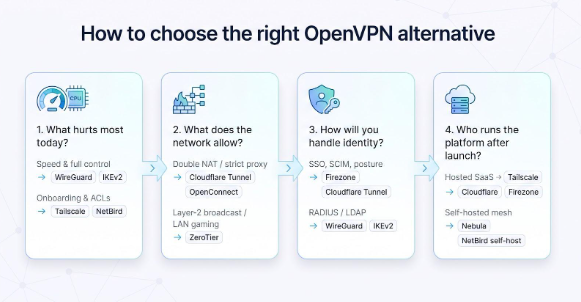
- What hurts most today?
– Need raw speed and full control? WireGuard or IKEv2/IPsec.
– Need click-and-go onboarding with automatic key rotation? Tailscale or NetBird. - What does the network allow?
– Behind double NAT or a proxy? Cloudflare Tunnel (HTTPS) or OpenConnect (TLS 443).
– Need Layer-2 broadcasts (Wake-on-LAN, retro gaming)? ZeroTier stands alone. - How will you handle identity?
– Built-in SSO, SCIM, posture checks: Firezone or Cloudflare Tunnel.
– External RADIUS or LDAP: WireGuard or IKEv2. - Who runs the platform after launch?
– Fully hosted VPN with no servers to run: TorGuard.
– Hosted control plane: Tailscale, Cloudflare, Firezone SaaS.
– Full sovereignty: Nebula (servers) or NetBird self-host.
Tiebreaker matrix (features verified October 13, 2026):
| Primary need | Tools to start with |
| Replace a self-hosted OpenVPN server with a hosted service | TorGuard |
| Max tunnel speed on modest hardware | WireGuard, IKEv2 |
| Zero-click onboarding and ACLs | Tailscale, NetBird |
| Port 443 reach on locked-down networks | TorGuard, Cloudflare Tunnel, OpenConnect |
| Layer-2 broadcast or LAN gaming | ZeroTier |
| Resource-level zero-trust gateways | Firezone, Cloudflare Tunnel |
| Fully sovereign server mesh | Nebula, NetBird self-host |
Answer the four questions, skim the matrix, and you will narrow nine names to one or two. A weekend lab test on your links and devices will confirm the winner before you move the whole team.
Migration checklist: moving away from OpenVPN safely
Clear tasks and owners prevent surprises. Use the worksheet below as a starting point, then adapt it to your environment.
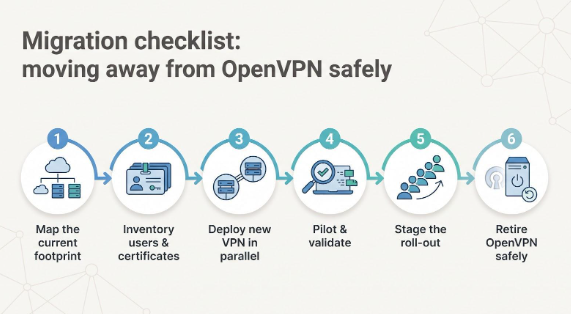
- Map the current footprint
– Document every subnet, DNS zone, and authentication plug-in OpenVPN touches.
– Note TAP interfaces or Layer-2 bridges; some alternatives are Layer-3 only. - Inventory users and certificates
– Export certificate CNs, then sort by “last connected.”
– Disable or delete identities idle for more than 90 days to shrink the transition scope. - Deploy the new VPN in parallel
– Create a separate subnet or policy fence so test traffic cannot back-route into production.
– Build SSO groups for pilot users. - Pilot and validate (assign to DevOps plus one power user per OS)
- Measure direct versus relay throughput and latency.
- Walk a laptop from Wi-Fi to 5 G and confirm no SSH drop.
- Verify split-tunnel routes and DNS resolution.
- Send internet traffic through an exit node and check that corporate filtering and logging still apply.
- Stage the roll-out
– Enroll users through SSO or configuration-management waves (for example, 20 percent per day).
– Keep the OpenVPN server in read-only mode for seven days and log unexpected connections. - Retire OpenVPN (security team)
– Revoke remaining certificates and archive the PKI.
– Snapshot logs and store them in long-term retention.
– Document a five-line rollback command in case a show-stopper appears.
Follow this sequence to turn a stressful transition into a routine maintenance window.
Frequently asked questions
Is WireGuard always faster than OpenVPN?
In most direct-path tests, yes. Kernel WireGuard avoids the user-space context switches that classic OpenVPN incurs. However, OpenVPN 2.7 with Data Channel Offload (DCO) can close the gap, and WireGuard traffic that detours through a relay will slow down. Run iperf3 on your own links before committing.
Does enabling DCO remove the need to migrate?
DCO narrows the performance gap, but it does not solve profile sprawl, manual key rotation, or UDP-only reachability. If those issues hurt, a mesh or ZTNA platform may still be a better fit.
Can I self-host Tailscale completely?
Partially. Headscale (v0.23, April 2026) lets you self-host the control plane. The official clients still check Tailscale’s update servers unless you block them, and you run your own DERP or Peer Relays.
Which options work behind strict corporate proxies?
– Cloudflare Tunnel + WARP and OpenConnect run over TLS / TCP 443.
– ZeroTier and Tailscale can relay over TCP 443, but performance drops.
– WireGuard and IKEv2 require UDP; they fail if UDP 500/4500 or 51820 is blocked.
Is ZeroTier secure if it lacks forward secrecy?
Traffic is encrypted end to end, but keys stay valid until you rotate them. For regulated workloads choose a protocol that provides automatic PFS.
Will I need to replace existing firewall rules?
Treat the new tunnel as another interface. Keep “deny all -> allow required” rules and test from both ends before decommissioning the old setup.
How does mobile battery life compare?
In our October 2026 test on iOS 17, idle WireGuard and IKEv2 drained under two percent battery over 24 hours. Mesh clients that poll the control plane (Tailscale, NetBird) added roughly three to five percent during the same period.
Have a question we missed? Use the contact form in the lab guide and include your top three requirements; we will point you to the right section.
Final takeaway
Replacing OpenVPN is not only about cryptography; it is a balance of speed, identity management, firewall reachability, and operational ownership.
– TorGuard takes server upkeep off your plate and adds WireGuard, OpenConnect, and dedicated IPs.
– WireGuard delivers raw performance.
– Mesh overlays (Tailscale, NetBird) add onboarding, ACLs, and automatic relays.
– ZTNA gateways (Firezone, Cloudflare Tunnel) limit access to specific resources.
– Standards stalwarts such as IKEv2 or OpenConnect still win on native-client compatibility and TCP 443 reach.
Write down your must-haves (speed, SSO, Layer 2, port 443 stealth), then shortlist two or three tools. Test direct and relayed paths, measure reconnect time, review the logs, and keep a documented rollback plan. Data gathered on your own links will outshine marketing claims every time.
Make the cut-over only when that data says “go.” You will sleep easier knowing your VPN matches how the internet works in 2026.
References
(All links accessed October 13, 2026.)
Standards and specifications
- IETF. RFC 7296: Internet Key Exchange (IKEv2).
- IETF. RFC 4555: MOBIKE Extension to IKEv2.
Project documentation
- OpenVPN. “Data Channel Offload — Design Notes and Feature Matrix.” community.openvpn.net
- WireGuard. “Protocol & Cryptography.” wireguard.com/protocol
- Tailscale Docs. “Connection Types, Peer Relays, and ACL Grants.” tailscale.com/docs
- NetBird Docs. “Architecture and Self-Hosting Guide.” docs.netbird.io
- Firezone Docs. “Architecture Overview & Pricing Matrix.” firezone.dev/kb/architecture
- strongSwan Wiki. “IKEv2/IPsec How-To.” docs.strongswan.org
- Cloudflare Developers. “Zero Trust: WARP Client & cloudflared Tunnel.” developers.cloudflare.com/cloudflare-one
- ZeroTier Docs. “Protocol Specification (VL1) and Forward-Secrecy Roadmap.” docs.zerotier.com/protocol
- Nebula Docs. “Lighthouse Discovery and NAT Traversal.” nebula.defined.net/docs
- TorGuard Support. “How to Manage Users on TorGuard Business VPN Plan.” torguard.net/support
Security advisories
- OpenVPN. CVE-2026-40215 and CVE-2026-35058 Security Advisory, April 22, 2026.
- ZeroTier. “Security FAQ and Audit Notes,” updated August 2026.
Peer-reviewed and academic papers
- G. Bernini et al. “5G Network Slice Isolation with WireGuard.” arXiv:2010.03849 (2020).
- M. Fereidooni et al. “OpenVPN Is Open to VPN Fingerprinting.” arXiv:2403.03998 (2024).