











How to Revise an Essay Without Losing Your Argument
Revise an essay by checking what it argues before polishing how it sounds. A smooth sentence cannot repair a paragraph that leaves the reader asking, “How does this support the point?” Whether you are improving a first draft or responding to feedback, work from the argument to the evidence and then to the wording. That order also helps when revising a report: establish what the findings support before refining the explanation.
Build the argument before polishing it
Start with the assignment and your main claim. Write a plain answer to the question you were asked, then compare it with the argument your draft actually makes. If the assignment asks you to evaluate a policy but your essay mainly describes its history, better transitions will not close that gap.
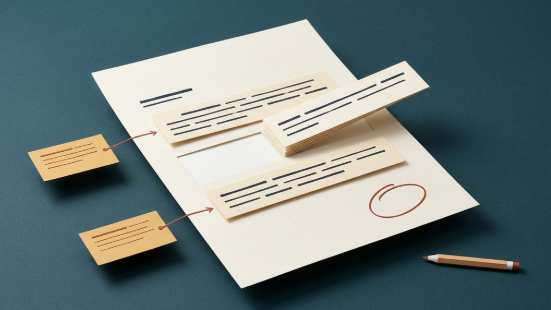
Next, give each body paragraph a short margin label describing its job: explains a cause, supplies evidence, considers an objection. Miami University’s guidance on reverse outlining uses a shortened version of the draft to examine how its arguments connect. The useful result is a view of the whole paper, without every sentence competing for attention.
Two paragraphs doing the same job may belong together. A paragraph with an interesting fact but no role in your argument may belong in your notes. Move the material before spending time perfecting its wording.
If the strongest evidence points somewhere different from your opening claim, reconsider the claim.
Explain the step between what a source shows and what you want the reader to conclude before adding another quotation.
Consider a hypothetical report about extending a university library’s opening hours. Imagine that student interviews describe difficulty finding quiet study space after evening classes. A weak paragraph repeats those complaints, then declares that longer opening hours will improve grades. The interviews establish a problem with access; they do not establish an effect on grades.
A more defensible passage would say: “The interviews suggest that current hours leave some evening students without a suitable place to study. A later closing time would address that access problem, although its effect on academic results would need separate evidence.” The explanation now connects the evidence to a limited recommendation. It also gives the next section a job: consider staffing, demand and the practical cost of keeping the building open.
In a literature essay, the same move means explaining how a detail supports your interpretation. If a narrator repeatedly avoids naming another character, identify the relevant passages and explain why that omission matters. Simply labelling it “effective” leaves your reader to supply the reasoning.
Check the source itself while making these changes. Read around the passage you plan to use, confirm who is speaking and preserve any qualification that affects your claim. Purdue OWL’s paraphrasing guidance recommends comparing a new version with the original for accuracy and recording the source details. Rephrasing borrowed ideas still requires attribution.
Edit the sentence you actually mean
Make the action and the relationship between ideas easier to follow by removing wording that delays the explanation.
For example, “A comparison of the two accounts was carried out by the group in order to identify differences” can become “The group compared the two accounts to identify differences.” Both versions name the same actor, action and purpose. The second gets there sooner. By contrast, changing “The accounts differed” to “One account was unreliable” adds a judgment the original sentence never made.
If your course permits AI rewriting assistance, TextToHuman offers sentence alternatives and direct editing within its rewriting interface. Use an alternative as a candidate to examine, alongside your own version. Compare who did what, how certain the claim is and whether any exception disappeared. Keep the version that says what you mean, even if that means rejecting every suggestion.
Reading a paragraph aloud can expose a different problem: a sentence may be correct on its own but land in the wrong place. If “this finding” appears before you have explained the finding, move the explanation earlier. A synonym will not fix the order.
An AI detector addresses a different question from a writing review. Detecting-AI describes sentence-level analysis and highlighting, but also acknowledges false positives and false negatives. Its methodology states:
“The report is a review signal. It cannot establish who wrote a document.”
A low score does not establish that sources are cited properly or that your use of assistance follows course rules. If a passage needs attention, name the actual problem: an unsupported claim, a vague explanation, an inaccurate paraphrase. If the passage is accurate and useful, changing it merely to alter a detector result can weaken it. Keep your drafts and source notes so you can explain your work if asked; a detector result cannot do that for you.
Finish with an argument you can explain
It is ready when the argument answers the assignment, the evidence supports the claims and the final wording expresses what you intend. Read the introduction and conclusion together. The opening should promise the argument you have now made; the ending should state what that argument allows you to conclude, rather than introduce an unsupported new claim.
Then check the submission rules, including permitted assistance and any required acknowledgement. Permission to use a grammar checker does not by itself answer whether generated rewrites are allowed. If the instructions leave that distinction unclear, ask your instructor before using the output. Proofread the finished file, check that each citation leads to the intended reference and confirm that headings, page numbers and the bibliography survived export.
You should be able to explain why each important paragraph is there and where its evidence came from. For the library report, that means a recommendation about access supported by the interviews, with the grade claim removed unless further evidence justifies it.
Submit the version whose reasoning you can stand behind.