












What Local Service Businesses Need From a Website
A local service website is not simply an online brochure. It is often the first place a homeowner or property manager goes to decide whether a company appears qualified, available, and easy to work with. Businesses that need help connecting layout, service information, and lead paths can review Website Design Services from Ghost Engine Digital. The agency builds conversion-focused websites for trades and home service companies, with related support for local SEO and Google Business Profile visibility in Ocala and Central Florida.
That first impression matters because visitors frequently compare several providers before making contact. A polished site can support that decision, but appearance alone is not enough. The website should answer practical questions, remove uncertainty, and make the next step clear.
Why a Local Business Website Must Do More Than Look Good
Think of the site as a digital receptionist, sales assistant, and trust check working at the same time. A homeowner comparing two HVAC companies may see similar promises on both homepages. The company that clearly lists emergency availability, service areas, recent reviews, licensing information, and an easy way to request service gives the visitor more reasons to act.
A lead-focused website guides a person toward a useful action. That might be calling for immediate help, requesting an estimate, scheduling an inspection, or sending photos of a problem. Every important page should support one of those decisions.
The First Screen Should Answer Three Questions
Before visitors scroll, the homepage should make three points obvious:
- What does the business do?
- Where does it provide service?
- What should the visitor do next?
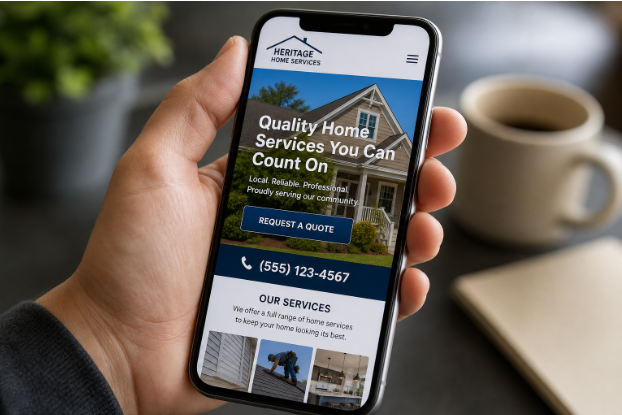
A specific headline, such as “Roof Repair and Replacement for Homes in Marion County,” is more useful than a broad slogan. Pair it with one primary call to action, such as “Request a Quote” or “Call for Service,” and keep the phone number visible in the header. Avoid unsupported claims that provide no details about the work, location, or customer benefit.
Mobile-First Design Is a Basic Requirement
Many service decisions happen when someone is away from a desk, dealing with a leak, a broken air conditioner, an electrical concern, or a damaged roof. Mobile visitors need readable text, large buttons, click-to-call options, short forms, and menus that do not hide essential pages. Heavy image files, autoplay media, crowded navigation, and unnecessary pop-ups can make a simple task feel difficult.
Test the website on several phones and screen sizes before launch. Confirm that buttons are easy to tap, forms can be completed without zooming, and phone links start a call correctly. Accessibility also improves everyday usability. For example, the web accessibility guidance from the ADA highlights practices that help people use digital services more effectively.
Build Pages Around Services and Customer Intent
One general services page rarely answers enough questions. Focused pages for heating repair, air conditioning installation, emergency plumbing, roof replacement, landscape maintenance, or electrical inspections give customers information that matches their needs.
Each page should explain what the service includes, who may need it, what the process generally involves, factors that can affect timing, and how to request help. Plain language is more useful than internal trade terminology. Related pages should link to one another when doing so helps a customer move from a problem to the right solution.
Make Local Relevance Useful, Not Repetitive
Mention cities, neighborhoods, counties, and service areas where they provide meaningful context. A plumbing company might explain common issues in older homes. A landscaping business may address regional weather patterns or property types. Dedicated location pages can be useful when the business genuinely serves those communities and has distinct information to share.
Avoid publishing many near-identical pages that only replace one city name with another. Keep the company name, address, phone number, service area, and hours consistent across the website, business profiles, and listings. Clear structure also supports search engine optimization by helping people and search systems understand what each page is about.
Trust Signals Help Visitors Make a Decision
Customers commonly look for proof before inviting a service provider to their home or business. Useful trust signals include:
- Recent customer reviews and testimonials
- Before-and-after project photos with accurate descriptions
- Applicable licenses, certifications, and insurance details
- Years in business and service guarantees, when offered
- Real team photos and clear business contact information
Specific proof is stronger than a generic quality claim. Photos from completed roofing work in nearby communities, for example, can help a visitor understand the type of projects the company handles.
Make Contact Simple
Put the primary contact option in the header and repeat it naturally throughout important pages. On mobile, the phone number should be clickable. Quote forms should request only the information needed to start a conversation, such as name, contact method, service needed, and location. Text messaging, email, and online booking can be useful alternatives when they fit the business model.
Set realistic response expectations. If inquiries are reviewed during business hours, say so. If emergency service is available, explain how customers should use it.
Search-Friendly Structure Supports Growth
Use one clear H1 heading per page, then organize details with descriptive H2 and H3 headings. Write page titles that identify the service and relevant location, link related pages, and publish answers to real customer questions. Structured data can also be helpful when it accurately reflects the business and its services.
Good structure benefits visitors first. A person should be able to scan a page, find the relevant service, understand the next step, and reach the company without hunting through long blocks of text.
A Simple Website Planning Process
- Define the ideal customer. Identify the service need, location, and likely concern.
- List core services. Organize them around the terms customers use.
- Map the journey. Plan the route from the search result to the service page to the contact action.
- Collect proof. Gather reviews, certifications, photos, and accurate company details.
- Design for mobile. Test speed, forms, menus, and calls to action on real devices.
- Measure useful actions. Track calls, quote requests, bookings, and qualified leads.
Common Mistakes to Avoid
- Hiding the phone number or contact button.
- Using generic stock images for every service and team section.
- Publishing thin location pages with no local value.
- Making claims that the business cannot support.
- Ignoring outdated pages after launch.
- Measuring traffic without tracking calls, forms, or booked work.
Questions Local Business Owners Often Ask
How Many Pages Should a Local Service Website Have?
The right number depends on the business, its services, service area, and customer questions. A smaller site can perform well when each page has a clear purpose.
Should a Business Show Prices Online?
Some companies can publish starting prices, ranges, or cost factors. Others need an inspection before quoting. The key is to be clear about what the information represents.
What Should Be Measured After Launch?
Track calls, contact submissions, quote requests, bookings, engagement with key service pages, mobile conversions, and qualified leads by source.
Final Checklist Before Launch
- Every key service has a useful page.
- The location and service area are clear.
- Phone links and forms work correctly on mobile.
- Reviews, photos, hours, and contact details are current.
- Headings and page titles accurately describe the content.
- Visitors can take the next step without searching for it.
Conclusion
A strong local service website helps the right customer feel informed and confident. It explains the work, demonstrates trustworthiness, supports local discovery, and makes contact easy. In 2026, the most effective sites will focus less on visual effects and more on helping real people solve a problem and take action.

