











Navigating Commercial Insurance and Surety Bonds for Your Business
Understanding the Core Differences Between Commercial Insurance and Surety Bonds
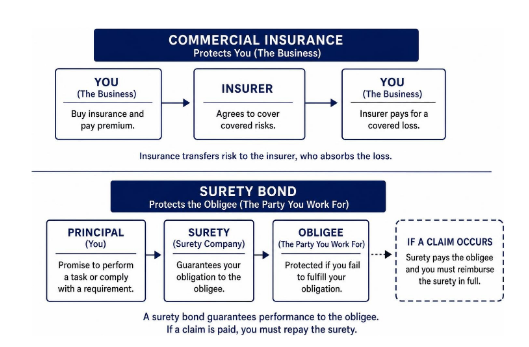
To effectively manage business risk, one must first recognize that insurance and bonds operate on entirely different financial principles. Commercial insurance is a risk-transfer product designed to protect you, the business owner, from financial loss. If a fire damages your warehouse or a customer sustains an injury on your premises, your insurance policy steps in to cover the costs, provided the event is a covered peril.
Conversely, a surety bond is a three-party financial guarantee. It does not exist to protect your business; it exists to protect the party you are working for—the obligee. In this arrangement, you are the “principal” who promises to perform a task or comply with a regulation. If you fail to meet that obligation, the surety company compensates the obligee for their loss. Unlike insurance, where the insurer absorbs the loss, a surety bond requires you to reimburse the surety for any claims paid out on your behalf.
How Risk Transfer Differs in Commercial Insurance and Surety Bonds
In commercial insurance, you pay a premium in exchange for the insurer’s agreement to assume the financial burden of specific risks. The insurer expects that some claims will occur, and they price their premiums based on actuarial data and anticipated loss ratios.
Surety bonds, however, are underwritten with the expectation of zero loss. When you apply for a bond, the surety is essentially extending your credit. They are betting on your character, your capacity to perform, and your capital. Because the surety expects you to fulfill your contract or legal duty, they do not view the bond as a risk transfer in the traditional sense. If a claim is filed, the indemnity agreement you signed at the inception of the bond requires you to pay the surety back for every dollar they spent resolving the issue.
Two-Party Protection vs. Three-Party Financial Guarantees
The fundamental difference in structure dictates who is being shielded from harm. Commercial insurance is a two-party contract between the insured (you) and the insurer. It provides first-party protection for your assets and third-party protection against liability claims.
A surety bond is a three-party guarantee involving:
- The Principal: You, the business owner, who is required to perform the task.
- The Obligee: The person or government entity requiring the bond to ensure you do your job correctly.
- The Surety: The company that backs your promise with a financial guarantee.
This distinction is vital for business planning. If you are a contractor, your general liability insurance protects you if you accidentally damage a client’s property, but your performance bond ensures that if you walk off the job, the client has the funds to hire someone else to finish it.
Essential Types of Business Coverage and Bonds
Navigating the landscape of requirements can be daunting, but most businesses fall into predictable categories. Whether you are seeking commercial surety bonds to satisfy a municipal requirement or looking for comprehensive commercial insurance solutions, the goal is to align your coverage with your operational risks.

Contract Bonds vs. Commercial Bonds for Growing Enterprises
Contract bonds are specifically tied to a project. These include bid bonds, which guarantee you will enter into a contract if you win the bid; performance bonds, which guarantee the project will be completed according to specifications; and payment bonds, which ensure you pay your subcontractors and material suppliers.
Commercial bonds are broader and are often required for licensing. If you operate an auto dealership, a notary office, or a freight brokerage, you likely need a license and permit bond to prove you will operate in accordance with state and local laws. These are often ongoing requirements that must be renewed annually.
Core Commercial Property, Liability, and Workers’ Compensation Policies
While bonds handle performance, insurance handles operational hazards. A standard commercial package usually includes:
- Commercial General Liability (CGL): Covers bodily injury and property damage claims.
- Property Insurance: Protects your physical assets. Be mindful of the “coinsurance” clause, which often requires you to insure your property for at least 80% of its replacement value to avoid penalties during a claim.
- Workers’ Compensation: A statutory requirement in most states that covers medical expenses and lost wages for employees injured on the job.
Industry Profiles: When Businesses Require Commercial Insurance and Surety Bonds
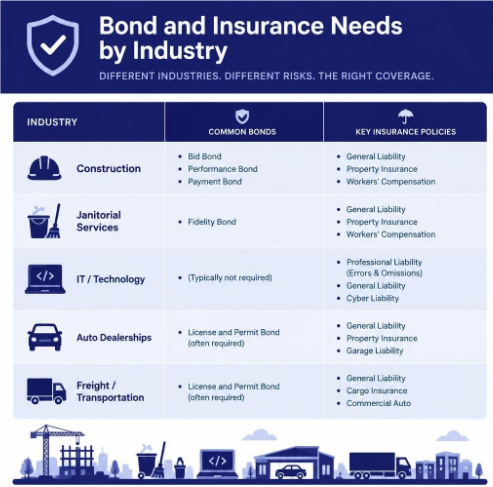
Different sectors face unique pressures. Construction firms are almost universally required to carry both heavy-duty performance bonds and comprehensive liability insurance. Janitorial services, meanwhile, often utilize fidelity bonds—a form of surety—to protect their clients against employee theft. IT firms, while less likely to need performance bonds, often require professional liability (errors and omissions) insurance to protect against claims of data breaches or system failures.
Underwriting Criteria and Cost Factors
Your ability to secure competitive rates for both insurance and bonds depends on how underwriters perceive your business health.
What Influences Insurance Premiums and Bond Rates
For insurance, underwriters look at your industry classification, your total payroll, your gross revenue, and your historical claims data. A business with a history of frequent, small claims will naturally pay higher premiums than one with a clean record.
For surety bonds, the primary factor is your credit score and financial strength. Because the surety is essentially providing a line of credit, they want to see a strong balance sheet, liquid working capital, and a proven track record. If you have poor credit, you may still be able to get a bond, but you will likely pay a higher premium, often ranging from 1% to 15% of the bond amount depending on the risk profile.
Evaluating Occurrence vs. Claims-Made Liability Policies
When selecting liability insurance, you will encounter two main forms:
- Occurrence Policies: Cover incidents that happen during the policy period, regardless of when the claim is filed. This provides long-term peace of mind.
- Claims-Made Policies: Only cover claims filed while the policy is active. If you switch carriers or let your policy lapse, you may need to purchase “tail coverage” (Extended Reporting Period) to protect against claims arising from work performed in the past.
Leveraging the SBA Surety Bond Guarantee Program for Contract Growth
Many small businesses struggle to win large government contracts because they lack the bonding capacity required by the Miller Act or state regulations. The Small Business Administration (SBA) fills this gap by guaranteeing surety bonds for eligible small businesses.

Eligibility Limits and Guarantee Fee Structures
The SBA provides guarantees for bid, performance, and payment bonds on contracts up to $9 million for non-federal work and up to $14 million for federal contracts. The SBA charges a modest guarantee fee—typically 0.6% of the contract price—which is a small price to pay for the ability to compete for high-value projects that would otherwise be out of reach.
Expanding Capacity for Small Business Contractors
By participating in the SBA program, you can demonstrate to project owners that your business has the backing of the federal government. This helps you build a track record of successful project completion, which eventually allows you to move into the “standard” surety market without needing government assistance. It is a powerful tool for scaling your operations and bidding on more complex infrastructure work.
Frequently Asked Questions About Commercial Coverage and Bonding
Does a business need both commercial insurance and a surety bond?
In most cases, yes. Insurance protects your business from the “what-ifs” of daily operations, while a surety bond acts as a “promise-keeper” for your clients. They serve different masters and cover different risks; relying on one to do the job of the other is a recipe for financial exposure.
Does a surety bond protect a business against employee theft?
No. This is a common misconception. A surety bond protects the third party (your client) from your failure to perform. If your own employee steals from you, you need a commercial crime insurance policy or a fidelity bond to cover that internal loss.
How do credit scores impact the cost of securing a surety bond?
Your credit score is the primary proxy for your reliability in the eyes of a surety underwriter. A high credit score signals that you are financially responsible, which lowers the surety’s perceived risk and results in a lower premium. Conversely, lower credit scores indicate a higher risk of default, leading to higher premiums or the requirement of collateral.
Conclusion
Managing the intersection of commercial insurance and surety bonds is a hallmark of a mature, professional business. By viewing these tools not as burdensome costs, but as strategic assets, you position your company to handle risk with confidence. Whether you are securing a new license, bidding on a massive municipal contract, or simply protecting your employees and assets, a balanced portfolio of insurance and bonds is the foundation upon which long-term growth is built. Take the time to audit your current requirements, strengthen your financial records, and work with experienced professionals to ensure your business remains both protected and empowered.