











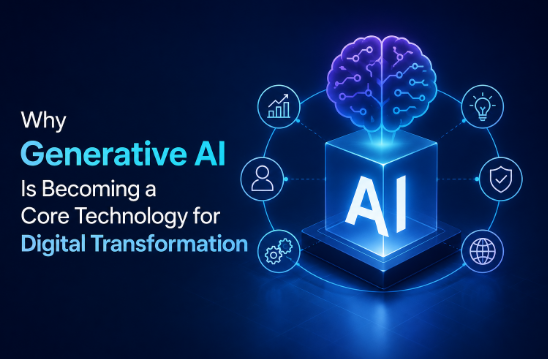
Why Generative AI Is Becoming a Core Technology for Digital Transformation
Digital transformation used to be a five-year roadmap item. Now it’s something businesses have to act on right away. Companies across every industry are hunting for ways to get more done with less — lower costs, faster delivery, better customer experiences — all without putting innovation on hold. That’s exactly the gap Generative AI for digital transformation is stepping into.
What sets it apart from older automation tools is that generative AI doesn’t just execute rules — it creates. It can write content, dig through dense information, generate working code, summarize long documents, and take on knowledge-heavy tasks that used to eat up hours of an employee’s day.As these capabilities continue to evolve, many organizations are adopting Agentic AI systems that can autonomously plan, reason, and execute complex multi-step workflows with minimal human intervention. So instead of just speeding up what already exists, it’s changing how the work happens in the first place. As enterprise AI adoption keeps climbing, more companies are weaving AI into daily operations rather than treating it as a side experiment, which is what makes it a genuine growth driver rather than a passing trend.
The numbers back this up. According to McKinsey’s most recent research, roughly 88% of organizations now report using AI in at least one business function, and generative AI specifically has seen adoption double within less than a year. Accenture has also found that generative AI tools deliver an average productivity value of around $7,800 per employee, per year — a number that’s hard for leadership teams to ignore.
What Actually Makes Generative AI Different?
Older AI systems were built to spot patterns, sort data, or run repetitive workflows on autopilot. Generative AI does something else entirely — it produces new output based on a prompt and everything it’s learned. That means it can draft reports, write marketing copy, generate software code, respond to customers, and describe products, often in a way that reads as if a person wrote it.
That shift matters because it changes where people spend their time. Employees aren’t starting from a blank page anymore — they’re refining something AI already drafted, which frees them up for the parts of the job that actually need human judgment.
A few of the more common generative AI applications right now:
- Automated content creation
- Intelligent customer support
- Code generation for developers
- Document summarization
- Product design assistance
- Knowledge management
- Data analysis and reporting
- Personalized recommendations
If you want to go deeper into how these models actually work under the hood, Wikipedia’s overview of generative artificial intelligence is a solid starting point.
Why Businesses Are Prioritizing Generative AI Right Now
Most businesses pursuing digital transformation run into the same handful of walls:
- Operational costs that keep climbing
- Manual repetitive processes
- More information than anyone can realistically process
- Decision-making that moves too slowly
- Not enough skilled people to go around
Generative AI chips away at all of these by helping employees move faster through knowledge-heavy work without cutting corners on quality. It’s worth being clear about the framing here — AI isn’t replacing the workforce, it’s acting more like a second set of hands. People still own the relationships, the strategy, and the judgment calls; AI just takes the repetitive cognitive load off their plate.
That reframe — from “tool that automates tasks” to “partner that supports people” — is becoming one of the strongest forces behind AI in business transformation today.
Enterprise AI Adoption Is Accelerating Fast
A couple of years ago, plenty of organizations were hesitant to touch AI — the cost, the security questions, the technical overhead all felt like too much. That calculus has changed. Cloud platforms, accessible APIs, and pre-trained language models have knocked down most of those barriers, and it shows: enterprise AI adoption is no longer an IT-only initiative — it’s spreading across nearly every department.
Marketing teams are using generative AI to:
- Draft campaign copy
- Brainstorm blog topics
- Write email content
- Personalize customer messaging
- Pull insights from audience data
It’s not replacing the creative process — it’s clearing out the repetitive production work that used to slow it down.
Customer service teams lean on it to:
- Draft faster responses
- Summarize long customer conversations
- Surface relevant knowledge base articles
- Support live agents in real time
The result is quicker answers for customers and more bandwidth for agents to handle the harder cases.
Software development teams use generative AI to:
- Generate code snippets
- Catch bugs earlier
- Write documentation
- Explain unfamiliar or legacy code
- Build out test cases
Teams are shipping projects faster without letting quality slip — GitHub’s own research found that Copilot was involved in writing a significant share of code across languages, which says a lot about how normalized this has become in dev workflows.
HR departments are putting it to work drafting job descriptions, screening resumes, building onboarding material, and writing internal communications — freeing up HR professionals to spend more time actually engaging with employees instead of being buried in admin work.
Generative AI’s Impact on Operational Efficiency
Improving productivity is still one of the top goals behind most digital transformation efforts, and it makes sense why — so much of the average workday is spent creating, reviewing, or summarizing information that doesn’t move the needle strategically on its own.
Generative AI takes a real bite out of that workload by helping with:
- Meeting summaries
- Proposal creation
- Financial reporting
- Compliance documentation
- Technical documentation
- Internal knowledge sharing
None of this requires a company to tear down and rebuild its processes from scratch. It just makes the existing ones move faster.
Driving Business Innovation with AI
Companies that get past the early automation phase tend to start finding new ways to build products, deliver services, and engage customers altogether. That’s really where business innovation with AI starts to show up:
- Personalized product recommendations
- AI-assisted product design
- Faster, more thorough market research
- Virtual business assistants
- Intelligent document search
- AI-powered knowledge bases
At that point, AI stops being “just another piece of software” and starts functioning as a strategic capability that touches nearly every part of the business.
Best Practices for Successful AI Adoption
Generative AI tends to work best when it’s tied to clear, specific business goals rather than adopted for its own sake. A few things worth keeping in mind:
- Start with high-value use cases. Target the repetitive tasks eating up the most employee time before rolling AI out more broadly.
- Keep humans in the loop. AI-generated content should always get a human review, especially anything touching legal, financial, or customer-facing communication.
- Invest in training. Technology alone doesn’t drive transformation — people do. Teams need to understand both what generative AI can do and where its limits are.
- Data protection should never be ignored. Effective governance should include:
- Data privacy
- Security
- Compliance
- Ethical use of AI
- Access control
These are not mere compliance measures; these are the key ingredients that will create enough internal trust to adopt AI.
Choosing the Right Technology Partner
Most companies quickly discover that “implementing AI” is a lot bigger than picking a model or signing up for a platform. Integration with legacy systems, workflow automation, security requirements, and long-term scalability all shape whether a project actually succeeds. Working with an experienced technology partner like CMARIX can help organizations identify the right use cases, integrate AI into existing applications, and build solutions that support their digital transformation goals — without disrupting the operations already running day to day.
What’s Coming Next
It’s safe to say that generative AI won’t stop there. The future capabilities of AI are expected to be better at reasoning, personalized, multimodal, and integrated into the enterprise software used today. Businesses experimenting now are the ones that’ll be ready when these capabilities become the baseline rather than the edge case.
Digital transformation used to mean migrating to the cloud or digitizing old paperwork. Now it’s increasingly about giving employees genuinely intelligent tools — ones that help them think faster, produce better work, and make sharper decisions. Organizations that pair human expertise with generative AI are the ones most likely to see real gains in productivity, innovation, and customer experience. As generative AI applications keep expanding across industries, the businesses that invest with intention today are the ones best positioned to compete and grow in the years ahead