











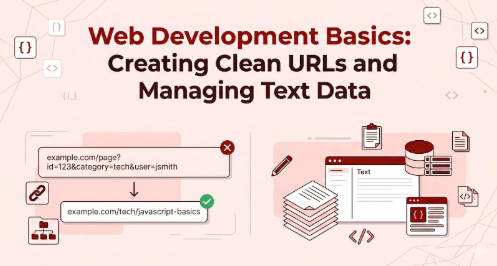
Web Development Basics: Creating Clean URLs and Managing Text Data
Introduction
One of the most feasible and desired skills for computer science students today is web development. You should know how to deal with URLs and text data, whether you are creating a personal project, building a portfolio site, or writing a university project.
In the actual development of a product, small details such as well-structured URLs and well-structured text can matter greatly in terms of usability and functionality. Simple online text tools are frequently used by developers to accelerate these operations, prevent manual mistakes, and gain time in processing volumes of content.
What Are Clean URLs and Why Do They Matter?
A clean URL refers to a simple, easy-to-read, and easy-to-use web address. It does not have random numbers or symbols but rather explicitly outlines what is on the page.
Example:
- Messy URL:
www.example.com/page?id=123&ref=abc - Clean URL:
www.example.com/web-development-basics
Why clean URLs are important:
Enhanced usability: The visitor can easily get the idea of what is on the page.
SEO advantages: search engines believe in readable and significant URLs.
Share with ease: Clean links are more professional and meaningful.
This is one of the initial steps that students who are studying web development have to make in order to create professional-quality websites.
The mechanics of Slugs in Web Development.
The chunk of a URL that follows a domain name is known as a slug. It typically is a simplified form of the title or subject of the page.
Example:
www.example.com/web-development-basics
Here, “web-development-basics” is the slug.
Good suggestions on how to make slugs:
- Use lowercase letters
- Replace spaces with hyphens
- Remove special characters
- Make it concise and descriptive.
This is because manual creation of slugs may also cause errors, mainly where the title is long. This is why a slug generator is often utilized by many developers in order to quickly turn text into clean, SEO-friendly URLs.
Dynamic Vs. Static URLs Difference.
Pages within a web may have dynamic or static URLs, and it is worth knowing the distinction between the two. Dynamic URLs have query parameters or database IDs, which are usually long and hard to read. The fixed, descriptive nature of static URLs makes them more user-friendly and simple to remember.
Content pages, blogs, and portfolios are perfect examples of pages that should use the static URLs, as they are readable and search engine-friendly. Search results or content that may be generated by a database are often served using dynamic URLs, but may easily be simplified through URL rewriting tricks.
To students, being aware of such differences assists in creating professional and useful website structures. The knowledge will also enhance your skills in designing user and search engine-friendly websites.
The benefits of Clean URLs and their effect on SEO.
Clean URLs are not just attractive to the eye but also have real SEO advantages. The more descriptive the URL is, the better chance you have of getting your content included in the search results, as the search engines index the pages with ease. Users will also tend to, more often, click on URLs that explicitly state the contents of the page.
Tidy slugs and well-designed URLs are more visible and productive for websites. It also facilitates internal linking because descriptive URLs are easier to make reference to within a site.
Learning clean URLs early in project training conditions allows students to go to work in the field of web development when they need SEO and usability.
Typical Problems in Working with Text Data.
Almost all types of development projects require text data, which can be quite challenging. An uneven layout and repetition and redundancy of words and content may slow down the working process and create inaccuracies.
Text editing can be very laborious, particularly in large projects. Errors have the potential to influence the quality and readability of a project. Being able to structure and clean up a text is thus an important skill to have as a student.
Text replacement in real-world development.
A highly popular programming and content management task is text replacement. Often, developers have to update or change text in large quantities.
Common use cases:
- Renaming variables in code
- Revising repetitive statements in text.
- Removing undesired words in datasets.
- Formatting consistency across files.
Rather than doing all of the editing by hand, a text replacer tool can help to save time and make sure that no mistakes are made. It is also able to find and change certain words or patterns very fast and allows you to make your work process much more productive.
Dealing with Text Data in Student Assignments.
In a student project, text data management may comprise a text coding assignment, text essay, text report, or text documentation. Big chunks of text usually need to be cleaned, formatted, or standardized in order to remain readable.
The tools to help with those tasks help in making the work quicker and show professionalism. Early development of this skill also teaches students to handle content in the most effective way, one of the most useful skills in both school and work.
Best Practices in Managing Text in Projects.
Texts cannot be handled without a pattern. The text must be clear, constructed well, and without any nonessential characters. Clear naming conventions will ensure consistency within various sections of a project.
Efficiency is also achieved through automation. Rather than hand-editing it, developers are supposed to employ tools that make repetitive work easy. Proofreading of URLs and text prior to publication will make certain that all is valid and proficient.
How These Skills Help CS Students
Knowledge of the process of the clean URL and how to handle the text data can provide a student with a strong point in web development. These skills enhance the quality of any project and simplify the process of its creation.
They even get students ready to face real-world situations where performance counts. When it comes to freelance work as well as professional applications, the skills to deal with text and URLs correctly are extremely useful.
Conclusion
Proper text management and clean URLs are fundamental elements of web development in the present day. These can be minor details, but they can affect usability, search engine presence, and project quality greatly.
Students can develop superior applications and can create useful skills that are beyond the theory by learning how to develop effective slugs and how to manipulate text effectively.