












Running The Air Conditioner Nonstop Points At Service Not At Sizing
Why does a spare bedroom holding a home lab and a streaming rig sit at seventy-nine degrees while the condenser outside runs from two in the afternoon until dark? That question drives most of the late-summer calls for ac services shawnee ks homeowners make, and the first guess is almost always that the system is too small for the equipment in the room. Two machines, three monitors, a small rack and a person breathing do add real load. The cheaper argument deserves testing first: a system that runs without stopping has usually lost capacity it once had, and a seasonal service visit is how that capacity comes back.
Nonstop Runtime Signals Lost Capacity
Continuous runtime on a hundred degree afternoon is not a fault by itself. Equipment is sized for the design day, and on that day it is supposed to run nearly all the time. The trouble is the room that never comes down anyway, because that means the machine is moving air without moving much heat. The measurement that separates those two cases is the temperature split, which is what technicians call the difference between the air pulled into the return and the air coming back out of the supply vent.
A healthy split lands in the high teens to low twenties, measured in Fahrenheit. Eight degrees is not an undersized system, it is a starved one.
Taking that reading costs four minutes and a probe thermometer most people who build their own machines already own. Run it once at two in the afternoon, then again at seven in the evening. In practice a low split usually means the fault sits upstream of sizing, in airflow, in refrigerant charge, or in a coil that has quietly stopped trading heat with the air passing over it.
Dirty Coils Outrank Undersizing As The Cause
A room full of case fans moves a remarkable amount of dust, and all of it eventually reaches the return grille. That load lands on the evaporator coil, the cold one buried inside the air handler, where it builds a felt-like mat across the fins. Job after job, the coil that comes back cleanest belongs to the house that changed filters on a calendar rather than whenever somebody remembered. Once the mat forms, airflow drops, the coil runs colder than it should, and the system spends its whole afternoon wringing moisture out of a small volume of air instead of cooling a room. The reading at the vent still feels cold, which is exactly why the symptom gets misread as a sizing problem.
The outdoor half fails the same way for a different reason. A condenser sitting in a Shawnee back yard collects grass clippings every week and cottonwood fluff every June, and a coil packed with that debris is wearing a winter coat in August. Heat that cannot leave the fins stays in the refrigerant, head pressure climbs, and capacity falls while the compressor works harder for less return. Cut back the shrubs that filled in over spring too, because eighteen inches of clearance on all four sides is the difference between rejecting heat and recycling it.
Charge is the third suspect, and on a fourteen-year-old condenser it is the one worth settling before anyone writes a replacement quote. Refrigerant is not consumed; if the system is low, it leaked, and a unit running a couple of pounds short will still cool a house on a mild day while failing badly on a hot one. That pattern sits behind a good share of the seasonal AC services Shawnee KS homeowners book in July, and it also explains why a technician who tops off the charge and leaves has only postponed the identical call to next summer. Ask for the measured charge, the split before and after the work, and where the leak was found.
One Cooling Season Of Runtime Priced Out
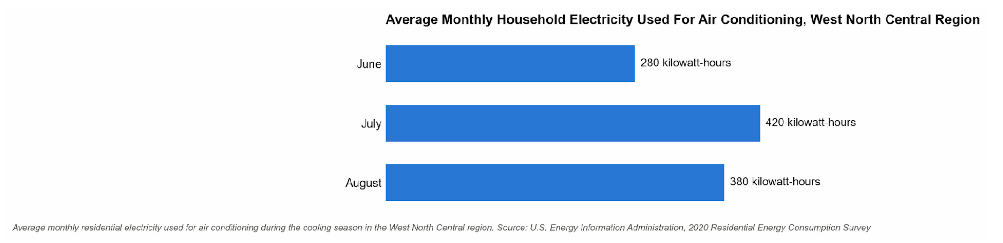
Runtime costs money on a curve rather than a straight line, and the shape of the season matters when deciding between service and steel. Federal consumption data puts July well ahead of the months on either side of it. A capacity fault does not add a flat surcharge either, it multiplies whatever the hottest weeks were already going to cost.
Say the spare-room system tracks the regional July figure of 420 kilowatt-hours, and the fouled coil has cost it roughly a quarter of its output, pushing that month toward 525. At a hypothetical thirteen cents per kilowatt-hour, those 105 extra units run about $13.65 in July, call it $9 in June and $12 in August, so the season’s energy penalty comes to somewhere near $35 all in. Set against an advertised $115 check and tune-up, the meter by itself does not close that gap in a single summer.
The payback sits somewhere the energy arithmetic hides. A compressor asked to work against high head pressure through fourteen Kansas summers gives out sooner than one that was not, and replacing a condenser with a matching coil is a four-figure decision rather than a three-figure one. The tune-up is protecting the compressor, not the power bill.
Service The System Before Replacing It
Price the diagnosis before pricing a bigger system, because those two answers lead in opposite directions. Manufacturers publish lifespan numbers that quietly assume the maintenance actually happened: Carrier puts a properly maintained furnace at 15 to 20 years of expected service life, guidance still posted in August 2026, and the cooling half of that same equipment answers to the same kind of attention. Neglect moves the number the wrong way. A fourteen-year-old condenser that has been cleaned, charged correctly and given room to breathe is a genuinely different asset from a fourteen-year-old condenser that has had none of it.
So run the measurement first. Check the split, look at both coils, have the charge verified, and set a filter interval that matches a room full of fans instead of a spare bedroom nobody uses. If those numbers come back healthy and the lab still will not hold seventy-four with the door closed, then duct design and sizing are the honest conversation and a replacement is a defensible answer. That whole sequence costs about the price of one tune-up, and it is the only order of operations that tells you which problem you are actually paying to fix.