












How AI Website Builders Are Revolutionizing Web Design
Key Takeaways
- AI website builders are revolutionizing web design by enabling rapid, code-free site creation.
- These tools democratize web development, allowing individuals without technical expertise to build professional websites.
- While AI enhances efficiency, human creativity remains essential for unique and engaging designs.
The Rise of AI in Web Design
The evolution of Artificial Intelligence has rapidly expanded its reach into web design, introducing powerful new tools that are redefining traditional web development. Companies and individuals can now use advanced platforms to create sophisticated websites without writing a single line of code or having technical expertise. For example, the AI website builder approach enables users to generate website layouts, populate content, and optimize site structure simply by providing conversational prompts or filling out a straightforward questionnaire.
Multiple AI-driven platforms are leveraging state-of-the-art models to make automated web development even more accessible. Services like Wix use AI to not only automate basic site-building tasks but also support more complex features, such as business management tools, SEO optimization, e-commerce, and analytics, through user-friendly interfaces. This wide array of integrations signals that AI is no longer a niche add-on but a foundational component of the next generation of web development.
Democratizing Web Development
Creating a website once meant learning HTML, CSS, and possibly numerous programming languages. AI website builders are changing this by lowering the learning curve for millions of people. Shadcn AI website builders are changing this by lowering the learning curve for millions of people. Modern platforms can deliver a finished site in under an hour, making professional-quality web presences accessible to small businesses, solopreneurs, and anyone looking to establish an online presence. The process typically starts with the user describing their needs, after which the platform generates design, layout, text, and images tailored to the project’s goals.
Notably, WordPress.com’s AI site builder has introduced a toolset that lets anyone describe the desired type of website, from a photography portfolio to a restaurant landing page, and watch as the AI quickly constructs a tailored, visually appealing, and content-rich site. This trend enables a wider range of individuals to participate in the digital economy without hiring expensive developers or agencies.
As these platforms continue to evolve, their increasing versatility has prompted leading publishers and tech analysts to recognize the potential for AI to fundamentally shift the balance of power, allowing users worldwide to build compelling and effective web presences at minimal cost.
Enhancing Efficiency and Speed
With AI automating content creation, layout selection, and imagery, users can reduce design and deployment cycles from weeks or days to just hours or even minutes. This is particularly advantageous for small business owners, startups, and entrepreneurs needing to pivot quickly or capitalize on timely opportunities. AI-generated recommendations, whether for branding, color schemes, or promotional copy, streamline the user’s workflow and eliminate the repetitive tasks that often slow down project completion.
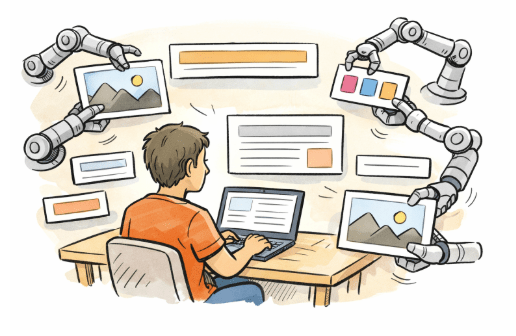
Research and case studies published by tech outlets such as ZDNet have shown that businesses launching their first websites or updating legacy sites benefit greatly from the productivity boost automated design solutions offer. The efficiency gains directly translate into lower costs, increased flexibility, and a faster path to market.
Maintaining Creativity and Uniqueness
AI may handle the repetitive or technical aspects of website building, but human creativity remains indispensable. While templates and layouts can provide structure, uniqueness in design still relies on the vision and input of business owners, marketers, or creative professionals. The most successful sites are those in which the foundational work is accelerated by AI, but strategic content adaptation, branding choices, and innovation remain in human hands.
Designers and entrepreneurs should use the rapid prototyping abilities of AI-driven builders as a starting point. By customizing color palettes, tweaking layouts, and refining messaging, users ensure their sites avoid the potential pitfalls of a “cookie-cutter” digital presence. AI assists creativity, but should not replace the personality that each organization brings to its project.
Challenges and Considerations
Despite the advantages, it is important to consider the potential drawbacks of heavy reliance on automated tools. Overreliance on templates and AI-generated suggestions can make it harder for businesses to differentiate themselves. Sites built solely through automation risk becoming too similar to others in their industry, diminishing brand recognition and engagement.
Furthermore, while AI can mimic many aspects of natural language and design, it may not fully grasp the underlying values and cultural nuances that define a brand. This is where ongoing human oversight and iterative refinement become essential components of a sustainable web strategy.
The Future of AI in Web Design
As AI advances, the line between automated and human-driven design will continue to blur. Innovations on the horizon include even greater personalization, more intelligent content recommendations, and seamless integration with marketing, CRM, and analytics tools. Web design will increasingly involve collaboration between people and algorithms, resulting in smarter, more effective websites that are responsive to the user’s goals and behaviors.
The next era of AI-driven site builders will likely prioritize customization, ensuring that automated tools are adaptable and open-ended rather than limited to simple, preset templates. The industry is poised for a future where anyone can quickly create a stunning digital presence while retaining the power to refine and reinvent it over time.
In summary, AI website builders are dramatically reshaping the landscape of online design, making development faster, simpler, and more accessible. However, lasting digital success depends on pairing the power of automation with the creative instincts and unique vision of real people.