











Amazon SIPP Requirements for Retail Packaging: Redesign the Box or Eat the Fees
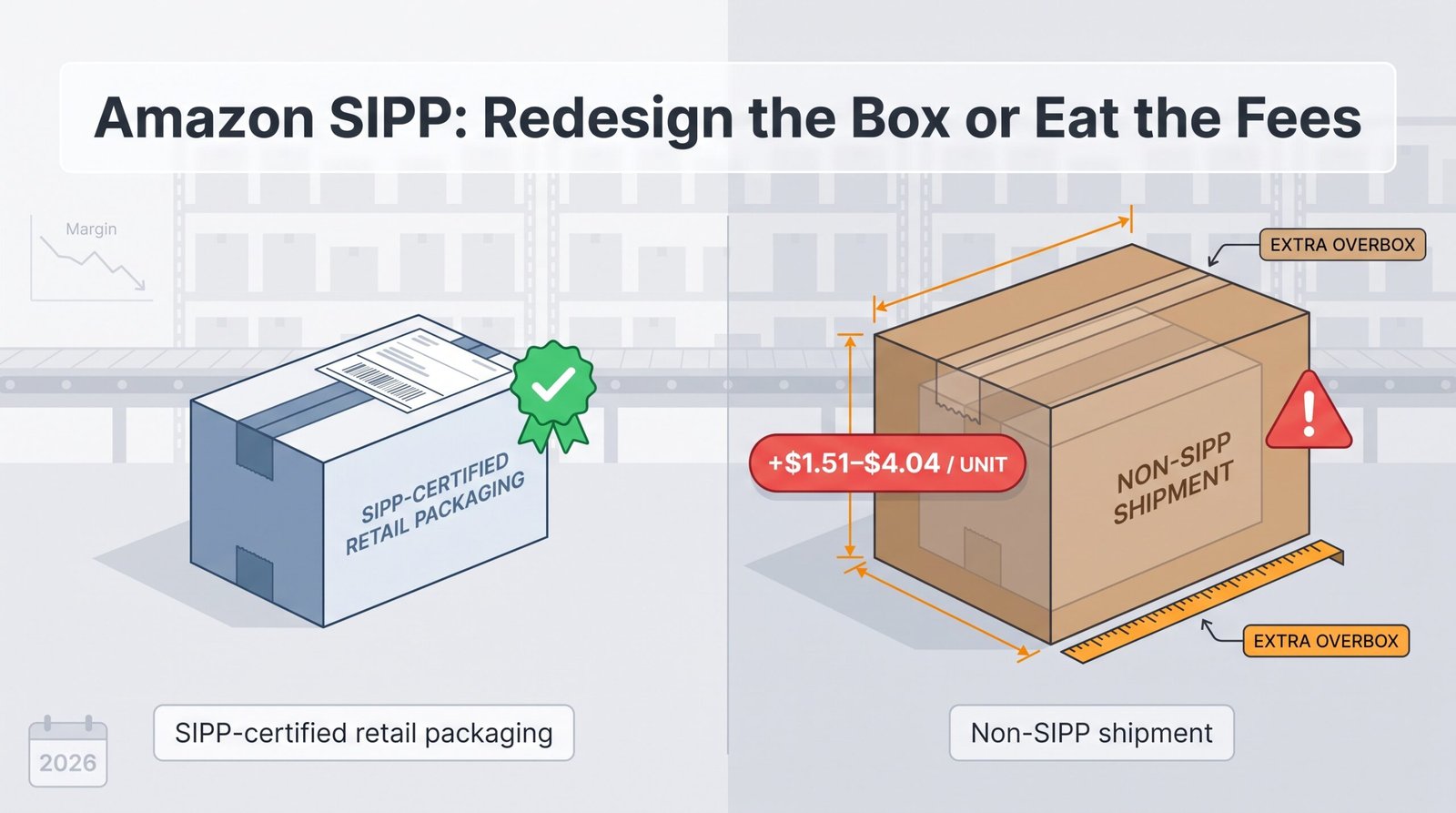
Every extra inch of cardboard now dents your Amazon P&L. Under the Ships in Product Packaging (SIPP) program—Amazon’s new name for SIOC—qualified FBA items ship in their retail boxes; no overbox required. Starting January 15, 2026, any Small or Large Bulky item that isn’t certified will pay an extra $1.51–$4.04 per unit on top of fulfillment and storage fees. This guide shows you how to measure, test, and crunch the numbers so you can decide whether to certify, redesign, or simply absorb the fee.
The road to 2026: key SIPP milestones
- December 2023. Amazon quietly rebranded “Ships in Own Container” as Ships in Product Packaging (SIPP). The drop-test standard stayed the same; only the name changed.
- February 5, 2024. U.S. sellers could self-enroll for the first time, earning a launch credit of $0.04–$1.32 per certified unit.
- January 1, 2026. Amazon ended its paid FBA prep and labeling service, so every inbound unit must arrive shelf-ready.
- January 15, 2026. Small Bulky and Large Bulky items that aren’t SIPP-certified now face an extra packaging surcharge of $1.51–$4.04 per unit; overnight, SIPP shifted from a sustainability badge to a margin safeguard.
Can your retail package pass the first SIPP gate?
Rigid or flexible? Start with the structure
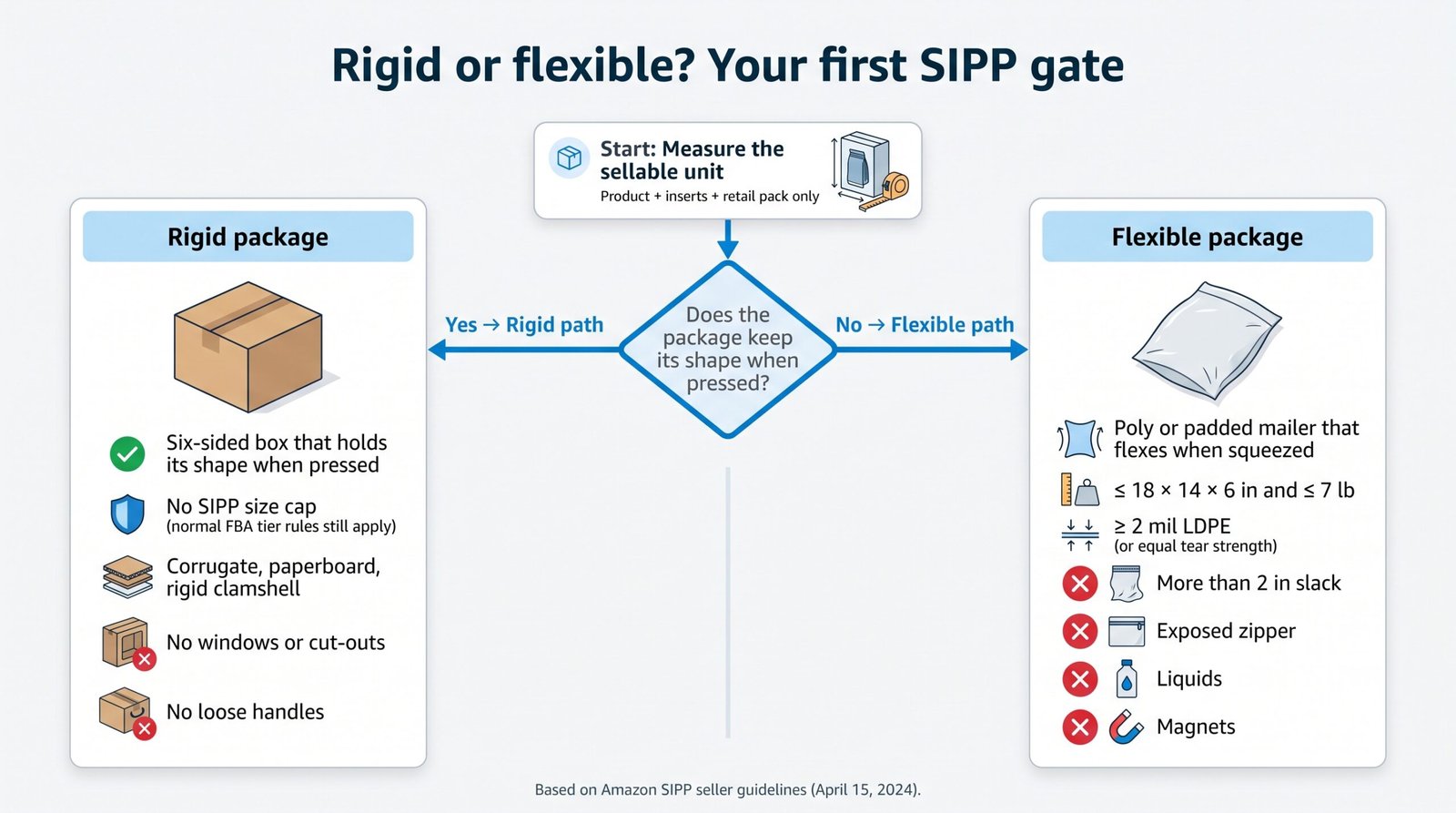
| Test this first | Rigid package | Flexible package* |
| Definition | Six-sided box that holds its shape when pressed | Poly or padded mailer that flexes when squeezed |
| Size & weight cap (US) | None under SIPP, but normal FBA tiers apply | ≤ 18 × 14 × 6 in and ≤ 7 lb |
| Material spec | Corrugate, paperboard, rigid clamshell | ≥ 2 mil LDPE (or equal tear strength) |
| Instant fails | Windows, cut-outs, loose handles | More than 2 in slack, exposed zipper, liquids, magnets |
*Source: Amazon seller guidelines, April 15, 2024.
Measure the sellable unit exactly as it leaves your line (product, inserts, and retail pack only). Press on the walls; if it keeps its shape, it’s rigid, and if it bends, you’re in the flexible lane. That single fork sets your test path, fee exposure, and redesign cost.
If that fork points to a redesign, the work usually spans three pieces at once: ISTA-6 testing, SIPP/SIOC redesign, and Frustration-Free Packaging optimization. Packaging partners such as Zenpack handle all three for brands moving retail packaging onto Amazon, so the test plan and the dieline change are decided together.
Zenpack’s Amazon compliance guide puts the 2026 packaging fee for Small and Large Bulky products not enrolled in SIPP at an average of $2.07 per unit, so settle the structure question before you pay for lab time.
Amazon SIPP packaging requirements checklist
Requirements that apply to every package
Amazon will not review rigid-versus-flexible details until these basics are met. Source: Seller certification guidelines, April 15, 2024.
- Minimum outer size – at least 6 × 4 × 0.375 in so a 4 × 6-inch shipping label sits flat
- Flat label zone – no ridges, curves, or busy graphics that hide the barcode; the FNSKU or UPC must scan on the first pass
- Secure closure – seal every seam; shrink-wrap alone isn’t a primary seal. Add tamper evidence inside the closure, not afterward
- Product protection – the package has to survive the SIPP drop test with the item fully functional
- Discreet exterior – “adult” or sensitive products must ship in opaque packaging
Testing and enrollment: proving your package under pressure
Self-test or send it to the lab?
| Path | When it applies | Key steps |
| SIPP self-test (DIY) | Item is non-fragile, ≤ 50 lb, and contains no liquids, glass, or exposed sharp edges | 17 drops from 18 and 36 in → inspect for broken seals or damage → submit photos and checklist in Seller Central |
| ISTA 6-Amazon.com lab | Any glass, liquid, moving parts, sharp edges, or weight over 50 lb | 17 drops plus compression and vibration → lab issues report → upload report and photos to Seller Central |
Source: Amazon SIPP certification guidelines, April 15, 2024.
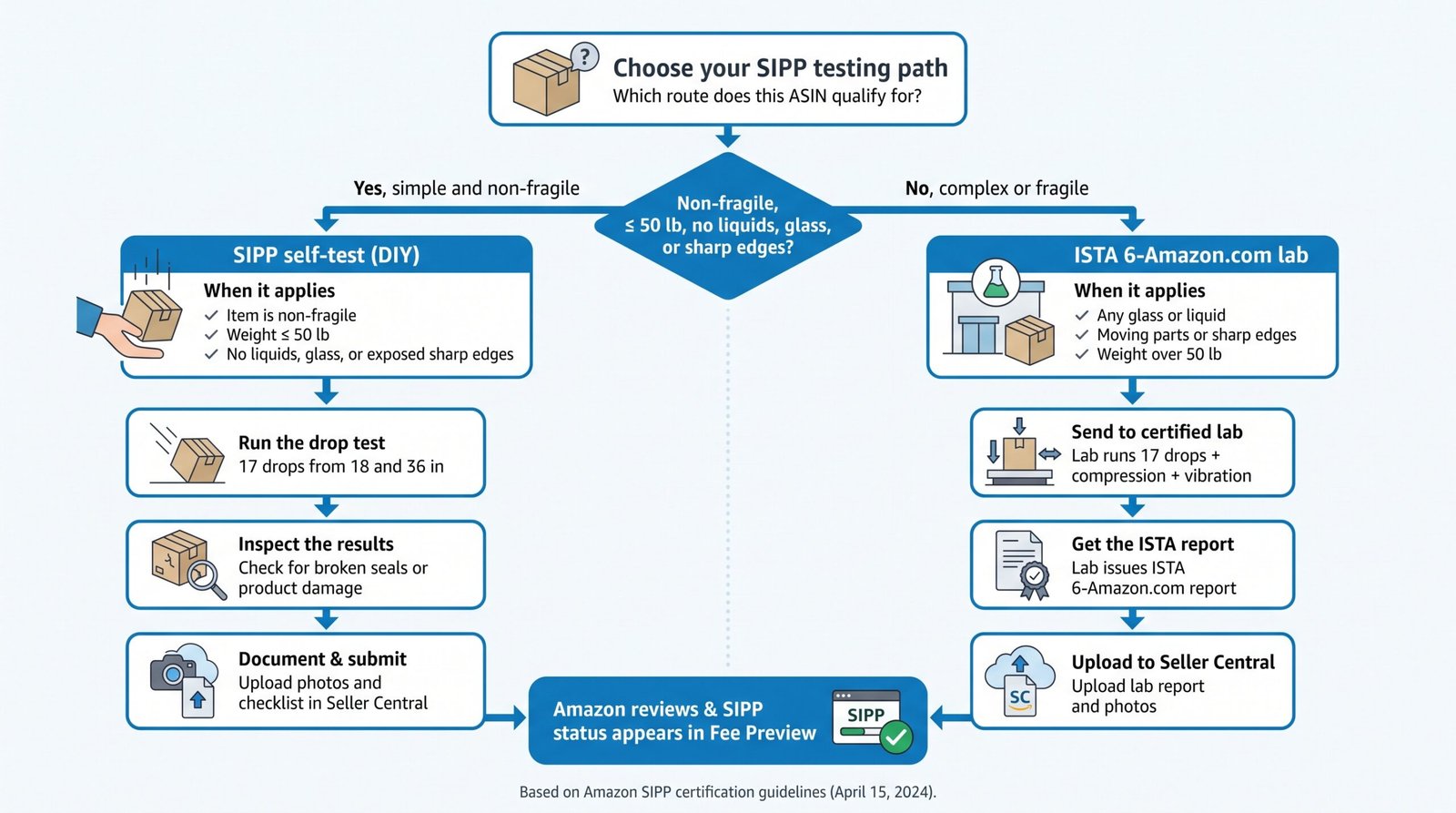
A clean ISTA report costs more, but it often speeds Amazon approval and shields you from damage claims.
Don’t skip the paperwork
Amazon reviewers need the exact photo set, measurement shots, and completed checklist from the 2024 guide. Miss one asset, and the queue restarts; you could wait days, sometimes weeks.
Once your lead SKU passes, group eligible variations and click Enroll to lock in the benefit date.
The 2026 fee cliff: know your size tier
| Amazon tier (2026) | Max dimensions (L × W × H) | Max weight | Length + girth cap |
| Large Standard | 18 × 14 × 8 in | 20 lb | n/a |
| Small Bulky | 37 × 28 × 20 in | 50 lb | 130 in |
| Large Bulky | 59 × 33 × 33 in | 50 lb | 130 in |
| Extra-large | Anything bigger (carrier limits apply) | — | 96-in longest side or 130-in L + G before Overmax |
Source: Amazon product-size tiers, updated for 2026.
Measure the fully packaged unit (product, inserts, retail box, shrink, or mailer), then sort the three dimensions from longest to shortest. Slip just 0.25 in over a limit and Amazon bumps the ASIN up a tier, adding weight-based fulfillment costs and, for non-SIPP Small or Large Bulky items, an extra $1.51–$4.04 packaging fee on every shipment. Always measure production samples, not CAD drawings; bulging corrugate counts.
Redesign or absorb the fee?
Break-even units = one-time redesign cost ÷ per-unit savings.
Savings can include avoided packaging fees, lower FBA tier rates, better carton density, and fewer returns. Costs cover engineering, tooling, prototypes, ISTA tests, and write-offs of old inventory. Model the math before touching the box.
Rollout checklist
- Benchmark current fees, FC measurements, and return codes.
- Prototype at least 0.25 in below the target tier; stress-test until it passes.
- Pilot a 5 percent lot to one FC, then review fees and feedback.
- Monitor inbound pallets for size creep; retest after any material change.
Frequently asked questions about Amazon SIPP
Is SIPP the same as SIOC?
Yes. Amazon simply renamed Ships in Own Container in December 2023; the testing standard stayed the same.
Do third-party sellers have to certify?
No, but any Small or Large Bulky item that isn’t certified now pays the 2026 non-SIPP packaging surcharge.
How much can SIPP save per unit?
Avoiding that surcharge puts $1.51–$4.04 back into margin on every bulky unit. Some standard-size items still earn a smaller legacy discount.
Will Amazon ever put a SIPP item in another box?
Occasionally, multi-item orders or concealment requests can trigger an overbox, but you still receive the SIPP fee benefit.
Can Amazon auto-enroll my ASIN?
Yes. FC scanners and test data can certify products automatically; check Fee Preview for the SIPP flag before counting the savings.
How common is SIPP today?
According to Amazon’s 2024 Sustainability Report, 12 percent of global shipments already leave fulfillment centers without an added Amazon box, showing shoppers accept well-designed retail packaging.
Conclusion
Sort the package into the rigid or flexible lane, choose the test path, and price the redesign against the 2026 surcharge before anyone touches the dieline. Work in that order, enroll the lead SKU, and keep measuring inbound cartons for size creep. Follow that loop and SIPP turns from paperwork into a profit lever.