










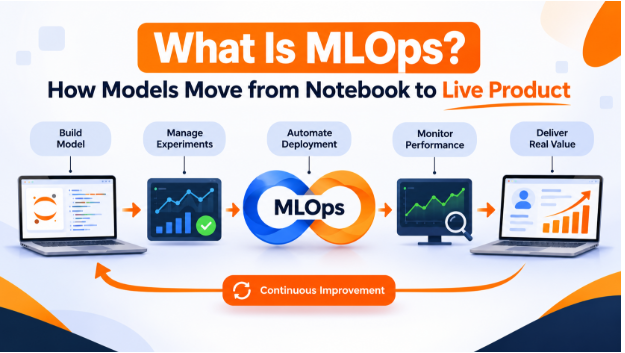
What Is MLOps? How Models Move from Notebook to Live Product
The data scientist takes three weeks to construct a churn prediction model on Jupyter Notebook. Everything seems to be perfect, the prediction is accurate, the graphs look great, and everybody in the reviewing committee is happy with the results. But there comes the inevitable question: when would customers start benefiting from all of this? This is where most machine learning projects hit an obstacle, and MLOps helps resolve it.
MLOps is the process of making a model move from an experimental stage to a stable production stage. Model training is just one of those processes. Using it for months on end in a live environment where actual people are using it, the input changes, and availability needs to be maintained is something completely different. Here we explain what MLOps is, its lifecycle, its pipeline, and when your company needs it.
What Is MLOps in Machine Learning?
MLOps stands for machine learning operations. It brings together machine learning, DevOps, and data engineering so that models can be built, deployed, monitored, and updated in a repeatable way.
One straightforward way to visualize this is data scientists analyze and model the data, data engineers prepare and transfer this data, and DevOps engineers ensure that the software works properly. MLOps, thus, is the intersection of these three roles. This is because MLOps adopts the automation and version control techniques used in DevOps and introduces something DevOps never needed to deal with.
There is one important difference. A traditional application changes only when developers change the code. A machine learning application can also change because the data changed, even if nobody touched the code. That extra moving part is why teams cannot simply reuse a normal software release process. Companies that build custom models through machine learning development services usually learn this the first time a promising prototype has to survive real traffic.
Why Moving ML Models from Notebooks to Production Is Difficult
Notebooks are great for exploring. They enable quick experimentation, plotting, and collaboration. However, notebooks are not designed to process a business task non-stop. Projects typically become blocked at that point.
- Infrastructure and environments. The notebook was developed on a single machine with a particular set of versioned libraries installed. A production environment should be reproducible, most likely containerized, and capable of doing the computation.
- Data quality. Training data comes with all the clean examples. In the live scenario, data comes in dirty, in the wrong format or just too late. This can lead to failures.
- Scalability. Scoring ten thousand rows in a notebook is easy. Answering thousands of requests per minute with low latency is an engineering problem of its own.
- Security and compliance. Models often touch customer or financial data. Access control, audit trails, and data handling rules need to be designed in from the start.
- Deployment and integration. A model creates value only when another system can call it. Connecting predictions to a CRM, an app, or a dashboard is where AI integration services become relevant, because the model is often the smaller part of the finished solution.
- None of these problems are about model accuracy. They are about everything around the model, which is exactly the territory MLOps covers.
How the MLOps Lifecycle Works
The MLOps lifecycle is a loop, not a straight line. Each stage feeds the next, and the last one sends you back to the start.
Data collection and preparation
It all begins with data. It is gathered by teams from databases, APIs, event streams, etc., cleansed, tagged if necessary, and converted into features to be used for training the model. In MLOps, this process is fully automated and tracked, meaning that the source of any particular model will always be known.
Model training and experimentation
This is what comes to mind when talking about machine learning. Scientists experiment with various algorithms, their configuration, and features. What makes MLOps unique is the fact that all these runs get logged, and you know your algorithm version, parameters used, data version, and outcomes.
Model evaluation and validation
Before doing anything else, models go through tests using unseen data. Models go through checks on the performance metrics that are appropriate for the problem, bias among different customer segments, and comparison against the existing model. A model performing well on average but badly among one segment should never be deployed.
Model deployment
Deployment involves packaging up the model and deploying it in a way that it can be used by other applications in the form of an API, or even as a batch process. Training and deployment are two different things. Trained models are nothing but files until they are deployed successfully.
Monitoring and maintenance
The model should be monitored after coming alive. Monitoring involves checking the service status such as errors and latencies, in addition to data and prediction quality. If there is any decline in performance, the cycle continues from the start with new data.
Step-by-Step: Moving a Machine Learning Model to Production
Consider a machine learning model for predicting customer churn for a subscription business. The aim is to detect potential churners so the retention team can contact them ahead of time. This is the journey of the machine learning model from the notebook to production.
- Prototype in the notebook. The first iteration of the model is made by the data scientist using historical customer data to check whether the model can distinguish between churners and non-churners. Beginners can also practice similar concepts through Python projects to improve their coding skills and understand how machine learning models work.
- Turn notebook code into modules. Messy cells become tested Python modules for data preparation, training, and prediction. The code moves into a shared repository under version control.
- Build a data pipeline. The features used in training, such as login frequency, support tickets, and billing history, are pulled automatically from source systems and validated before use.
- Automate training and tracking. A pipeline runs training on a schedule or on demand, logs each experiment, and stores the best model in a registry with a version number.
- Test and approve. Automated checks run on the code and the model. If the new version beats the current one and passes validation, it is approved for release.
- Deploy as a service. The model is packaged in a container and exposed through an API. Each night, or on every customer event, the application asks the service for a churn score.
- Connect it to the business. Scores flow into the CRM, where the retention team sees a ranked list of at-risk customers. Building this layer is usually part of AI application development services, since the prediction has to land inside a tool people already use.
- Monitor and retrain. Dashboards track the service and the quality of predictions. As customer behavior shifts, the pipeline retrains the model on newer data and promotes it once checks pass.
If you are still validating the hypothesis of whether it is even worth developing, then using the AI MVP development process minimizes your risk. A small functional prototype exposed to real users will teach you more than another month in the notebook and will help you understand which MLOps components to use first.
Key Components of an MLOps Pipeline
An MLOps pipeline is the connected set of automated steps that carries a model from data to production. Most pipelines include the following parts.
- Data pipelines. Automated jobs that ingest, clean, validate, and transform data. Checks at this stage catch broken or unexpected inputs before they reach the model.
- Model registry and versioning. A central place that stores trained models with their version, metrics, and lineage. Model versioning makes it possible to compare releases and roll back quickly if a new one misbehaves.
- CI/CD and automation. An ML CI/CD pipeline tests code, validates models, and deploys approved versions automatically. Continuous training can be added so new models are built when new data arrives.
- Model serving. The layer that runs the model and returns predictions through real-time APIs or batch jobs. Model serving and inference have to meet latency, cost, and availability targets.
- Monitoring and retraining. Monitoring of the status of the system, changes to data, and prediction accuracy, including alerts and, where appropriate, automated retraining.
Popular MLOps Tools and Platforms
No single tool covers every need, and the right choice depends on your cloud provider, team skills, and budget. These are among the most widely used options.
- MLflow. An open source platform for tracking experiments, packaging models, and managing them in a model registry. It works with many ML libraries and can run on different infrastructure.
- Kubeflow. An open source toolkit for running machine learning workflows on Kubernetes. Teams use it to build and run pipelines on their own clusters, which suits organizations already comfortable with Kubernetes.
- Amazon SageMaker. A managed AWS service that supports building, training, and deploying models, with tools for pipelines, a model registry, and monitoring.
- Azure Machine Learning. Microsoft’s cloud service for training, deploying, and managing models, including pipelines and registries. It is a natural option for teams already working in Azure.
- Google Vertex AI. This is the Google Cloud service that allows users to build, deploy, and manage their machine learning models.
The use of tools is useful, but it does not eliminate the process itself. A team that has clarity on ownership, versioning, and release criteria will achieve more by using a simple stack rather than spending money on a platform and skipping the process.
How MLOps Helps Businesses Scale AI
A single AI model can be managed manually. Five, or even fifty, cannot be. This is how MLOps enables businesses to scale their AI capabilities.
- Faster deployment. Automated pipelines shorten the gap between a finished model and a live one, because packaging, testing, and release no longer depend on manual handoffs.
- Improved reliability. Tested, versioned releases with rollback options reduce the chance of a bad model reaching users.
- Better model monitoring. Problems such as model drift get caught by dashboards and alerts instead of by an unhappy customer.
- Reduced manual work. Data scientists spend less time on repetitive deployment tasks and more time improving models.
- Easier scalability. Standardized procedures and shared pipelines enable the reuse of existing infrastructure when deploying new models.
Common MLOps Challenges and Best Practices
Adopting MLOps is as much about people and process as it is about technology. These are the problems teams meet most often, and what tends to help.
| Challenge | Best practice |
| Data scientists and engineers working in silos | Share ownership of the pipeline, with agreed handoffs and common tooling. |
| Experiments that cannot be reproduced | Version code, data, and configuration together, and log every training run. |
| Model drift going unnoticed | Monitor input data and prediction quality, and set alert thresholds early. |
| Automating too much too soon | Automate the most repetitive steps first, then expand as the team matures. |
| Unclear success metrics | Tie model metrics to a business outcome, such as fewer cancellations. |
| Weak governance and security | Control access to data and models, and keep audit records of changes and approvals. |
When Should a Business Invest in MLOps?
Not every company needs a full MLOps platform on day one. A single experimental model can live with lighter processes. The picture changes when you notice signs like these.
- A model is already making decisions that affect customers or revenue.
- Releasing a new model version takes weeks and depends on one or two people.
- You run, or plan to run, several models at the same time.
- Nobody can say for certain which data or code produced the model in production.
- Model performance has dropped before, and the team found out late.
- Regulations or internal policy require traceability and audit records.
If you recognize more than a few of these, it’s time to lay the groundwork. For many teams, this takes place in stages: starting with version control and experiment tracking, followed by automated deployment, and then monitoring and retraining. Working with specialists through MLOps consulting services can speed this up, especially when the goal is to set up the pipeline once and let your own team run it afterward.
The journey from notebook to live product is rarely about finding a better algorithm. It comes down to dependable data, repeatable releases, and careful monitoring, and MLOps is how teams get there.