












Six Treatments Cost Less Than A Summer Of Gadgets And Candles
A bucket candle runs about nine dollars and burns out in roughly five hours. Buy three for one Saturday and the evening cost twenty-seven dollars in wax before anyone touched the grill. That is the arithmetic a Stamford household with a standing weekly gathering almost never sits down and adds up, because the money leaves in small pieces: a zapper in May, a case of coils in July, a one off spray booked the week the in-laws visit. Guests still drift inside by eight. The argument here is plain, and the rest of this piece is the math behind it: a scheduled six visit season, spread across June through September, costs less than a summer of one night fixes and covers every weekend rather than one. Homeowners pricing mosquito removal Stamford CT meet that number as a per visit range, usually somewhere between sixty and one hundred ten dollars, which looks expensive next to a nine dollar candle right up until the season gets totaled.
Gadget Spending Adds Up Faster Than Anyone Tracks
Nobody keeps the receipts, which is the honest weakness in every comparison like this one, mine included. There is no solid figure for what a typical household spends on mosquito gadgets over a summer, and I have not found anyone who tracks it at the household level. What usually turns up instead is a garage shelf: a propane trap bought at full price three summers ago, two zappers, a milk crate of coils, and a bottle of yard spray with the trigger jammed. Price out a hypothetical season at Stamford numbers and the shape gets clear enough. Say three candles a week at nine dollars across fourteen summer weekends, one trap at a hundred and ten dollars plus four forty dollar refills, and two one off event sprays at ninety-five dollars each, and the shoebox tells on you by Labor Day: that comes to roughly eight hundred and forty dollars for coverage that lasted only the evenings someone remembered to light everything.
Cost is not the only ledger a host should be watching. Sudden high fever, a severe headache, a stiff neck or confusion in the days after heavy mosquito exposure needs prompt medical attention, which means calling a doctor or going to an emergency room rather than waiting to see whether it passes. Ticks share the same yard and the same months in Fairfield County. The Connecticut Department of Public Health’s Lyme disease fact sheet says the rash, fever and aching joints that follow a bite generally show up within the first 30 days, and its instruction is to contact a clinician rather than wait the symptoms out.
The reflex behind the gadget drawer is the same one that wrecks lawns, the belief that more product equals more control. In July 2026 guidance on turfgrass pests and diseases, Penn State Extension says excess nitrogen forces rapid top growth the root system cannot support, while salt buildup from overapplication interferes with water uptake and leaves the grass stressed. Mosquito gadgets fail differently, but for a related reason. Volume is not timing, and a yard hit hard once in the middle of July sits unprotected for the ten weeks around it.
A Six Visit Season Prices Out Predictably
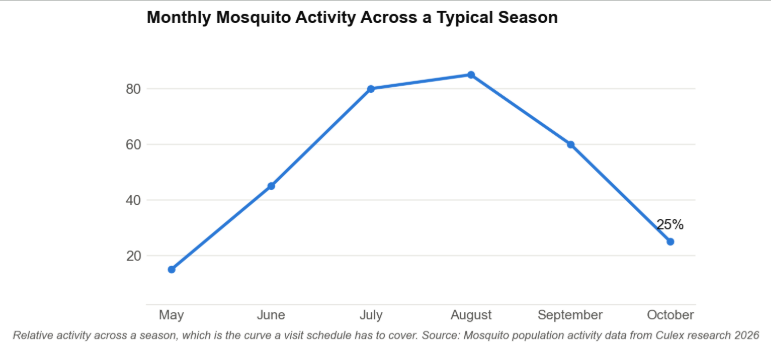
Six visits at sixty to one hundred ten dollars is a season somewhere between three hundred sixty and six hundred sixty dollars, and a standard Stamford deck and patio lot tends to land near the middle, call it five hundred and forty. Treatments knock down adult mosquitoes and hold for several weeks per application, which is why reapplication every three to four weeks through peak season is the working interval rather than a sales quota. Six visits from early June to mid September covers the entire hosting stretch, weekends included. Priced honestly, mosquito removal Stamford CT is a five hundred dollar line item for the summer, not a nine dollar one. Set that beside the eight hundred and forty dollar gadget season above.
The curve is what decides the schedule. Mosquito activity does not sit flat across a summer; it climbs through June, peaks in the July and August stretch, then tails off into the fall, so one event spray bought for a single July party misses both shoulders of the season. Published work on Culex populations tracks that arc. Visits have to cover the ramp and the tail, not the party.
The recurring program is the cheaper line item, and it is the only one of the two that shows up on the weekends nobody planned for.
Ten years ago the pitch was thinner: a barrier spray along the shrub line, a monthly interval, whatever product the truck happened to be carrying. The program a homeowner buys now usually includes a choice between organic plant based material and professional grade conventional product, plus treatment of breeding areas instead of foliage alone. That second half matters more than the spray, because standing water in a clogged gutter or an unturned wheelbarrow will repopulate a yard in about a week. The programs worth the money treat the water and not just the leaves, and a quote that never mentions breeding sites is quoting a thinner job than the one next to it.
Questions That Decide Whether The Money Works
Price per visit only means something next to what the visit includes. Two quotes at eighty dollars can be different jobs entirely, and the difference surfaces in August rather than on the invoice. Ask four questions before signing for a season, and listen for specifics instead of reassurance.
- How many visits does the season include, and on what dates? A good answer names a count and a start month, not “as needed.”
- What happens after heavy rain, and is a return visit charged? A good answer commits to a free re-treatment inside a stated window, often seven to fourteen days.
- Is the product organic and plant based or professional grade conventional, and can I choose? A good answer explains how long each one holds and why you might pick either.
- Do you inspect and treat breeding areas, or only spray foliage? A good answer describes walking the property for standing water, gutters and containers.
Run the numbers on your own drawer before the next quote lands. Add the candles, the coil cases, the trap refills and the two panic sprays, then set that total beside six scheduled visits between June and September. For a household hosting every weekend, the program usually comes in lower and covers ninety days rather than ninety minutes. The gadgets are not useless, they are simply billed the expensive way, one evening at a time.