








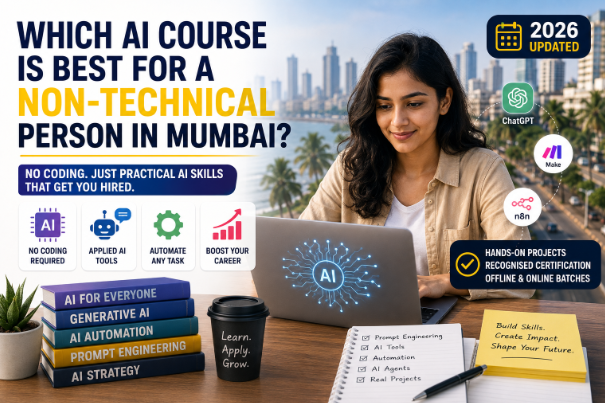
Which AI Course Is Best for a Non-Technical Person in Mumbai? (2026 Answer)
The best AI course for a non-technical person in Mumbai is one that is fully no-code, teaches applied tools like ChatGPT, Make, and n8n instead of programming, includes hands-on projects, and carries a recognised certification.
IIDE’s offline AI course will be the best option. They also have an online version with the same curriculum for people who prefer to learn from home.
Most non-technical people get this decision wrong for one simple reason: they pick a course built for engineers. The syllabus said “AI course,” but week 4 turned into Python, statistics, and model training.
If you are from a commerce, arts, or management background, that is not the course you need, and honestly, it is not the course the job market needs you to take either. So before comparing institutes, get clear on what “learning AI” actually means for a non-technical person in 2026.
What Does Learning AI Mean If You Can’t Code?
For a non-technical person, learning AI means learning to apply AI, not build it. That covers prompt engineering, generative AI, no-code automation, and agentic AI.
The newest addition is vibe coding, where you build working apps and websites by describing them to AI tools like Lovable and Bolt. Even product building, the most “technical” thing on this list, is now open to non-coders.
Engineering-track AI courses teach you to build models. Applied AI courses teach you to use them. Companies in Mumbai are hiring far more of the second kind right now.
AI content specialists, automation executives, AI-assisted marketers, and consultants who can bring AI into a business. India expects 2.3 million AI-related job openings by 2027.
What Should a Non-Technical Person Check Before Enrolling?
Check the curriculum, honestly. Ask the counsellor directly: “Is there any module where I will need to write code?” If the answer includes the words Python, SQL, or statistics, and you are a beginner, walk away.
Plenty of AI courses in Mumbai hide technical foundations behind friendly brochures, and non-tech students only discover them after paying.
Check what you build, not what you watch. A course should end with things you can show: an AI-generated ad campaign, a working automation, an AI agent, ideally a small app.
If the course has a capstone judged by industry people, even better. A certificate says you attended. A portfolio proves you can build.
Check whose tools you practise on. Serious AI work happens on paid tools, and subscriptions cost Rs 3,000 to 5,000 a month. Courses that include paid tool access save you that cost and, more importantly, train you on what professionals actually use, not the free trial version.
Check who certifies the course. Anyone can print a certificate. Look for backing that an employer recognises: government skill bodies like the Ministry of Skill Development and Entrepreneurship, industry councils like NASSCOM, or established institutes with verifiable placement records.
Check who teaches. Trainers should be practitioners currently using AI in agencies, brands, or startups, not academics reading slides. Ask for the mentor list and look them up on LinkedIn. Five minutes of checking saves months of regret.
Which AI Course Should a Non-Technical Person Choose in Mumbai?
Apply the five checks above to the Mumbai market, and IIDE, The Digital Business School in Andheri West, stands out as a strong option.
IIDE’s AI programs are designed around no-code, application-first learning. Instead of requiring learners to study programming or model development, the curriculum focuses on using AI for content creation, research, automation, data workflows, AI agents, and product building.
The institute offers three certification tracks with different levels of depth:
Certification in Generative AI (CGAI), 2 months: Covers four modules, including prompt engineering, AI research, photography and video fundamentals, and generative AI for images, video, and audio. Learners work with 10+ AI tools and complete three practical projects focused on digital content creation.
Advanced Certification in AI (ACAI), 3 months: Expands on the CGAI curriculum with seven modules covering automation fundamentals, data management, and agentic AI. Learners build no-code automations and AI agents using platforms such as Make and n8n while completing seven practical projects across 15+ tools.
Professional Certification in AI Strategy (PCAIS), 5 months: Offers an in-depth curriculum across eleven modules and 25+ AI tools. It covers AI strategy, automation, agentic workflows, and product development through vibe coding. Learners design, build, and launch a working AI application before presenting their final product to a jury of industry experts.
All three programs focus on practical application rather than traditional coding. Learners can attend offline sessions at IIDE’s Mumbai campus or study online, depending on their preferred learning format.