










7 Best Upfluence Alternatives With Bigger Creator Databases in 2026
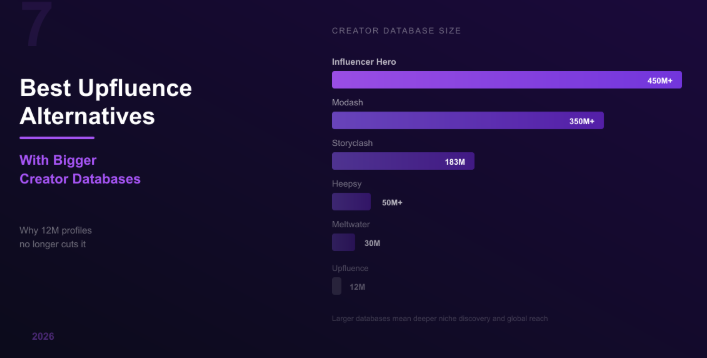
When Upfluence launched with a database of 12 million influencer profiles, it was considered one of the larger indexes on the market. That number hasn’t changed much since. Meanwhile, the creator economy has exploded – over 200 million people worldwide now consider content creation their primary or secondary income source, and the platforms indexing those creators have scaled accordingly.
For brands running influencer programs in 2026, database size isn’t vanity. It’s the foundation of discovery quality. A larger, more comprehensive creator index means better niche matching, stronger global reach, more granular filtering by audience demographics, and access to emerging creators before your competitors find them. When your platform only indexes 12 million profiles out of hundreds of millions of active creators, you’re searching a fraction of the market.
If you’ve hit the ceiling of what Upfluence’s database can surface – the same creators appearing in every search, limited coverage outside major English-speaking markets, or too few filters to narrow results meaningfully – the alternatives below offer significantly larger creator pools. Influencer Hero leads the list with 450M+ indexed profiles, and every platform here gives you more discovery firepower than Upfluence’s 12M.
- Influencer Hero (450M+ creators)
- Modash (350M+ creators)
- GRIN (large, undisclosed database)
- Meltwater (30M creators with True Reach AI)
- Storyclash (183M creators)
- Heepsy (50M+ creators)
- HypeAuditor (undisclosed, strong analytics layer)
Why Upfluence’s 12M Database No Longer Cuts It
Creator discovery is the starting point of every influencer campaign. When the database powering that discovery is too small or too shallow, the problems cascade through the entire workflow:
- Limited Niche Discovery: With only 12M profiles, Upfluence struggles to surface creators in specialized verticals – think vegan fitness in Southeast Asia, B2B SaaS reviewers on YouTube, or pet care micro-influencers in Germany. The smaller the database, the more generic the results.
- Quantity Over Quality Search: Users consistently report that Upfluence search returns require heavy manual filtering. The database lacks the depth to power truly granular audience-level filters, so you end up scrolling through profiles that look right on the surface but don’t match on audience demographics.
- Fewer Platforms Indexed: Modern influencer programs span Instagram, TikTok, YouTube, Pinterest, Twitch, and more. Upfluence’s coverage skews heavily toward Instagram and YouTube, leaving gaps on platforms where your next high-performing creator might be building their audience.
- Geographic Blind Spots: Global brands need global discovery. A 12M database inevitably underrepresents creators in Latin America, the Middle East, Southeast Asia, and other high-growth regions – exactly the markets where early-mover advantage matters most.
- Recycled Creator Results: A constrained database means you and your competitors are fishing from the same small pond. Over time, the same creators appear in every search, driving up partnership costs and reducing campaign freshness.
The platforms below address these limitations directly – with databases ranging from 30M to 450M+ profiles and discovery tools designed to surface creators Upfluence simply can’t reach.
Upfluence Alternatives With Larger Creator Databases
1. Influencer Hero
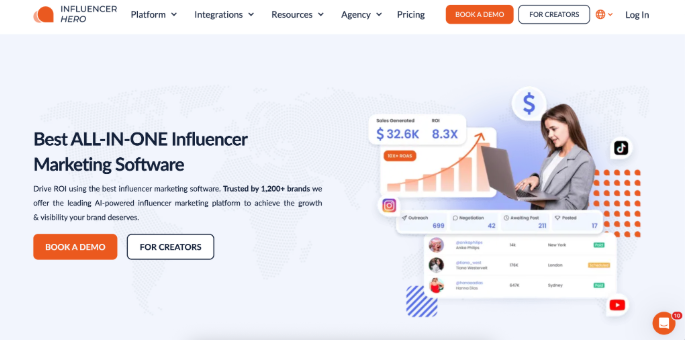
Influencer Hero operates the largest indexed creator database on the market at 450M+ profiles spanning eight platforms – Instagram, TikTok, YouTube, Pinterest, Snapchat, Twitch, and X. That’s roughly 37 times the size of Upfluence’s database, which translates directly into deeper niche discovery, broader global coverage, and access to emerging creators who haven’t been contacted by every brand running the same search.
Beyond raw database size, the platform pairs discovery with audience-level filtering – demographics, engagement quality, audience authenticity scoring, and lookalike recommendations – so the volume doesn’t come at the cost of precision. Discovery feeds directly into an all-in-one workflow covering AI-powered outreach, CRM, product gifting, UGC collection, affiliate tracking, and creator storefronts.
Best for: Brands that need the widest possible discovery net combined with end-to-end campaign management – from finding creators to tracking revenue attribution.
Pricing:
- Standard: $649/month (1 seat, up to 1,000 creators, 1,000 outreach/mo)
- Pro: $1,049/month (3 seats, up to 5,000 creators, 5,000 outreach/mo)
- Business: $2,490/month (8 seats, up to 10,000 creators, 10,000 outreach/mo)
- Custom & Agency plans available with unlimited outreach
Standout features:
- 450M+ Creator Database Across 8 Platforms: The largest indexed database available, with granular filters for audience demographics, engagement rates, content topics, and location at country, state, and city levels.
- AI-Powered Outreach (43% Response Rate): Automated drip campaigns with AI-personalized first lines tailored to each creator’s recent content. Handles thousands of outreach sequences simultaneously.
- Lookalike Creator Recommendations: Find a creator who performs well, and the platform surfaces similar profiles from the full 450M+ database – expanding successful partnerships exponentially.
- Fraud Detection Built Into Discovery: Audience authenticity analysis and fake follower identification integrated directly into the search workflow, so you vet creators before outreach – not after.
- Five eCommerce Integrations: Shopify, WooCommerce, Magento, BigCommerce, and Prestashop for product gifting, affiliate tracking, and per-creator revenue attribution.
- Creator Storefronts (Up to 8x ROI): Branded storefronts where creators sell products with affiliate commissions – turning one-time partnerships into persistent revenue channels.
The platform’s comprehensive feature set means teams adopting influencer software for the first time may need time to explore the full workflow. Brands running only a handful of campaigns per year may not leverage every capability, though the architecture ensures you won’t outgrow it.
2. Modash
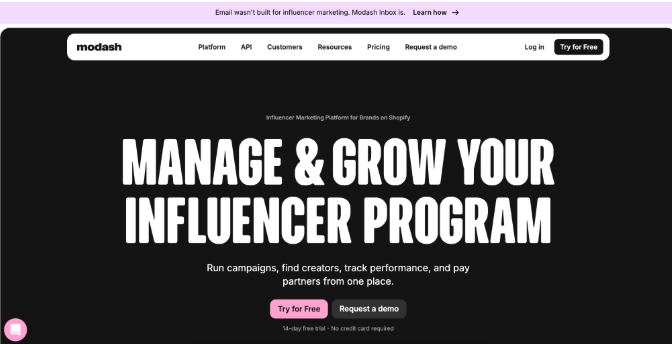
Modash indexes 350M+ public creator profiles using a non-opt-in approach – meaning it crawls publicly available data rather than requiring creators to sign up. This gives it the second-largest database on this list and makes it particularly strong for discovering creators who aren’t actively seeking brand deals but have the right audience and engagement metrics.
The platform pairs that discovery power with a visual AI search feature that lets you describe a creative style or upload a reference image to find aesthetically matching creators. For Shopify brands, Modash offers native gifting and affiliate workflows with automated discount codes, UTM tracking, and commission payouts.
Best for: Shopify-based brands that want massive discovery reach and affiliate management at mid-market pricing.
Pricing:
- Essentials: $199-$299/month
- Performance: $499-$599/month
- Enterprise: Custom (annual billing)
Standout features:
- 350M+ Non-Opt-In Creator Database: One of the widest discovery nets on the market, including creators who haven’t registered on any influencer platform.
- AI Visual Discovery: Describe a vibe or upload a reference image to find creators matching a specific aesthetic – useful for lifestyle, fashion, and beauty brands.
- Shopify-Native Gifting & Affiliates: Automated discount codes, UTM tracking, and product selection directly from your Shopify catalog.
- Fake Follower Detection: Audience quality scoring to filter out inflated profiles during discovery.
Modash’s deep integrations only work with Shopify – brands on WooCommerce, Magento, or BigCommerce will need to look elsewhere for native eCommerce support. The platform also lacks AI-powered outreach personalization and content licensing tools. For teams that need broader eCommerce coverage alongside a large database, platforms like Influencer Hero cover those gaps with five eCommerce integrations and AI outreach built in.
3. GRIN
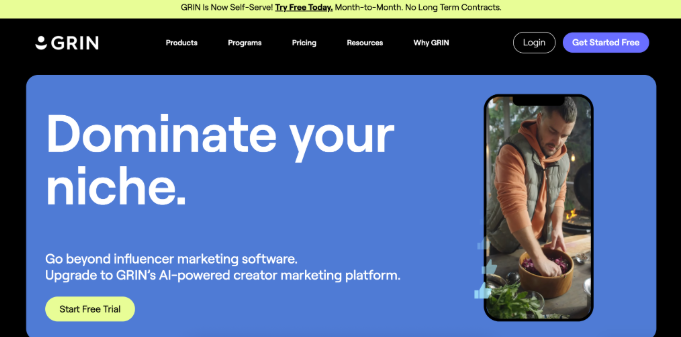
GRIN doesn’t publicly disclose its database size, but the platform is widely recognized as having one of the larger creator indexes among enterprise tools. Its AI-powered discovery assistant, Gia, handles creator sourcing by analyzing brand criteria and surfacing recommendations – shifting the model from manual search to intelligent matching.
Where GRIN differentiates on the discovery front is through its creator portals. Once you’ve found and onboarded creators, they get private dashboards for viewing briefs, submitting content, and tracking earnings. The platform also embeds content reuse rights directly into the booking flow, which eliminates separate licensing negotiations.
Best for: Established eCommerce brands with dedicated influencer teams managing large-scale, ongoing creator programs.
Pricing:
- Custom; entry tier typically starts around $2,500/month
- 12-month minimum commitment; $25,000+/year
Standout features:
- AI Discovery With Gia: Intelligent assistant that surfaces and evaluates creators based on brand criteria, reducing manual search time.
- Unlimited Creator Partnerships: No caps on the number of influencers you can manage – built for brands running hundreds of active relationships.
- Creator Portals: Private dashboards where influencers view briefs, submit content, and track their earnings independently.
- Automatic Media Rights: Content reuse rights embedded in the booking flow – no separate licensing negotiations needed.
- Searchable UGC Library: Repository of creator content including Stories for cross-channel repurposing.
GRIN’s $25,000+/year minimum and mandatory 12-month contracts recreate the same lock-in friction that drives many brands away from Upfluence. The interface can feel sluggish under heavy use, and the lack of database transparency makes it difficult to compare discovery breadth against platforms that publish their numbers. For teams that prioritize knowing exactly how wide their discovery net reaches, platforms with published databases of 350M-450M+ provide more certainty.
4. Meltwater
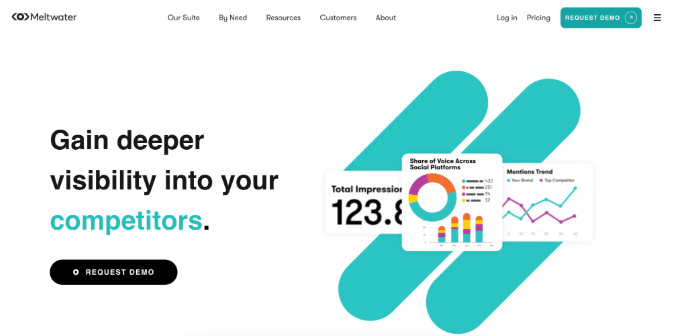
Meltwater (which incorporates Klear) takes a different approach to creator discovery. Its 30M influencer database is smaller than some competitors on this list, but it compensates with proprietary “True Reach” technology – AI that estimates real audience reach beyond raw follower counts by analyzing engagement patterns, audience overlap, and content distribution.
The platform’s real differentiator is its integration with the broader Meltwater media intelligence ecosystem. Brands can combine influencer data with PR monitoring, social listening, and audience sentiment analysis in a single dashboard – useful for teams that measure influencer impact alongside earned media and brand reputation.
Best for: Enterprise brands that need influencer marketing data combined with media monitoring, PR tracking, and audience sentiment in one platform.
Pricing:
- Klear plans: approximately $33,100-$45,000/year (discounted)
- Standard Meltwater packages: $50,000+/year
Standout features:
- True Reach Technology: AI estimates real audience reach beyond follower counts – accounting for engagement quality, audience overlap, and content distribution patterns.
- Visual AI Search: Find creators by image or content theme, useful for brands with specific visual brand guidelines.
- Audience Sentiment Analysis: Analyzes comment section sentiment to gauge how an influencer’s audience actually responds to sponsored content.
- Integrated Chat and Payments: In-platform communication and payment processing to keep the entire workflow centralized.
- Cross-Channel Reporting: Combines influencer campaign data with media intelligence for a unified performance view.
Meltwater’s enterprise pricing ($33,100-$50,000+/year) puts it out of reach for most mid-market brands. The 30M database, while enhanced by True Reach analytics, is still a fraction of what larger indexes offer for raw discovery volume. Setup and onboarding are heavy. Brands primarily looking for wide creator discovery and campaign management – rather than media intelligence – will find more database depth per dollar with platforms indexing 183M-450M+ creators.
5. Storyclash
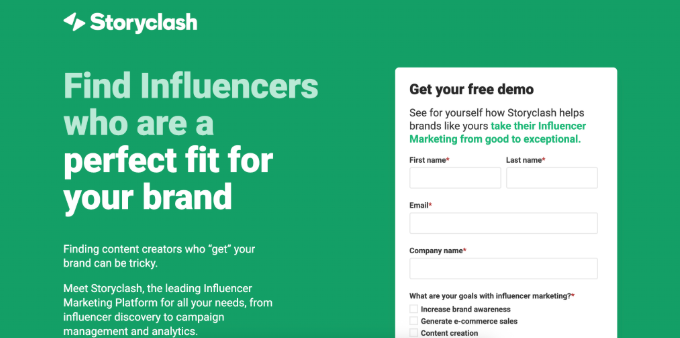
Storyclash indexes 183M creator profiles across Instagram, TikTok, and YouTube, making it one of the larger databases in this comparison. Its discovery approach leans heavily on AI – image recognition, natural language prompts, and lookalike search let you describe the type of creator you want rather than relying solely on keyword and filter combinations.
What sets Storyclash apart is its access to historical content data, including expired Instagram Stories. This means you can evaluate a creator’s actual posting behavior over time – not just what’s currently visible on their profile. The platform also offers competitive benchmarking, letting you see which creators your competitors are working with and how those partnerships perform.
Best for: Brands that want AI-driven discovery with competitive intelligence and historical content analysis to make more informed creator selections.
Pricing:
- Business plan: starts at $870/month
- Enterprise: custom pricing
Standout features:
- 183M Creator Database: Broad coverage across Instagram, TikTok, and YouTube with AI-powered search that understands natural language descriptions.
- AI Image Recognition Discovery: Upload a reference image or describe a visual style, and the platform surfaces matching creators based on their content.
- Historical Content Data (Including Expired Stories): Evaluate creators based on their full posting history, not just what’s currently live.
- Competitive Benchmarking: See which creators your competitors are hiring, what they’re paying, and how those campaigns perform.
- Shopify Integration for Revenue Tracking: ROAS, CAC, and AOV tracking connected directly to your Shopify store.
Storyclash lacks built-in contract generation and content licensing workflows – you’ll need to handle UGC repurposing rights manually or through external tools. The platform covers three social platforms compared to the eight covered by Influencer Hero’s 450M+ database, which limits discovery for brands active on Pinterest, Snapchat, Twitch, or X. For teams that prioritize competitive intelligence and content analytics alongside discovery, it’s a strong specialist choice.
6. Heepsy
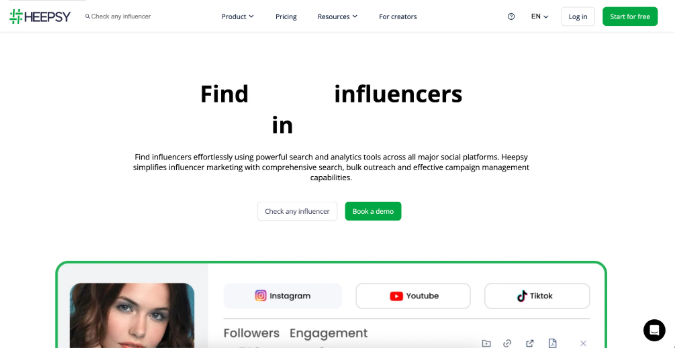
Heepsy’s 50M+ influencer database focuses on the US and European markets, offering strong coverage in the regions where most Western-market brands run the bulk of their campaigns. The platform is designed for accessibility – a free plan and paid tiers starting at $89/month make professional-grade discovery available to brands that would be priced out of enterprise tools.
Discovery filters include audience demographics, engagement rates, authenticity scores, and location data. The platform supplements search with a Kanban-style CRM for tracking creators through campaign stages and bulk email outreach supporting up to 3,000 emails per month.
Best for: Small to mid-sized eCommerce brands that need affordable discovery and outreach tools to build their influencer programs.
Pricing:
- Free plan available
- Starter: $89/month
- Plus: $249/month
- Advanced: $369/month (required for Shopify sales tracking)
Standout features:
- 50M+ Influencer Database: Strong US and European market coverage with audience quality scoring on every profile.
- Authenticity Filters: Fake follower detection and engagement quality analysis built into the discovery workflow.
- Kanban-Style CRM: Visual pipeline for managing creators through campaign stages – from outreach to content delivery.
- Bulk Email Outreach: Up to 3,000 emails per month with automated follow-up sequences.
Heepsy’s 50M database is four times the size of Upfluence’s, but still a fraction of the 350M-450M+ offered by top-tier platforms. The best features – Shopify tracking, affiliate management – require higher-priced plans. Outreach lacks AI personalization, so manual effort scales linearly with your creator list. For brands that start with Heepsy and outgrow its discovery range, platforms like Influencer Hero offer a natural graduation path with 450M+ profiles and AI-powered outreach.
7. HypeAuditor
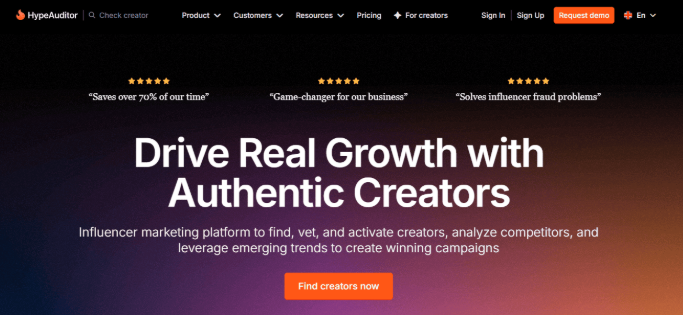
HypeAuditor doesn’t lead with a headline database number, but its discovery tools are backed by one of the most sophisticated analytics layers in the industry. The platform is best known as the gold standard for fake follower detection and influencer auditing – which means every creator it surfaces comes with deep audience authenticity data attached.
Discovery features include AI-powered lookalike search, caption and image analysis, and social listening for competitor monitoring. For brands where creator quality matters more than sheer volume – and where vetting is a bottleneck – HypeAuditor’s analytics-first approach can save significant time that would otherwise go to manual due diligence.
Best for: Brands and agencies that prioritize audience authenticity and deep analytics, and want the most rigorous vetting layer in their discovery workflow.
Pricing:
- Business: approximately $10,000/year
- Enterprise: up to $60,000/year
Standout features:
- Industry-Leading Fraud Detection: Advanced audience authenticity scoring, engagement quality analysis, and fake follower identification on every creator profile.
- AI Discovery With Lookalike Search: Analyzes captions, images, and engagement patterns to find creators similar to your best performers.
- Social Listening & Competitor Monitoring: Track hashtags, brand mentions, and competitor influencer activity to inform your discovery strategy.
- Shopify Revenue Attribution: Connects influencer campaigns to actual sales data for ROI tracking.
- Creator Application Pages: Custom pages where creators apply to your campaigns – building an inbound pipeline alongside outbound discovery.
HypeAuditor’s analytics depth comes with complexity that can overwhelm teams new to influencer marketing. Only a small portion of creators are registered for direct application features. The undisclosed database size makes it harder to compare raw discovery breadth against platforms that publish their numbers. For teams that want both wide discovery coverage and strong analytics, combining HypeAuditor’s vetting with a large-database platform like Influencer Hero’s 450M+ index is a common approach.
Final Thoughts
Creator discovery is the foundation of every influencer campaign, and database size is the foundation of discovery. When your platform only indexes a fraction of the active creator market, you’re making decisions with incomplete information – missing niche creators, underrepresenting entire regions, and competing with every other brand running the same limited search.
The seven platforms above each address Upfluence’s 12M database limitation differently. Influencer Hero offers the widest net at 450M+ profiles across eight platforms, paired with end-to-end campaign tools. Modash provides strong discovery volume at accessible pricing for Shopify brands. GRIN bundles large-scale discovery with enterprise creator management. Meltwater combines a curated database with media intelligence. Storyclash layers AI discovery over 183M profiles with competitive benchmarking. Heepsy makes 50M+ profiles accessible starting from free. And HypeAuditor brings the deepest analytics layer to whatever database size it covers.
The right choice depends on your priorities. If raw discovery breadth across the most platforms is the primary gap Upfluence left, start there. If analytics depth, competitive intelligence, or media monitoring matter more, weight those accordingly. And if budget flexibility is the constraint, several of these platforms offer monthly pricing or free tiers that let you validate the fit before committing.
It’s also worth noting that many influencer marketing agencies now build their operations on these larger-database platforms – managing discovery and campaign execution at scale for brands that want results without building a full in-house team.
Whatever you choose, moving beyond a 12M database is no longer optional. The market has scaled, the tools have scaled, and your discovery capability needs to scale with them.
FAQs
1. How does database size actually affect influencer discovery?
A larger database means more creators indexed, which translates to better niche matching, broader geographic coverage, and access to emerging creators that smaller databases miss. When a platform indexes 450M+ profiles versus 12M, you’re searching roughly 37 times more of the creator market – which directly impacts the quality and specificity of your results.
2. Is Upfluence’s 12M database still useful?
It’s functional for basic discovery in major English-speaking markets, but limiting for brands that need niche creators, global coverage, or access to emerging talent. The gap becomes especially apparent when searching for creators on platforms beyond Instagram and YouTube, or in regions outside North America and Western Europe.
3. Does a bigger database mean better results automatically?
Not on its own. Database size needs to be paired with granular filtering, audience analytics, and fraud detection to be useful. A database of 450M+ profiles with audience-level filters and authenticity scoring will outperform a larger unfiltered index. The platforms on this list combine size with precision.
4. Which platform has the largest creator database in 2026?
Influencer Hero leads with 450M+ profiles across eight platforms (Instagram, TikTok, YouTube, Pinterest, Snapchat, Twitch, and X). Modash follows with 350M+, Storyclash indexes 183M, and Heepsy has 50M+. GRIN and HypeAuditor don’t publicly disclose their database sizes.
5. Can I use multiple platforms to expand my discovery?
Yes, and many brands do – for example, using HypeAuditor for deep analytics and vetting alongside a large-database platform for broad discovery. However, managing multiple subscriptions adds cost and workflow complexity. All-in-one platforms that combine large databases with built-in analytics aim to eliminate that need.
6. What should I prioritize besides database size when switching from Upfluence?
Look at filtering granularity (audience demographics, not just creator demographics), platform coverage (how many social networks are indexed), pricing flexibility (monthly vs. annual contracts), and workflow integration (does discovery feed directly into outreach, CRM, and tracking). The best platforms combine a large database with end-to-end campaign tools so you’re not stitching together multiple solutions.
Keywords: Upfluence alternatives 2026, biggest influencer databases, creator discovery platforms, influencer marketing database comparison, Influencer Hero vs Upfluence, best influencer discovery tools, large creator database platforms