












7 Best Investment Banking Institutes in Bengaluru: Courses, Placements, Internships and Career Support Compared
Choosing an investment banking course in 2026 is no longer simply about finding a program that teaches financial statements, valuation and Excel.
The bigger question is what happens after the classroom.
Can the learner work on real financial projects? Is there internship exposure? Does the institute provide interview preparation? Can students build a portfolio that they can discuss during recruitment? And perhaps most importantly, does the institute have an actual career-support ecosystem?
These questions matter because investment banking is one of the most competitive areas of finance. A certificate alone rarely tells an employer what a candidate can actually do.
At the same time, investment banking itself is changing. Artificial intelligence is increasingly being used for financial research, document analysis, data extraction, transaction workflows and other information-heavy activities. That means the next generation of finance professionals will need a combination of financial knowledge, analytical ability, technology awareness and practical exposure.

For students searching for the best investment banking institute in Bengaluru, this makes choosing the right training provider more complicated than simply comparing course fees or duration.
This guide compares seven important factors that prospective students should evaluate when choosing an investment banking institute, with a closer look at Boston Institute of Analytics (BIA) and why its investment banking and financial analytics program stands out for its placement-oriented approach.
What Makes a Good Investment Banking Institute in 2026?
Before comparing institutions, it is useful to define what “best” actually means.
A strong investment banking program should ideally combine:
- Investment banking fundamentals
- Financial modeling and valuation
- M&A and transaction analysis
- Financial analytics
- Practical case studies
- Live or simulated projects
- Industry-led training
- Internship opportunities
- Interview preparation
- Resume development
- Career mentoring
- Corporate connections
- Placement assistance
- Exposure to modern financial technology and AI
This is particularly important for fresh graduates and career switchers.
Someone entering investment banking may understand finance academically but still have limited experience applying those concepts in a professional setting. A good program should help close that gap.
7 Things to Compare Before Choosing the Best Investment Banking Institute
Rather than ranking institutes based purely on advertising claims, students can use these seven criteria to compare programs.
1. Does the Course Go Beyond Financial Theory?
Investment banking is practical by nature.
Students should be able to work with financial statements, company data, valuation models, transaction scenarios and research assignments rather than only studying concepts from presentations.
A useful question to ask is:
“What will I actually build during the course?”
If the answer includes financial models, valuation reports, M&A case studies, equity research projects and a capstone, that is a stronger indication of practical learning.
2. Is There a Real Internship Component?
An internship can provide something a classroom cannot: exposure to professional expectations.
It can help students understand how financial analysis is performed, how teams communicate, how assignments are reviewed and how deadlines work.
This becomes particularly relevant when comparing an investment banking course with placement and internship support.
The internship should not simply be a certificate-generating exercise. Students should ideally be working on assignments that they can later discuss during interviews.
3. What Does “Placement Support” Actually Mean?
This is one of the most important questions students should ask.
“Placement assistance” can mean very different things across institutes.
Students should look for evidence of:
- Resume building
- Mock interviews
- Interview preparation
- Career counselling
- Employer connections
- Internship opportunities
- Job-search guidance
- Alumni networks
- Industry mentorship
A responsible institute should also distinguish between placement assistance, guaranteed internships and guaranteed job training.
These are not the same thing.
For example, BIA’s published program information states that its career assistance includes resume building, interview preparation and career counselling, while its different investment banking learning paths include specific internship and job-training components.
4. Does the Institute Have an Industry Network?
A finance education provider’s industry ecosystem can make a meaningful difference.
Boston Institute of Analytics currently has a network of 350+ corporate partners, 7,000+ industry mentors and advisors, and 50,000+ alumni across its broader ecosystem.
That matters because career preparation is rarely limited to classroom learning.
Exposure to industry mentors, professionals and corporate networks can help students understand what employers expect from entry-level candidates.
5. Are Students Given Real Projects?
Projects are increasingly important in finance recruitment.
Consider the difference between these two resumes:
Candidate A
Completed an investment banking course.
Candidate B
Built a DCF valuation, completed a comparable-company analysis, developed an M&A case study and presented a financial analysis project.
The second candidate has more evidence to discuss during an interview.
BIA’s investment banking program includes hands-on projects and capstone work. Its Mumbai program states that students work on investment banking projects under the guidance of industry trainers and faculty.
For students evaluating the best investment banking course in Mumbai, this practical component is worth examining closely.
6. Is Financial Analytics Part of the Program?
Investment banking is increasingly becoming a data-intensive profession.
Financial professionals work with market data, company financials, transaction information, industry datasets and large volumes of documents.
That is why programs combining investment banking with financial analytics can be particularly relevant.
BIA’s program is specifically structured as Investment Banking & Financial Analytics, rather than treating analytics as an unrelated add-on. The published program information also highlights exposure to multiple tools and technologies and practical case-based learning.
The broader trend is clear: finance professionals are increasingly expected to understand both financial decisions and the data supporting those decisions.
7. Does the Institute Prepare Students for the AI-Driven Finance Industry?
AI is becoming increasingly relevant across financial services.
The most useful question is not whether an institute has added an “AI module” to its brochure.
The better question is:
Can students understand how AI is actually being used in financial workflows?
For example:
- Financial research
- Data analysis
- Document processing
- Market research
- Financial forecasting
- Workflow automation
- Research summarization
- Investment analysis
BIA’s investment banking and financial analytics curriculum incorporates emerging technologies alongside traditional finance training, reflecting the direction in which modern finance roles are moving.
Boston Institute of Analytics: A Closer Look
Among the institutions students can consider, Boston Institute of Analytics has built a distinct position around professional, industry-oriented training.
Its Investment Banking & Financial Analytics program is available through multiple BIA locations, including Mumbai, and offers three primary learning paths:
- Investment Banking Certification: 4 months
- Investment Banking Diploma: 6 months
- Investment Banking Master Diploma: 10 months
The Mumbai program also highlights practical projects, industry-led training and career support.
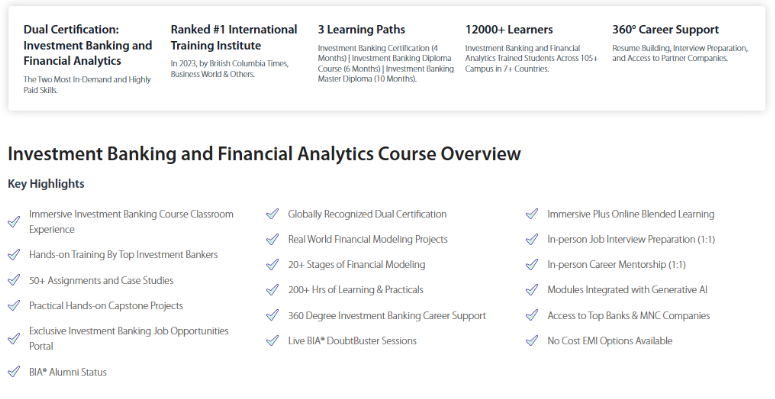
This multi-path structure is useful because not every learner enters with the same career objective.
Someone looking for a shorter certification may have different requirements from a graduate seeking a longer program with internship or job-training exposure.
The Placement Difference: What BIA Offers
This is where Boston Institute of Analytics deserves closer attention.
BIA’s published career-support structure includes:
- Resume building
- Interview preparation
- Career counselling
- One-to-one career mentoring
- Access to partner companies
- Industry-oriented projects
- Internship opportunities
- Job-training pathways
For its Mumbai Investment Banking & Financial Analytics program, BIA states that the 6-month diploma includes a 2-month guaranteed internship, while the 10-month master diploma includes 6 months of guaranteed on-job training.
This distinction is important.
The institute does not present job training as the same thing as guaranteeing every learner a permanent job. Its published information notes that actual placement success depends on individual performance, industry requirements and market conditions.
That is a more useful way for students to evaluate career support.
The question shouldn’t simply be:
“Does this institute promise a job?”
It should be:
“What does this institute actually do to make me job-ready?”
BIA’s Industry Scale
Another factor worth considering is the broader ecosystem around the program.
BIA currently reports:
- 50,000+ trained students
- 7,000+ industry trainers, mentors and advisors
- 350+ corporate partners
- Presence across 105+ campuses
- Operations across 7+ countries
These figures are published by BIA as part of its broader institutional network.
For a student, the relevance is less about the numbers themselves and more about what they represent: a larger professional training ecosystem can provide greater opportunities for networking, mentorship and exposure.
What Do BIA Learners Say?
Testimonials are useful, but they should be interpreted as individual experiences rather than universal outcomes.
BIA publishes several learner experiences on its investment banking course page.
One learner, Zara Patel, describes the investment banking course as comprehensive and industry-focused, saying it helped her develop toward a Financial Analyst role. Another learner, Varun Bharadwaj, highlights the real-world projects and their relevance to the fast-paced finance industry.
These testimonials are particularly relevant because they point toward something more meaningful than simply completing a course: using training to transition into finance roles.
Employer Feedback Adds Another Perspective
BIA also publishes employer feedback alongside learner testimonials.
For example, the institute’s Mumbai course page features comments attributed to professionals associated with organizations including JPMorgan Chase, PwC, ICICI Prudential Life and Goldman Sachs India. The comments focus on areas such as analytical ability, financial modeling, strategic analysis, M&A understanding and financial-market knowledge.
Such testimonials should not be interpreted as a guarantee that those companies recruit every BIA graduate.
Instead, they provide an indication of the types of capabilities the institute emphasizes in its finance training.
For students, that distinction matters.
BIA vs a Traditional Finance Course: What Is Different?
A traditional finance course may concentrate primarily on academic concepts.
An industry-oriented investment banking program attempts to bridge the gap between those concepts and professional application.
| Area | Traditional Finance Education | BIA Investment Banking & Financial Analytics |
| Finance fundamentals | Yes | Yes |
| Financial modeling | Varies | Core component |
| Valuation | Varies | Core component |
| Investment banking | May be theoretical | Specialized program |
| Financial analytics | Limited in some programs | Integrated |
| Practical projects | Depends on program | Emphasized |
| Capstone | Depends on program | Included |
| Internship pathway | Varies | Available in diploma path |
| Job-training pathway | Rare | Available in master diploma |
| Resume preparation | Varies | Career support |
| Interview preparation | Varies | Included in career assistance |
| Industry mentorship | Varies | Available |
| Corporate ecosystem | Institution-dependent | 350+ corporate partners reported by BIA |
The point is not that every traditional finance program is inferior.
Rather, students who are specifically targeting investment banking should compare programs according to the career outcome they want, not simply the academic credential they receive.
Why Mumbai Matters for Investment Banking Careers
Mumbai remains one of India’s most important financial centres.
For students targeting investment banking, equity research, financial analytics, corporate finance or related careers, studying in a city with a large financial-services ecosystem can provide proximity to relevant employers and professional networks.
Who Should Consider an Investment Banking Course?
An investment banking program can make sense for several groups:
Recent Graduates
Graduates from commerce, finance, economics, business or related backgrounds can use practical training to move beyond academic knowledge.
Career Switchers
Professionals already working in another field may use investment banking education to build financial modeling, valuation and transaction-analysis capabilities.
Finance Professionals
People already working in accounting, financial analysis or related roles can use specialized training to expand into investment banking and financial analytics.
Students Looking for Career-Focused Education
For students who are more interested in professional finance roles than purely academic study, an industry-focused course can provide structured exposure to practical work.
What Should You Ask Before Enrolling?
Before paying for any investment banking program, ask these questions:
- What projects will I complete?
- Is there a capstone project?
- What does the internship actually involve?
- How does placement assistance work?
- Are interviews arranged or only advertised?
- Who provides career mentoring?
- What companies are part of the corporate network?
- Can I see the curriculum before enrolling?
- Does the program include financial modeling and valuation?
- How does the course incorporate financial analytics and AI?
- What happens if I need help preparing for interviews?
- What is guaranteed, and what depends on my own performance?
That final question is particularly important.
Students should always distinguish between guaranteed internship or job-training components and actual permanent employment outcomes.
So, Which Is the Best Investment Banking Institute in Bengaluru?
There is no universal answer for every student.
The “best” institute depends on what the learner values: location, duration, practical exposure, internship opportunities, career support, specialization and budget.
However, if the objective is to find a program that combines investment banking, financial analytics, practical projects, industry exposure and structured career support, Boston Institute of Analytics deserves to be on the shortlist.
Its Investment Banking & Financial Analytics program offers multiple learning paths, practical case-based learning, capstone projects, industry mentorship and career assistance. The diploma and master diploma pathways additionally provide defined internship and job-training components.
For someone specifically searching for the best investment banking institute in Bangalore, best investment banking course in Mumbai, or an investment banking course with placement in Bengaluru, those are meaningful factors to evaluate.
The bigger lesson is that the strongest investment banking education is no longer about collecting another certificate.
It is about building enough practical evidence to answer an employer’s most important question:
“What can you actually do?”
If a candidate can walk into an interview with financial models, valuation work, transaction case studies, a capstone project, internship exposure and a clear understanding of modern financial analytics, the conversation becomes very different.
That is where career-focused investment banking education can make a real difference.
Final Verdict
The investment banking education market is becoming more competitive, but that can be good news for students.
It means learners have more options and can demand more from training providers.
The strongest programs will be those that connect education with employability.
For aspiring investment bankers, that means looking beyond a certificate and asking about projects, internships, mentorship, interview preparation, corporate connections and actual career support.
Boston Institute of Analytics stands out in this comparison because its Investment Banking & Financial Analytics offering brings these components together with multiple learning paths and a broader professional ecosystem.
For someone serious about building a career in investment banking, that is ultimately the comparison that matters most:
not just where you learn finance, but how effectively that education prepares you to enter the finance industry.
Frequently Asked Questions
Which is the best investment banking institute in Bengaluru in 2026?
The answer depends on the learner’s goals, but students should compare institutes on curriculum, practical projects, internship opportunities, career support, industry mentorship and employer connectivity. Boston Institute of Analytics is one option to consider because its Investment Banking & Financial Analytics program combines these elements with multiple learning pathways.
Which is the best investment banking course in Mumbai?
A strong investment banking course in Mumbai should cover practical financial modeling, valuation, investment banking, financial analytics and transaction-related work while also providing career support. BIA offers its Investment Banking & Financial Analytics program through its Mumbai locations, including Andheri and Borivali.
Does BIA provide placement assistance for investment banking?
Yes. BIA states that its career assistance includes resume building, interview preparation, career counselling and connections with partner companies. The specific internship and job-training components vary by learning path.
Does BIA provide an investment banking internship?
BIA states that its 6-month Investment Banking Diploma includes a 2-month guaranteed internship, while its longer Master Diploma includes 6 months of guaranteed on-job training.
Can a fresher join an investment banking course?
Yes. Investment banking programs can be suitable for fresh graduates who want structured training in financial analysis, modeling, valuation and transaction-related work. BIA’s published learner testimonials include experiences from both freshers and professionals with prior experience.